

Radiation source signal identification method combining two-domain multi-features
A signal identification and radiation source technology, applied in the field of information detection, can solve problems such as low recognition rate and weak generalization ability
- Summary
- Abstract
- Description
- Claims
- Application Information
AI Technical Summary
Problems solved by technology
Method used
Image

Examples
Embodiment Construction
[0121] The present invention will be further described below in conjunction with the accompanying drawings.
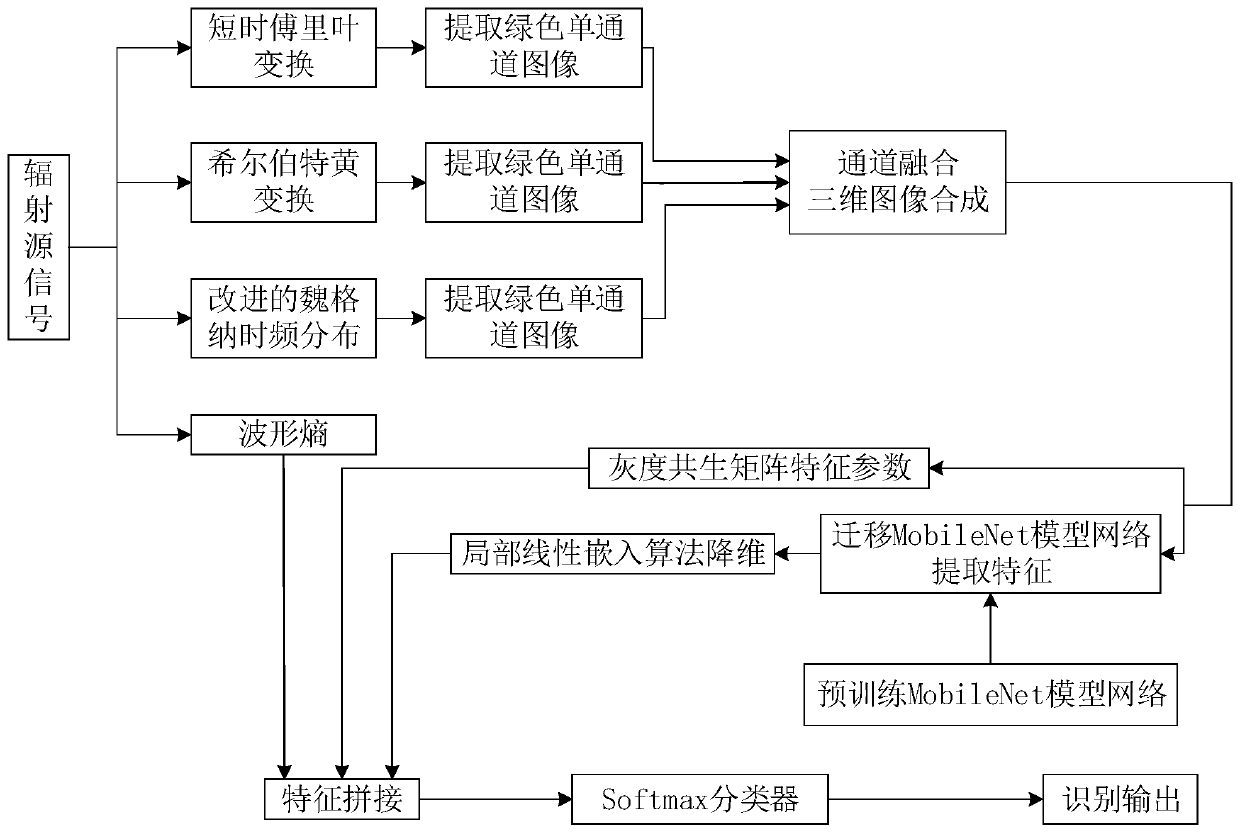
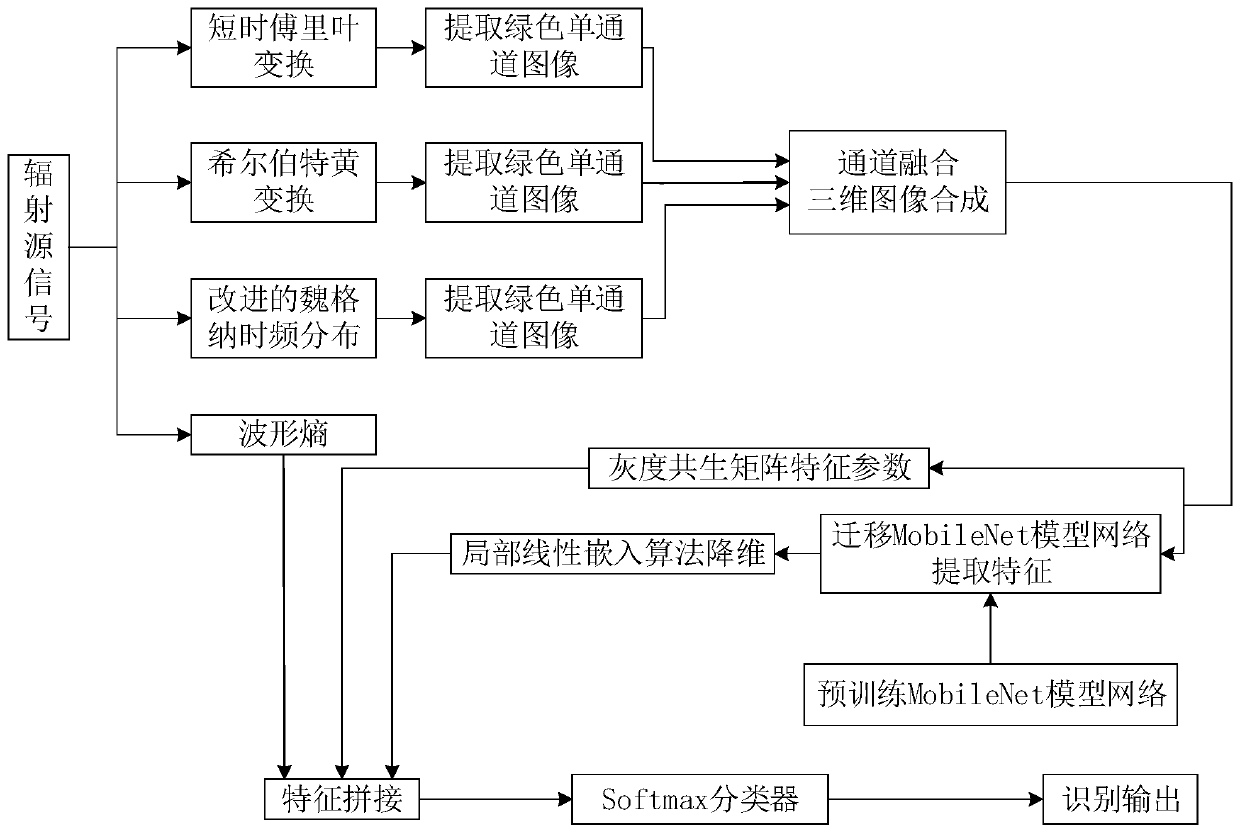
[0122] Step 1: Perform short-time Fourier transform on the radiation source signal sig(t) to obtain a time-frequency domain image, and denote the time-frequency domain image as TF 1 . The short-time Fourier transform formula is:
[0123]
[0124] In the formula, e is the Euler number, ζ(τ) is the window function, (·) * Indicates the conjugate operation, t represents time, f represents frequency, and τ is the integral variable.
[0125] Step 2: Perform an improved Wegener time-frequency distribution transformation on the radiation source signal to obtain a time-frequency domain image, and denote the time-frequency domain image as TF 2 . The improved Wegener time-frequency distribution transformation formula is:
[0126]
[0127] In the formula, (·) * Indicates conjugate operation, t is time, f is frequency, φ is frequency shift variable, is the time shift ...
PUM
 Login to View More
 Abstract
Description
Claims
Application Information
 Login to View More