
Non-contact sensing method based on Internet of Things LoRa signal
A non-contact, Internet of Things technology, applied in the field of intelligent perception, can solve the problems of small sensing distance and inability to achieve long-distance sensing.
- Summary
- Abstract
- Description
- Claims
- Application Information
AI Technical Summary
Problems solved by technology
Method used
Image

Examples
Embodiment Construction
[0053] In order to make the purpose, technical solution and advantages of the present invention clearer, the present invention will be further described in detail below in conjunction with the accompanying drawings and embodiments.
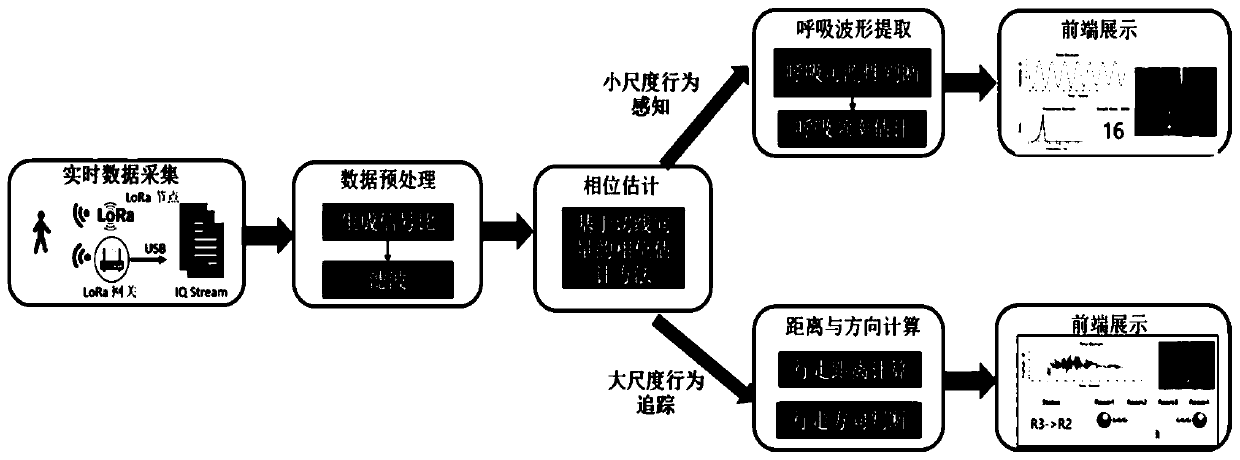
[0054] figure 1 The overall framework of non-contact perception based on LoRa signal is shown. The system is capable of real-time long-distance non-contact perception of human behavior, including small-scale behavior (human breathing) and large-scale behavior (human walking trajectory tracking).
[0055] The realization steps of the present invention are as follows:
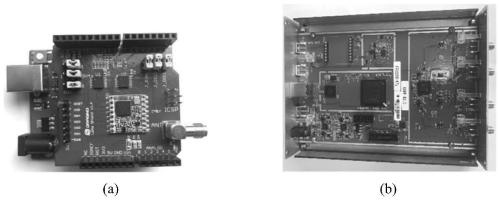
[0056] The first step: real-time data collection: such as figure 2 As shown, the LoRa-based non-contact sensing system includes a LoRa transmitter and a LoRa receiver (that is, a LoRa gateway). sender ( figure 2 (a)) consists of a LoRa SX1276 node, Arduino Uno development board and a directional antenna (the size of a conventional directional antenna is (25×22cm, 70-degree beam...
PUM
 Login to View More
 Abstract
Description
Claims
Application Information
 Login to View More