
Key layout suitable for pinyin input and keyboard
A pinyin input and button technology, applied in the input/output of user/computer interaction, the input/output process of data processing, instruments, etc., can solve the problems of limiting keystroke speed, inconsistent word frequency, and not being scientific enough to improve Chinese characters Input speed, shorter keystroke distance, simple and efficient actions
- Summary
- Abstract
- Description
- Claims
- Application Information
AI Technical Summary
Problems solved by technology
Method used
Image

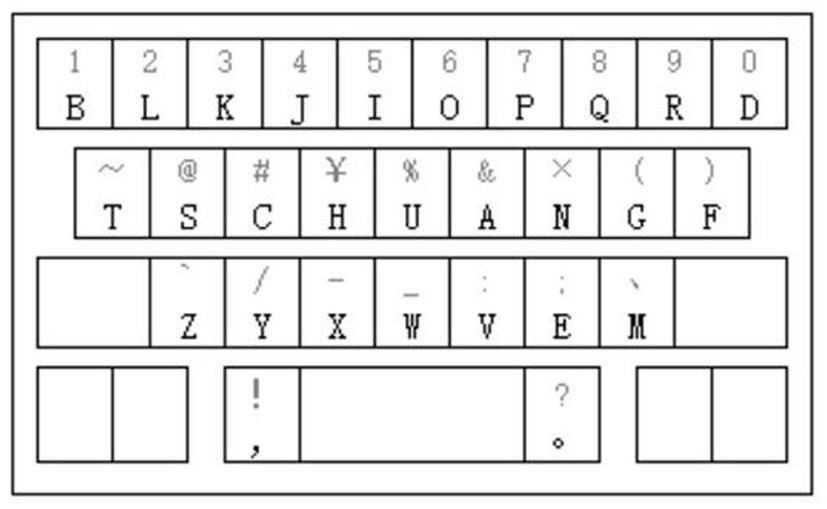
Examples
Embodiment 1
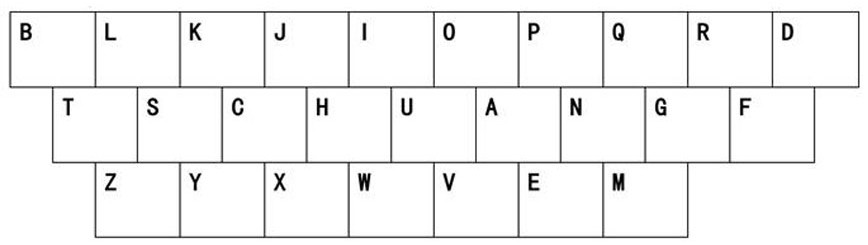
[0026] Such as figure 1 The shown key layout suitable for pinyin input includes: the first row of letter keys, the second row of letter keys and the third row of letter keys arranged up and down in sequence, the first row of letter keys includes from left to right The B key, L key, K key, J key, I key, O key, P key, Q key, R key and D key are arranged in sequence, and the second row of letter keys Including T key, S key, C key, H key, U key, A key, N key, G key and F key arranged in sequence from left to right, the third row of letter keys The positions include Z key, Y key, X key, W key, V key, E key and M key arranged in sequence from left to right, as can be seen from the attached figure:
[0027] 1. The I key, O key, U key, A key, V key and E key are relatively concentrated, forming a single final concentrated key area;
[0028] 2. The N key and the G key are used as common rhyme endings close to the concentrated key area of single finals, which is convenient for the c...
Embodiment 2
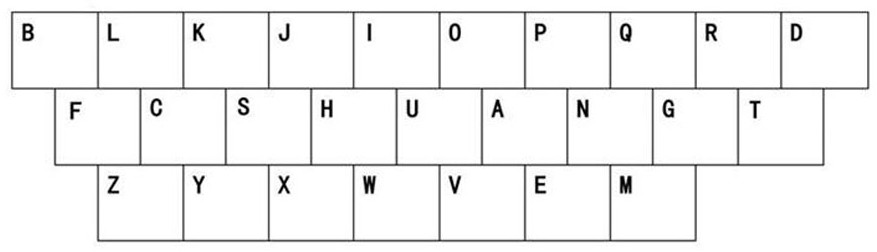
[0051] Such as figure 2The shown key layout suitable for pinyin input includes: the first row of letter keys, the second row of letter keys and the third row of letter keys arranged up and down in sequence, the first row of letter keys includes from left to right The B key, L key, K key, J key, I key, O key, P key, Q key, R key and D key are arranged in sequence, and the second row of letter keys Including F key, C key, S key, H key, U key, A key, N key, G key and T key arranged in sequence from left to right, the third row of letter keys The positions include the Z key position, the Y key position, the X key position, the W key position, the V key position, the E key position and the M key position arranged in sequence from left to right. Compared with embodiment 1, the F key position is the same as the T key position. The positions of the keys have been swapped, the positions of the C key and the S key have been swapped, the Z key, the C key and the S key are still closer ...
PUM
 Login to View More
 Abstract
Description
Claims
Application Information
 Login to View More