
Large vehicle panoramic splicing method
A technology for vehicles and panoramas, applied in details involving image stitching, image data processing, television, etc., can solve problems such as poor stitching methods, achieve better shooting processing, and improve stitching accuracy
- Summary
- Abstract
- Description
- Claims
- Application Information
AI Technical Summary
Problems solved by technology
Method used
Image

Examples
Embodiment 1
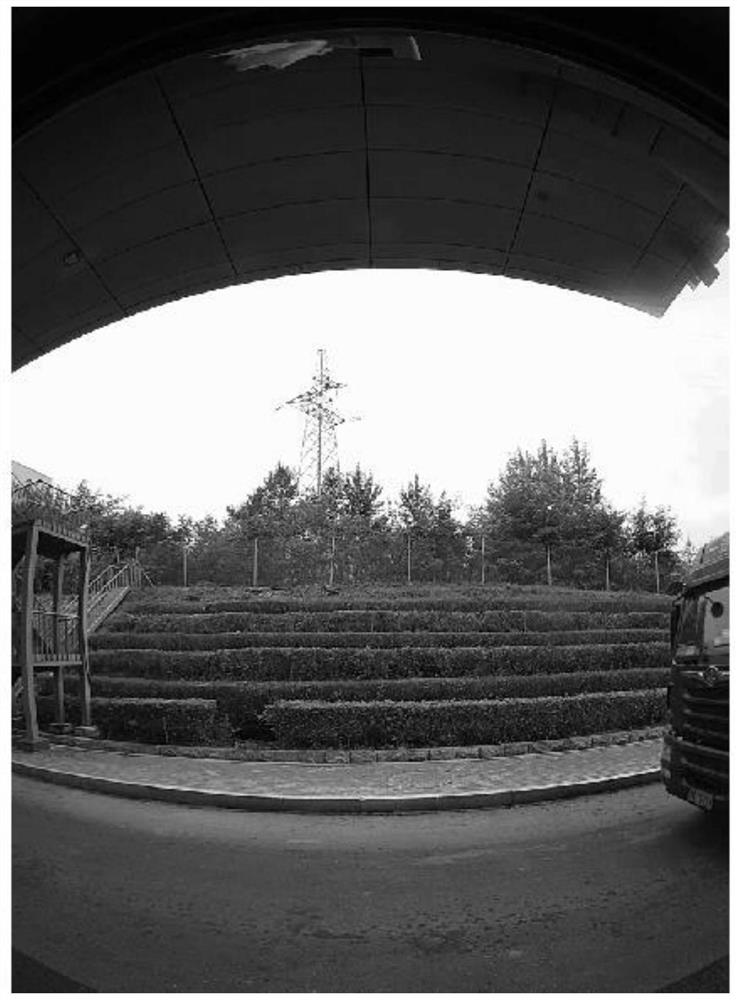
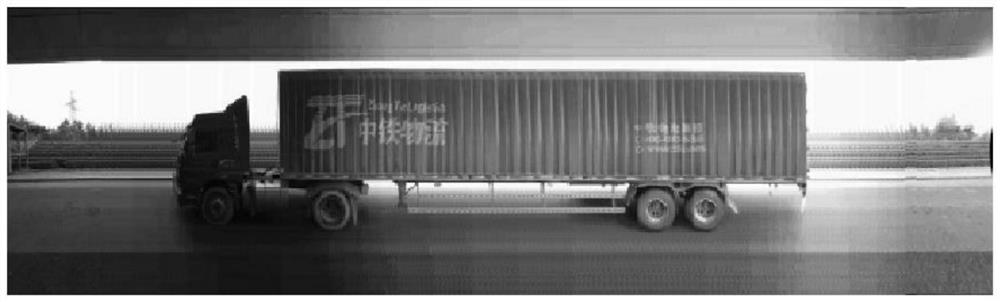
[0051] S201 acquires video data of at least one camera and pre-processed to get a video frame based on the camera type, the camera being a wide angle camera;
[0052] The video data generated by the wide-angle camera will produce distortion.
[0053] S202 matches the image feature point of the video frame to obtain processing data;
[0054] The specific method is to deform data on video data. The image captured by the wide-angle lens camera often has a problem of barrel distortion. The reason is that the wide-angle lens uses a convex lens, junior high school physics knowledge tells us that the convex lens will give a convergence of the light, which is caused by the refraction of light. The farther away from the center of the lens, the stronger the refractive effect, and the photos taken will be rounded in the center of the lens, and the distortion is expanded. Therefore, the wide-angle distortion modification algorithm can be used to process video data, resulting in normal video d...
Embodiment 2
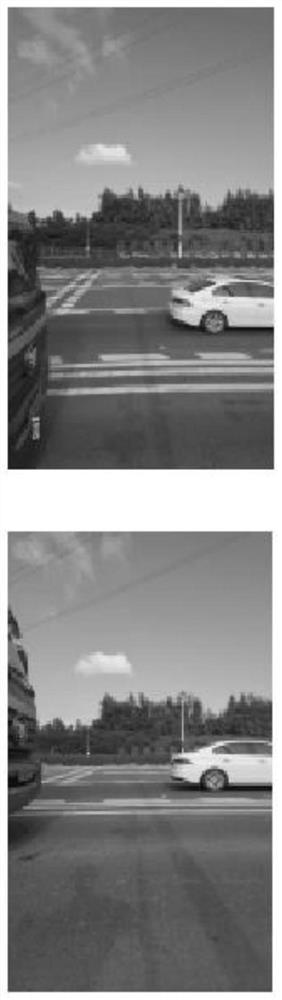
[0066]The S401 acquires video data of at least one camera and pre-processes the video frame based on the camera type, the camera being two flat angle cameras;
[0067] By setting two flat angle cameras, the upper portion and the lower portion of the vehicle are filmed to obtain the corresponding video data.
[0068] The specific steps are:
[0069] The characteristic match of video data based on two flat angle cameras determines the up and down offset distance of the two flat angle cameras; the video data of the two graphic cameras is spliced based on the up and down offset distance to obtain the processing data S403 horizontally splicing the processing data.
[0070] Since the position of the two square angle cameras is relatively fixed, each video frame will have the same upper and lower offset distance. It is therefore necessary to characterize the vehicle in the two video data to determine the up and down offset distance of the splicing, so that video data that splices the u...
PUM
 Login to View More
 Abstract
Description
Claims
Application Information
 Login to View More