

Electromagnetic interference objective complexity evaluation method based on fast S-transformation time-frequency space model
a time-frequency space model and objective complexity technology, applied in the field of electronic signal processing, can solve the problems of electromagnetic environment complexity, partial functions of electronic equipment may fail, normal communication of electronic equipment, etc., and achieve the effect of accurately reflecting electromagnetic interference intensity, high universality, and effective extraction of time-frequency evaluation characteristic parameters
- Summary
- Abstract
- Description
- Claims
- Application Information
AI Technical Summary
Benefits of technology
Problems solved by technology
Method used
Image

Examples
application embodiments
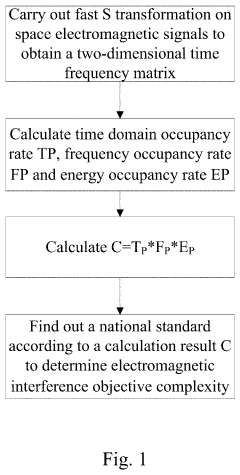
[0078]The method of the present invention is suitable for qualitative and quantitative evaluation of electromagnetic signal interference complexity in any complex electromagnetic environment. For convenience of illustration, a 13.56 MHz radiofrequency card is taken as an example to illustrate the design specification of the qualitative and quantitative evaluation of electromagnetic interference complexity.
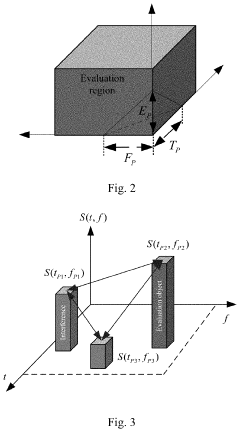
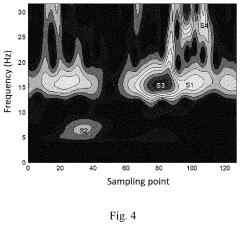
[0079]During the design, it mainly includes the following points: at first, a simulation signal is sampled, the frequency of the simulation signal is assumed to be 13.56 MHz, and the frequencies of the interference signals are assumed to be 25 MHz, 13 MHz and 5 MHz respectively. A two-dimensional time-frequency contour diagram of the simulation signal after fast S-transformation is shown in FIG. 4. In FIG. 4, S1 represents the simulation signal of which the frequency is 13.56 MHz, S2, S3 and S4 respectively represent the interference signals of which the frequencies are 5 MHz, 13 M...
PUM
 Login to View More
 Abstract
Description
Claims
Application Information
 Login to View More