Cost-benefit approach to automatically composing answers to questions by extracting information from large unstructured corpora

a large, unstructured corpus, cost-benefit technology, applied in the field of computer systems, can solve the problems of inability to automatically compose answers to questions from a single, inability to meet the requirements of search engines, so as to achieve the effect of enhancing the predictive power of models of answer accuracy and enhancing models

a large, unstructured corpus, cost-benefit technology, applied in the field of computer systems, can solve the problems of inability to automatically compose answers to questions from a single, inability to meet the requirements of search engines, so as to achieve the effect of enhancing the predictive power of models of answer accuracy and enhancing models

US20050033711A1Inactive Publication Date: 2005-02-10MICROSOFT TECH LICENSING LLC

Image

Smart Image Click on the blue labels to locate them in the text.
Viewing Examples
Smart Image
  • Cost-benefit approach to automatically composing answers to questions by extracting information from large unstructured corpora
  • Cost-benefit approach to automatically composing answers to questions by extracting information from large unstructured corpora
  • Cost-benefit approach to automatically composing answers to questions by extracting information from large unstructured corpora

Examples

Experimental program
Comparison scheme
Effect test

Embodiment Construction

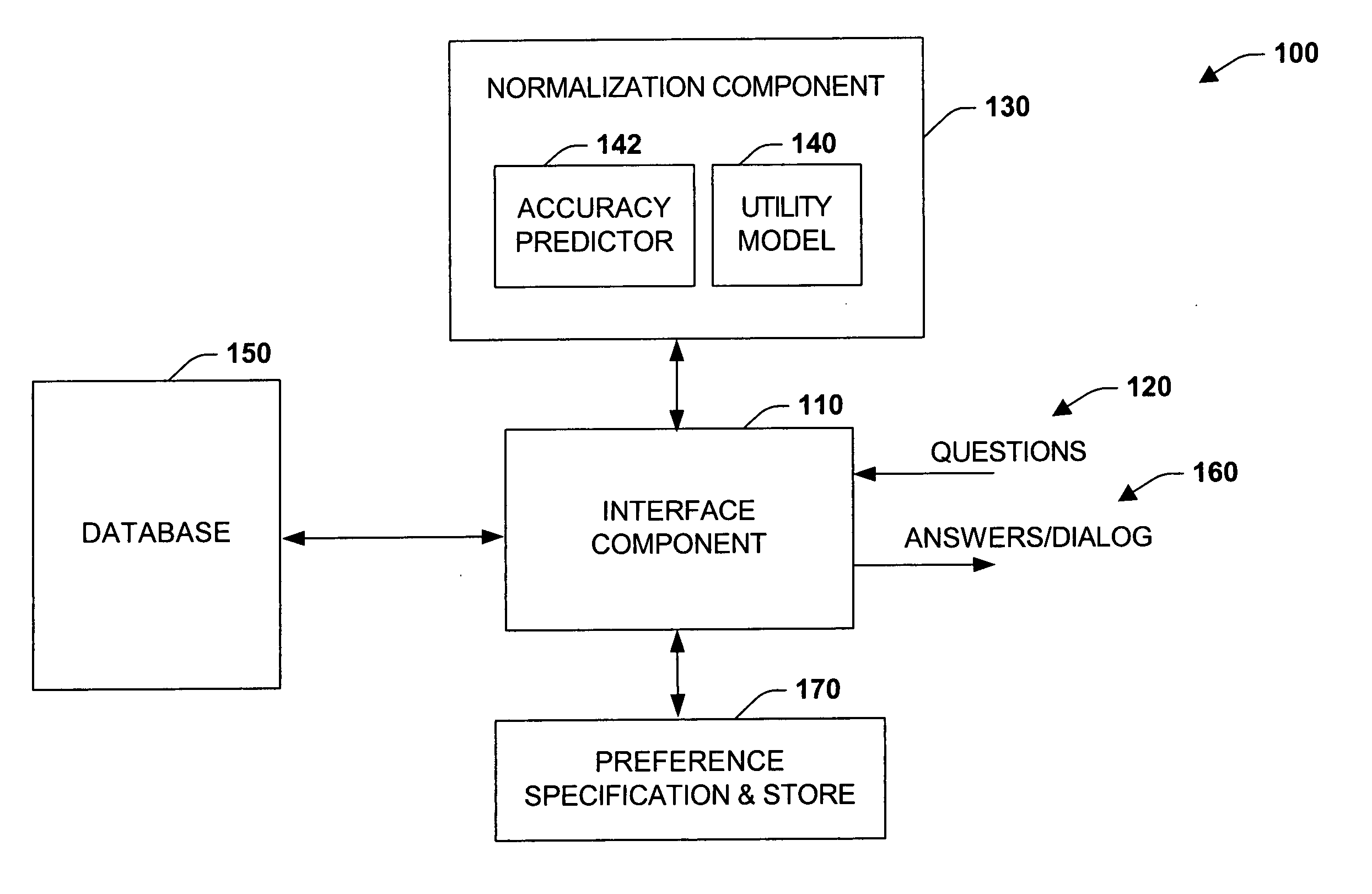
[0026] The present invention relates to a system and methodology to facilitate information extraction and learning from an unstructured corpora of information. This information can be retrieved from local and / or remote databases that house such information (e.g., web sites, local databases, electronic encyclopedias or dictionaries). In one aspect of the present invention, a normalization system is provided. The normalization system includes an interface component that receives data corresponding to a heterogeneous knowledge base such as from web sites or other sources. A normalization component applies a statistical or logical model that relates the expected accuracy or quality of answers to sets of information-acquisition actions, and a utility model capturing the costs and benefits associated with information extractions, to provide a regularized understanding of the value of extracting information from the knowledge base. The utility model is employed to provide dynamic controls ...

the structure of the environmentally friendly knitted fabric provided by the present invention; figure 2 Flow chart of the yarn wrapping machine for environmentally friendly knitted fabrics and storage devices; image 3 Is the parameter map of the yarn covering machine
Login to View More

PUM

No PUM Login to View More

Abstract

The present invention relates to a system and methodology to facilitate extraction of information from a large unstructured corpora such as from the World Wide Web and / or other unstructured sources. Information in the form of answers to questions can be automatically composed from such sources via probabilistic models and cost-benefit analyses to guide resource-intensive information-extraction procedures employed by a knowledge-based question answering system. The analyses can leverage predictions of the ultimate quality of answers generated by the system provided by Bayesian or other statistical models. Such predictions, when coupled with a utility model can provide the system with the ability to make decisions about the number of queries issued to a search engine (or engines), given the cost of queries and the expected value of query results in refining an ultimate answer. Given a preference model, information extraction actions can be taken with the highest expected utility. In this manner, the accuracy of answers to questions can be balanced with the cost of information extraction and analysis to compose the answers.

Description

TECHNICAL FIELD [0001] The present invention relates generally to computer systems, and more particularly to a system and method that facilitates automated extraction of information from a heterogeneous knowledge base by applying a utility model to selectively normalize the knowledge base. BACKGROUND OF THE INVENTION [0002] Over the years, computer systems designers have pursued the challenge of developing computational architectures that have the ability to generate answers to freely-posed questions. General question-answering systems typically depend on automated processes for analyzing questions and for composing answers from a large corpus of poorly structured information. In recent years, systems have been developed that employ the resources of the Web as a corpus of information for answering questions. Web-based question answering systems typically employ rewriting procedures for converting components of questions into sets of queries posed to search engines, and converting qu...

Claims

the structure of the environmentally friendly knitted fabric provided by the present invention; figure 2 Flow chart of the yarn wrapping machine for environmentally friendly knitted fabrics and storage devices; image 3 Is the parameter map of the yarn covering machine
Login to View More

Application Information

Patent Timeline
10 Feb 2005
Publication
US20050033711A1
IPC
G06F17/30
CPC
G06F17/30687; G06F17/30684; G06F16/3344; G06F16/3346; Y10S707/99933
Inventors
HORVITZ, ERIC J.; AZARI, DAVID R.