[0011] The invention has been accomplished in order to solve the aforementioned problems. An object of the invention is to provide a secondary battery
replacement method that allows maximum performance of a battery assembly as a whole after replacement of a battery module of the battery assembly, while avoiding a
false detection of battery
abnormality without the need to perform a special process, such as an equalizing process or the like, after the replacement.
[0013] According to the first aspect of the invention, when a secondary battery in a battery assembly made up of a plurality of secondary batteries is to be replaced with a fresh secondary battery, the fresh secondary battery is charged so that the quantity of charged
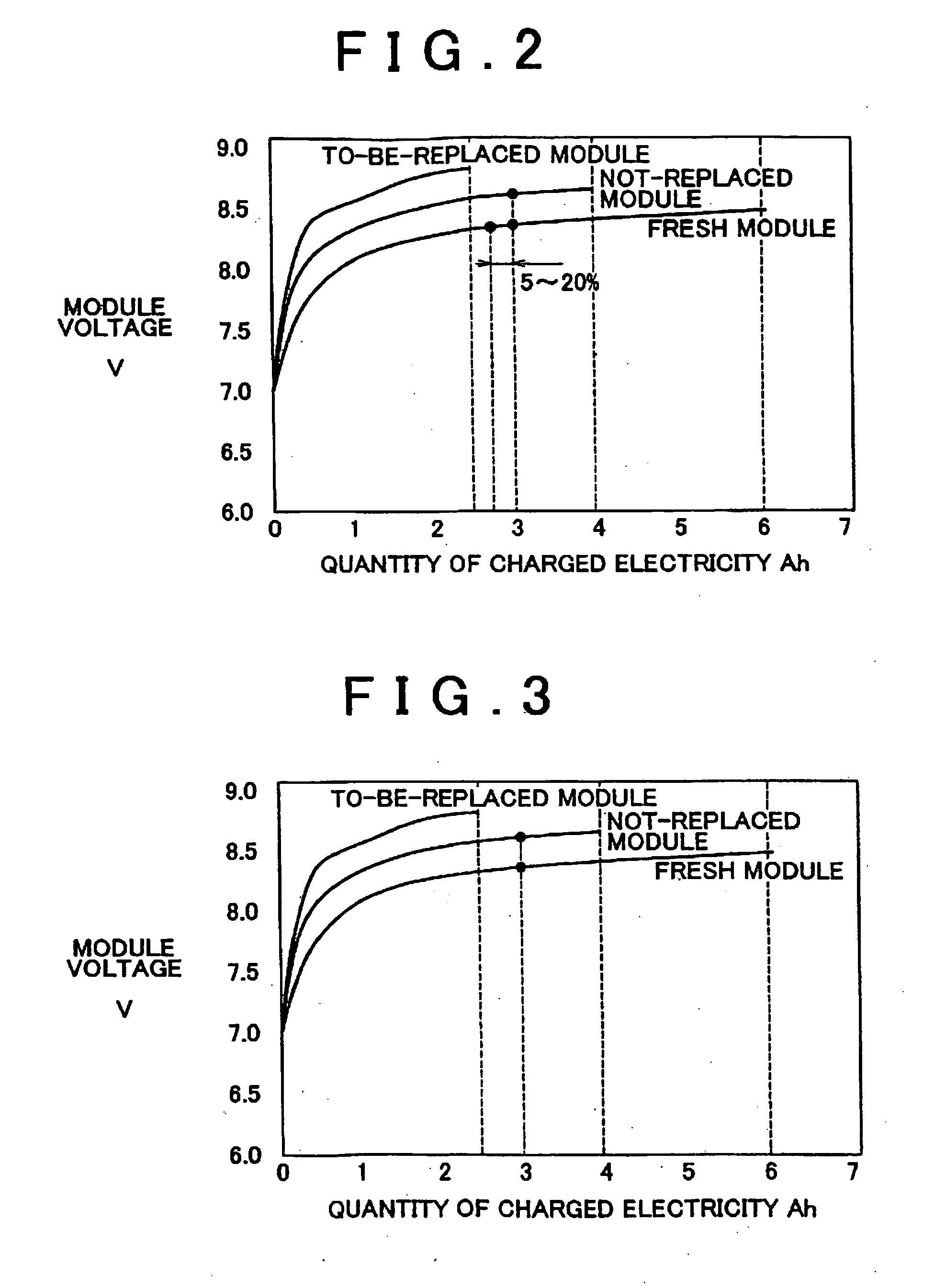
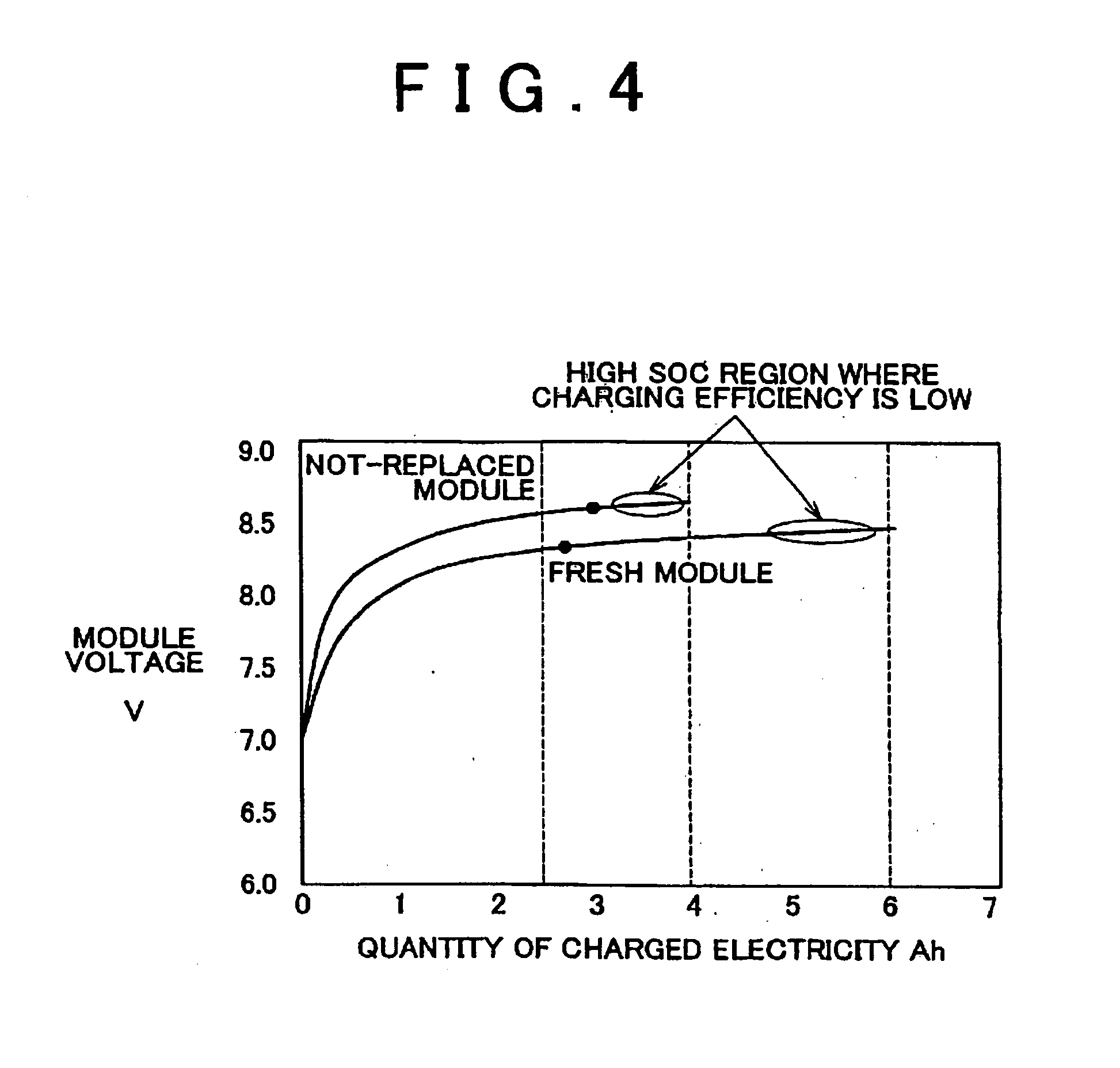
electricity of the fresh secondary battery is less than the quantity of charged electricity of a secondary battery present in the battery assembly which is other than the to-be-replaced secondary battery. For example, if one of the fifteen secondary batteries of a battery assembly installed in an HEV is to be replaced upon a diagnosis of battery abnormality, the fresh secondary battery is charged so that the quantity of charged electricity of the fresh secondary battery is 5 to 20% less than a quantity of charged electricity of the fourteen secondary batteries other than the to-be-replaced battery (e.g., a mean value of the quantities of charged electricity of the 14 batteries). While this state of the fresh secondary battery, that is, the state where the quantity of charged electricity of the fresh secondary battery is not equal to but is slightly less than the quantity of charged electricity regarding the fourteen secondary batteries, is maintained, the fresh secondary battery is incorporated into the battery assembly and is combined with the fourteen secondary batteries. The thus-rebuilt battery assembly is charged and discharged repeatedly corresponding to a secondary battery having a low full-charged capacity. Therefore, the fresh secondary battery is not degraded, and the operating region of the fresh secondary battery gradually shifts to a high SOC region since the fresh secondary battery is free of
memory effect. In this invention, since the quantity of charged electricity of a fresh secondary battery before incorporation into the battery assembly is less than the not-replaced secondary batteries of the assembly, the aforementioned shift to the high SOC region relatively delays. The fresh battery, as the
time of use increases, gradually degrades and acquires
memory effect, so that the operating region thereof shifts to a low SOC region. Thus, the fresh battery comes to have substantially the same capacity as the other batteries merely through charge-discharge cycles. Therefore, according to the invention, it is possible to provide a secondary battery replacement method that allows maximum performance of a battery assembly as a whole after replacement of a secondary battery of the battery assembly with a fresh secondary battery, while avoiding a
false detection of battery abnormality or avoiding
overcharge of the fresh battery, without the need to perform a special process, such as an equalizing process or the like, after the replacement.
[0014] In the first aspect of the invention, the to-be-replaced secondary battery may be a secondary battery having a reduced full-charged capacity or a secondary battery possessing a memory effect. In this case, it is possible to provide a secondary battery replacement method that allows maximum performance of a battery assembly as a whole by replacing a secondary battery having a reduced full-charged capacity or a secondary battery possessing a memory effect.
[0015] Furthermore, in the first aspect of the invention, the replacing step may include the step of incorporating the charged fresh secondary battery into a portion of the battery assembly where temperature is high. This incorporating step will accelerate the
equalization of performances of the secondary batteries of the battery assembly, since the fresh secondary battery degrades faster due to the effect of temperature.
[0016] Still further, in the first aspect of the invention, the charging step may include the step of charging the fresh secondary battery so that the quantity of charged electricity of the fresh secondary battery is 5 to 20% less than the quantity of charged electricity of the secondary battery other than the to-be-replaced secondary battery. This charging step avoids a difference in the quantity of charged electricity which is greater than 20%, and therefore avoids detection of battery abnormality by a battery ECU. The charging step also avoids a difference in the quantity of charged electricity which is less than 5%, and therefore avoids a failure in the
equalization.


 Login to View More
  Login to View More