
Block-diagonal covariance joint subspace typing and model compensation for noise robust automatic speech recognition
a noise robust and block-diagonal technology, applied in speech recognition, speech analysis, instruments, etc., can solve the problems of reducing the amount of memory consumed by a noise robust, the tendency of asr systems to be particularly problematic, and the size and computational complexity of compressed models. , to achieve the effect of reducing the impact of noise recognition accuracy and/or robustness, and reducing the size and computational complexity of compressed models
- Summary
- Abstract
- Description
- Claims
- Application Information
AI Technical Summary
Benefits of technology
Problems solved by technology
Method used
Image

Examples
Embodiment Construction
[0012] The following description of the preferred embodiments is merely exemplary in nature and is in no way intended to limit the invention, its application, or uses.
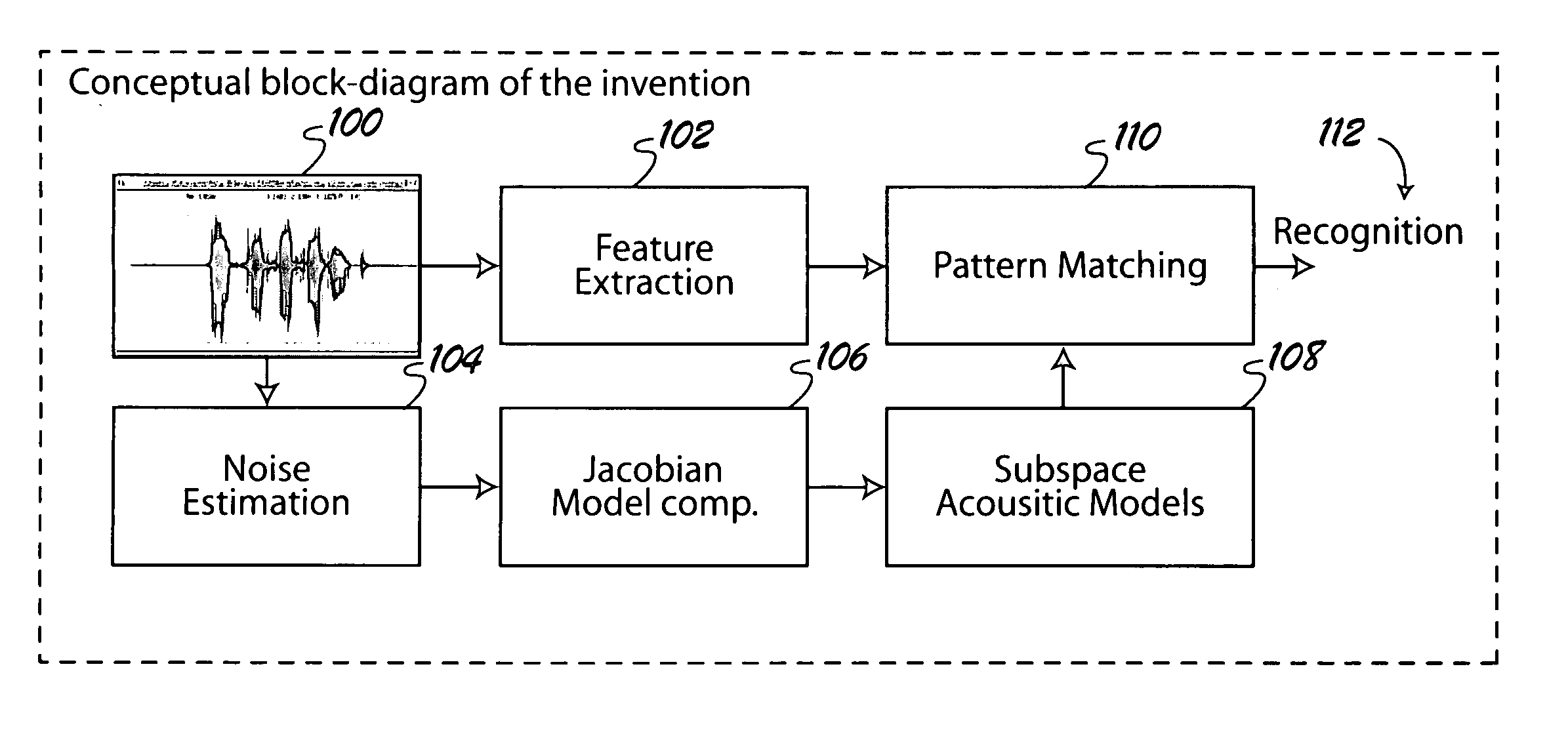
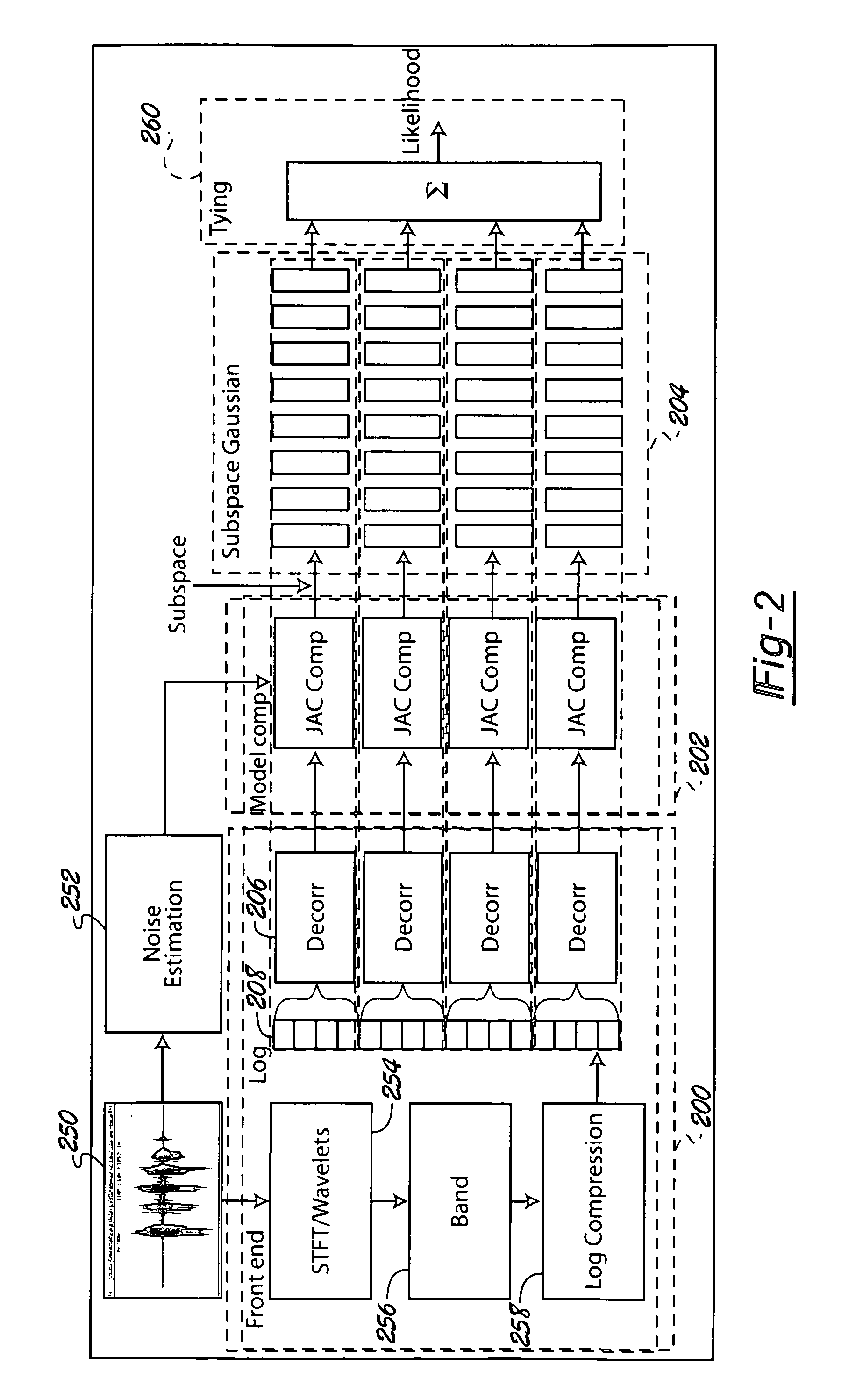
[0013] In some embodiments, the present invention combines sub-space tying for model compression with alpha-Jacobian model-compensation for noise robustness to achieve a compact noise robust speech recognition system. Unfortunately this combination cannot be accomplished directly as the subspace tying structure does not allow for model-compensation. This difficulty arises because the distortion function used in model compensation requires a full space transformation (full dimensionality) of the acoustic models that invalidates the tying structure.
[0014] One area of interest in the present invention is the present solution to this issue. Specifically, a model compensation distortion function is designed that does not invalidate the tying structure, thus allowing for the coexistence of subspace tying and model-compensa...
PUM
 Login to View More
 Abstract
Description
Claims
Application Information
 Login to View More