
Systems and methods for identifying long matches of data in a compression history
a compression history and data technology, applied in the field of data communication networks, can solve the problems of increasing the processing overhead, increasing the number of times that a compression history must be accessed, and general technique presents a number of challenges, so as to improve the efficiency and speed of compression, reduce bandwidth usage, and accelerate future communication
- Summary
- Abstract
- Description
- Claims
- Application Information
AI Technical Summary
Benefits of technology
Problems solved by technology
Method used
Image

Examples
second embodiment
[0259]Referring now to FIG. 6A, a block diagram illustrating using a compression index to locate compression history matches corresponding to input data is shown. In brief overview, an input stream “Call me Ishmael” is processed into a number of shingles. A fingerprint is computed for each shingle and the corresponding row in the index is identified. The appliance then counts the number of location identifiers in each row to determine which row to select for the purposes of accessing the disk.
[0260]Still referring to FIG. 6A, an appliance (or client agent or server agent) computes fingerprints for a number of shingles before accessing a compression history. After receiving the input string “Call me Ishmael”, the appliance computes fingerprints for each of the successive overlapping four-byte shingles that make up the input string. The first shingle “Call” has a fingerprint value of 4, and the corresponding compression index 410b entry has a plurality of location identifiers. This ma...
third embodiment
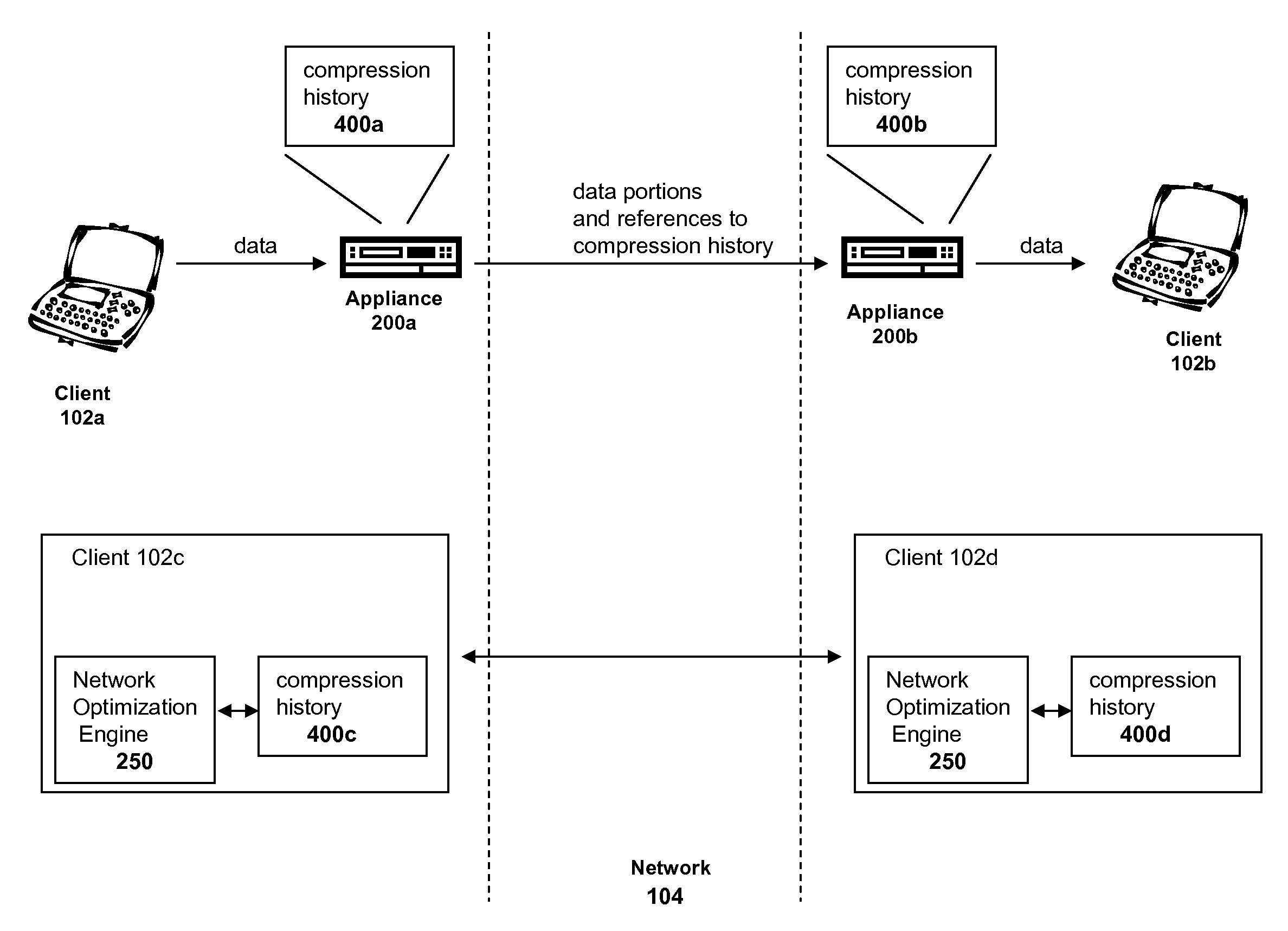
[0337]Referring now to FIG. 9D, a flow diagram of a method for sharing compression histories among a plurality of devices to improve compression of data transmitted via a plurality of connections is shown. In brief overview, the method comprises a first device receiving, by a first device from a second device, a data stream, the data stream compressed according to a compression history shared between the first device and a third device (step 921). The first device identifies the third device (step 923) and transmits, to the third device, a request for a portion of the compression history (step 925). The first device receives, from the third device, the requested portion of the compression history (step 927). The first device may then decompress the data stream (step 929) and transmit the decompressed stream to the client (step 931). The first, second and third devices may be any of a client, server, client agent, server agent, appliance, WAN optimization device, and / or transparent p...
PUM
 Login to View More
 Abstract
Description
Claims
Application Information
 Login to View More