
Diversity receiver and transceiver
a receiver and diversity technology, applied in diversity/multi-antenna systems, digital transmission, duplex signal operation, etc., can solve the problems of limiting the area available, limiting the margin of transmission links, and limiting the range of low-power communication devices or short-range devices (srds)
- Summary
- Abstract
- Description
- Claims
- Application Information
AI Technical Summary
Benefits of technology
Problems solved by technology
Method used
Image

Examples
Embodiment Construction
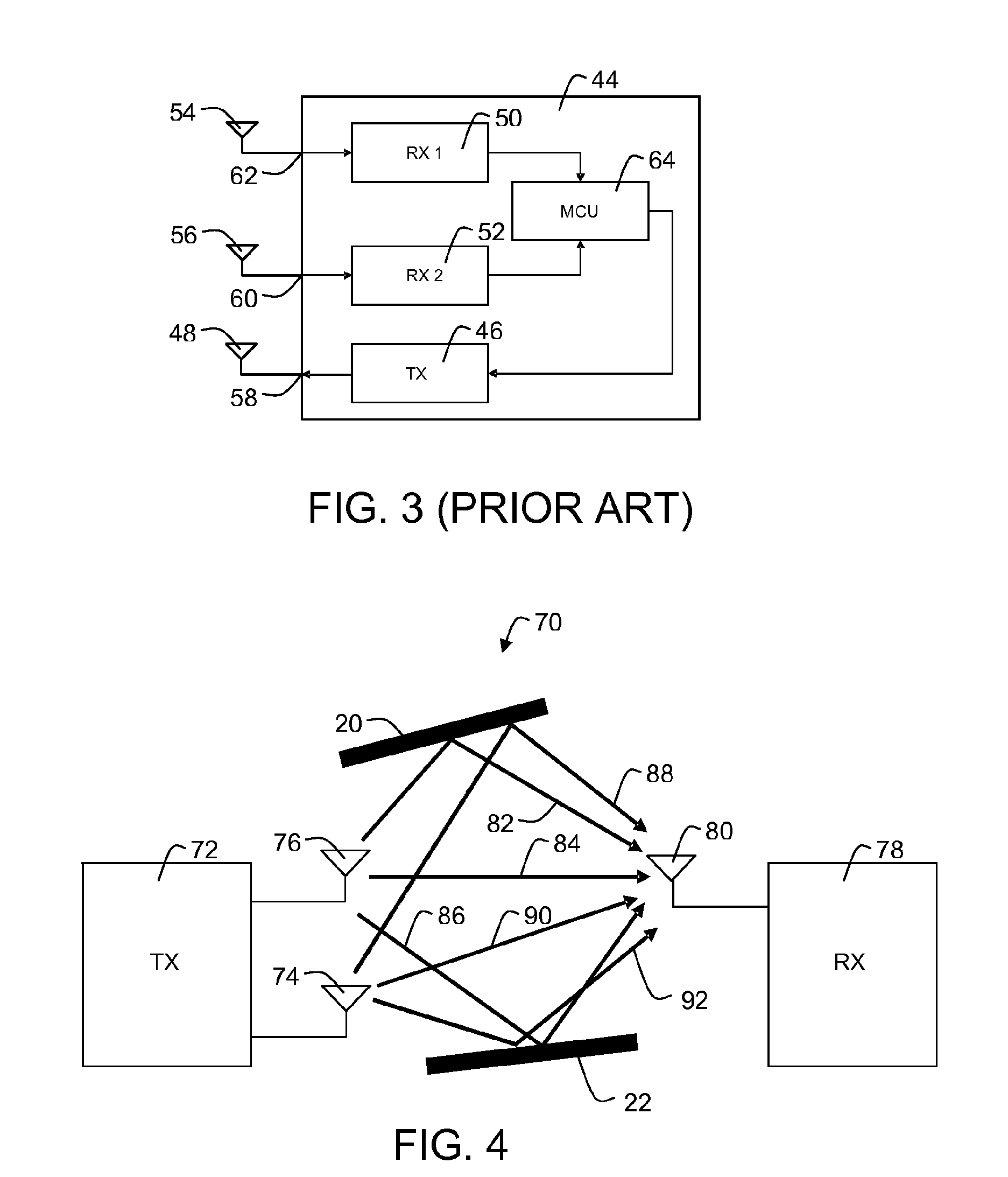
[0025]Referring to FIG. 4, a first schematic example of a diversity antenna system is shown. The shown antenna diversity system 70 comprises a diversity transmitter 72 having a plurality of transmitter-side antennas 74, 76. The diversity transmitter may be arranged to generate at least one sequence of signals comprising data packets having payloads identical and identifiers different for each of the data packets. Each of the identifiers may identify a corresponding one of the plurality of transmitter-side antennas 74, 76. And the diversity transmitter 72 may be arranged to successively transmit at least two of the signals at different points in time on the corresponding ones of the plurality of transmitter-side antennas 74, 76. And the shown diversity antenna system 70 may comprise a receiver 78 comprising a first receiver-side antenna 80. The receiver 78 may be arranged to successively receive the signals of the at least one sequence on the first receiver-side antenna 80, and to su...
PUM
 Login to View More
 Abstract
Description
Claims
Application Information
 Login to View More