
X-ray mammography and/or breast tomosynthesis using a compression paddle with an inflatable jacket enhancing imaging and improving patient comfort
a compression paddle and breast technology, applied in tomosynthesis, medical science, diagnostics, etc., can solve the problems of image blurring, inability to accurately position and manipulate the breast during the compression process, and inability to accurately distribute the compression force throughout the breast, so as to facilitate more uniform exposure, reduce radiation exposure to patients, and reduce image blurring
- Summary
- Abstract
- Description
- Claims
- Application Information
AI Technical Summary
Benefits of technology
Problems solved by technology
Method used
Image

Examples
Embodiment Construction
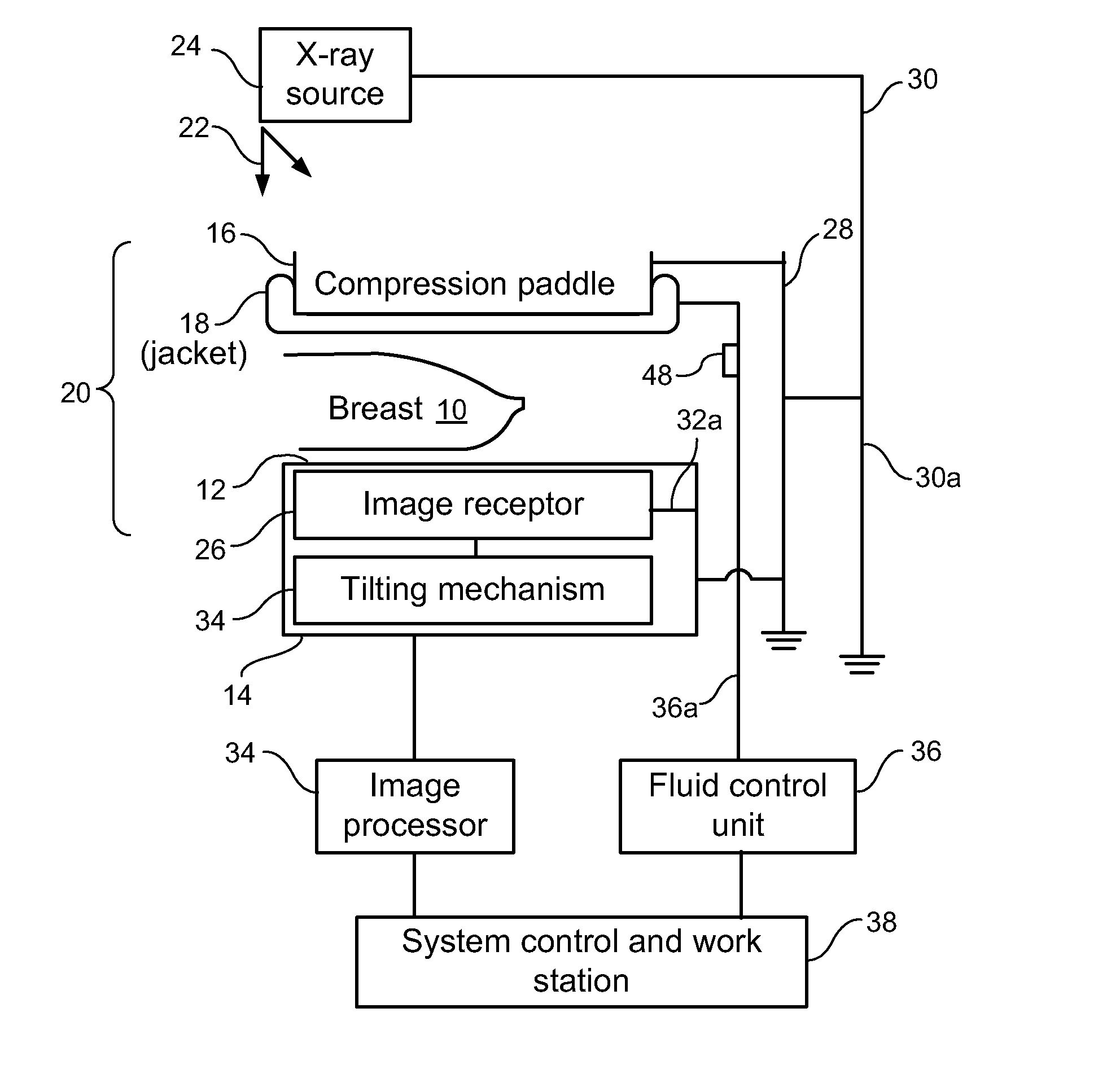
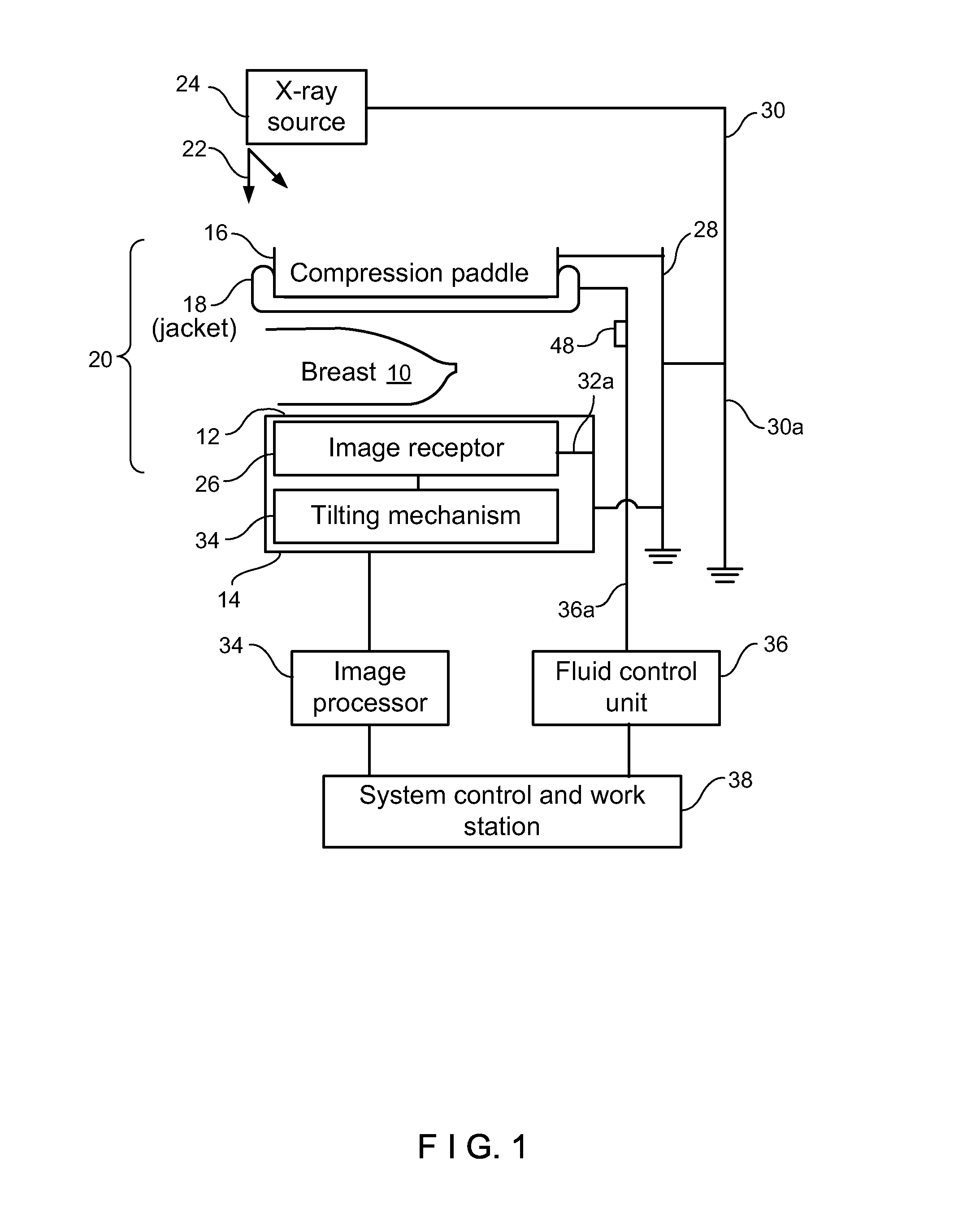
[0025]Referring to FIG. 1, a patient's breast 10 is immobilized for x-ray imaging between a breast platform 12 and a compression paddle 16. Platform 12 can be the upper surface of a housing 14. At least an underside of compression paddle 16 is covered with an inflatable paddle jacket 18. Platform 12 and paddle 16 form a breast immobilizer unit 20 that is in a path of an imaging beam 22 emanating from x-ray source 24. Beam 22 impinges on image receptor 26 that is in housing 14. Immobilizer 20 and housing 14 are supported on an arm 28. X-ray source 24 is supported on an arm 30. For mammography, support arms 28 and 30 can rotate as a unit about an axis such as at 30a between different imaging orientations such as CC and MLO, so that the system can take a mammogram projection image Mp at each orientation. Image receptor 26 remains in place relative to housing 14 while an image Mp is taken. Immobilizer 20 releases breast 10 for movement of arms 28 and 30 to a different imaging orientatio...
PUM
 Login to View More
 Abstract
Description
Claims
Application Information
 Login to View More