Microbiocidal Control in the Processing of Meat-Producing Four-Legged Animals
What is AI technical title?
AI technical title is built by Patsnap AI team. It summarizes the technical point description of the patent document.
a technology of four-legged animals and microorganisms, applied in the direction of biocide, animal repellents, carcasses disinfection, etc., can solve the problems of unsatisfactory total elimination of bacteria from fresh raw meat, bacterial contamination of fresh meat as an undesirable, and contamination of meat and meat products, so as to reduce microbial contamination
Inactive Publication Date: 2013-09-26
ALBEMARLE CORP
View PDF4 Cites 3 Cited by
Summary
Abstract
Description
Claims
Application Information
AI Technical Summary
This helps you quickly interpret patents by identifying the three key elements:
Problems solved by technology
Method used
Benefits of technology
Benefits of technology
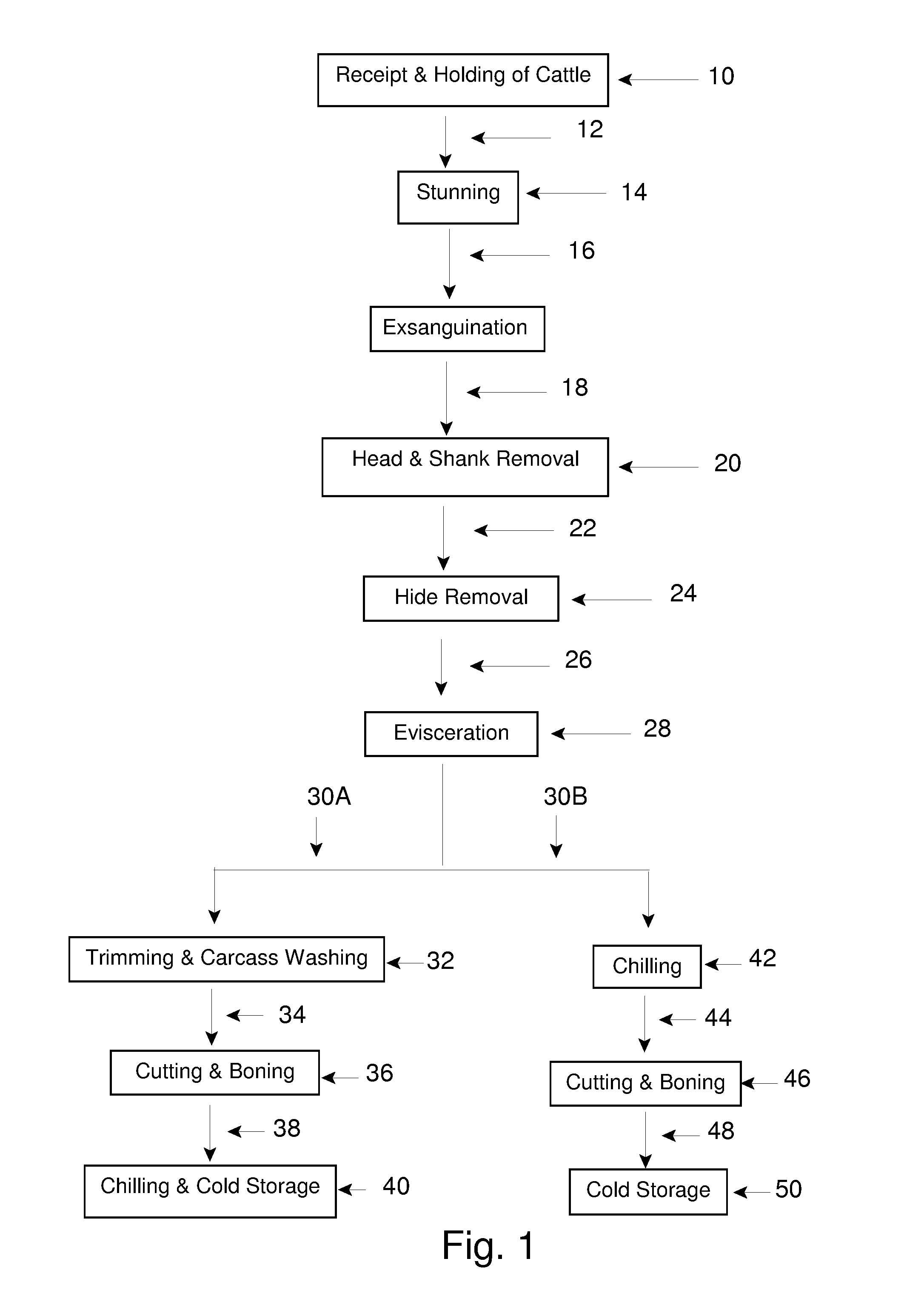
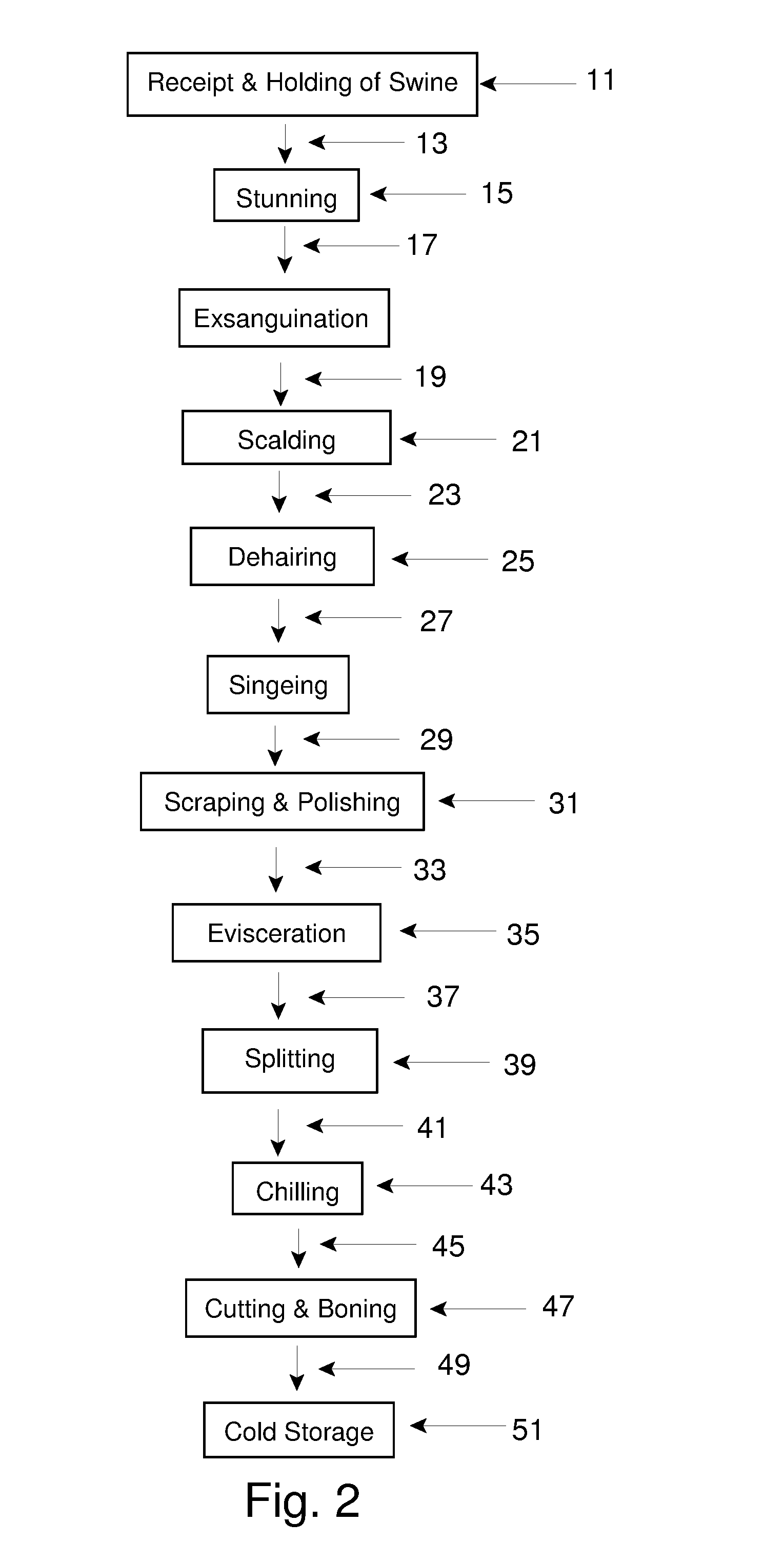
[0010]This invention provides methods for decreasing microbial contamination of (I) a four-legged slaughter animal (for convenience hereinafter often referred to simply as “animal”) being processed for slaughter and / or (II) the carcass of such animal and / or (III) raw meat products and / or processed meat products derived from the carcasses of such animals.
[0023]Substantial benefits can be achieved by the use of an aqueous microbiocidally-effective composition of this invention. Besides being highly effective in broad spectrum microbiocidal activity, the aqueous microbiocidal compositions of this invention are relatively non-corrosive to the nozzles, fittings, cabinets, transporting apparatus, and other parts of the various washing, showering, spraying, and / or misting systems used. Moreover, because of their effectiveness as antimicrobials, the aqueous microbiocidally-effective compositions of this invention can be introduced into an aqueous medium at low dosage levels and yet form compositions having enhanced microbiocidal effectiveness, and with no appreciable adverse effect when applied to a live four-legged slaughter animal being processed for slaughter. In addition, the aqueous microbiocidally-effective compositions of this invention are stable over a range of temperatures from as low as just above the freezing point of the composition to about 70° C. and which throughout this temperature range are highly effective against microorganisms and pathogens even when employed at low dosage levels. Thus, the microbiocidally-effective compositions of this invention can be effectively utilized under most, if not all, temperature conditions encountered in the processing of four-legged slaughter animals, at least for meat. Furthermore, experimental results have shown that, surprisingly, the practice of this invention will not cause noticeable degradation in the quality or properties of meat from the carcasses resulting from the use or methods of this invention. Thus the combination of extremely high antimicrobial effectiveness and lack of adverse effects upon meat enables the aqueous microbiocidally-effective composition of this invention to also be effectively used in sanitizing raw meat and / or meat products at any stage before, during, and / or after their preparation.
Problems solved by technology
Contamination of meat and meat products with various pathogens such as species of Listeria, Escherichia, Salmonella, Campylobacter, and others, is a problem that has existed for many years.
Despite modern processing procedures, bacterial contamination of fresh meat occurs as an undesirable but unavoidable result of converting live four-legged slaughter animals into food.
Although current Good Manufacturing Procedures (GMPs) and / or recent government regulations can reduce this contamination, the total elimination of bacteria from fresh raw meats has not been achieved.
Soil, dust and manure on the hair, hides and hooves of the animals represent one significant source of contamination.
In addition, in some cases internal organs rupture during the removal process, resulting in further contamination of the carcass.
A number of the conventionally-used steps in the processing of four-legged slaughter animals for food constitute opportunities for microbial and pathogen contamination.
Method used
the structure of the environmentally friendly knitted fabric provided by the present invention; figure 2 Flow chart of the yarn wrapping machine for environmentally friendly knitted fabrics and storage devices; image 3 Is the parameter map of the yarn covering machine
View more
Image
Smart Image Click on the blue labels to locate them in the text.
Viewing Examples
Smart Image
Click on the blue label to locate the original text in one second.
Reading with bidirectional positioning of images and text.
Smart Image
Examples
Experimental program
Comparison scheme
Effect test
example
[0096]A study was conducted in which individual samples of raw meat were directly contacted individually with a test substance to determine the effect each such substance had on the quality of the meat. The raw meat used was top round beef. The test materials were: (a) household bleach (commercially available hypochlorite bleach solution); (b) water-diluted household bleach containing 50 ppm as chlorine bleach; (c) 2% aqueous lactic acid solution; and pursuant to this invention, (d) 92 ppm as bromine of Stabrom 909 concentrated aqueous biocide solution (Albemarle Corporation), which is a commercially-available concentrated solution useful in forming an aqueous microbiocidally-effective composition of an embodiment of this invention previously denoted as a). Individual samples of beef (approximately 30 grams each) were placed in 80 mm×40 mm crystallization dishes. Each such sample was exposed to 30.0 grams of one of the respective test materials for a period of 5 minutes. The beef sa...
the structure of the environmentally friendly knitted fabric provided by the present invention; figure 2 Flow chart of the yarn wrapping machine for environmentally friendly knitted fabrics and storage devices; image 3 Is the parameter map of the yarn covering machine
Login to View More
PUM
Login to View More
Abstract
Methods of processing four-legged animals are described. The methods comprise contacting exterior surfaces of the live animal at least once when the animal is en route to being slaughtered but before it is killed by exsanguination, with a microbiocidal solution. The microbiocidal solution is comprised of: water having a bromine residual derived from (a) (i) at least one bromine source, (ii) at least one alkali metal base, and / or at least one alkaline earth metal base, and (iii) at least one halogen stabilizer; (b) (i) ammonium bromide, and / or at least one alkali metal bromide, and / or at least one alkaline earth metal bromide, and (ii) at least one alkali metal hypohalite and / or at least one alkaline earth metal hypohalite; or (c) a mixture or combination of any one or more of (a) and / or (b); the bromine residual in each of (a), (b), and (c) sufficient to provide microbiocidal activity.
Description
[0001]This application a divisional of U.S. application Ser. No. 11 / 722,641 filed on Jun. 22, 2007, which application is the National Stage of International Patent Appl. No. PCT / US2004 / 43381, filed on Dec. 23, 2004, now published as WO 2006 / 071215, the disclosure of which is incorporated herein by reference.[0002]Reference is hereby made to U.S. application Ser. No. 10 / 029,329, filed Dec. 21, 2001, now U.S. Pat. No. 6,908,636, issued Jun. 21, 2005, and to U.S. application Ser. No. 10 / 028,631, filed Dec. 21, 2001 now U.S. Pat. No. 6,919,364, issued Jul. 19, 2005, both of which applications are continuations-in-part of application Ser. No. 09 / 893,581, filed Jun. 28, 2001, now abandoned, and to U.S. application Ser. No. 10 / 313,245, filed Dec. 6, 2002, now U.S. Pat. No. 6,986,910, issued Jan. 17, 2006, which is a continuation-in-part of U.S. application Ser. No. 10 / 029,329, filed Dec. 21, 2001, now U.S. Pat. No. 6,908,636, issued Jun. 21, 2005, which in turn is a continuation-in-part of...
Claims
the structure of the environmentally friendly knitted fabric provided by the present invention; figure 2 Flow chart of the yarn wrapping machine for environmentally friendly knitted fabrics and storage devices; image 3 Is the parameter map of the yarn covering machine
Login to View More
Application Information
Patent Timeline
Application Date:The date an application was filed.
Publication Date:The date a patent or application was officially published.
First Publication Date:The earliest publication date of a patent with the same application number.
Issue Date:Publication date of the patent grant document.
PCT Entry Date:The Entry date of PCT National Phase.
Estimated Expiry Date:The statutory expiry date of a patent right according to the Patent Law, and it is the longest term of protection that the patent right can achieve without the termination of the patent right due to other reasons(Term extension factor has been taken into account ).
Invalid Date:Actual expiry date is based on effective date or publication date of legal transaction data of invalid patent.
Login to View More
Patent Type & AuthorityApplications(United States)


 Login to View More
  Login to View More