PLL Frequency Selection

a phase lock and frequency technology, applied in the direction of digital transmission, transmission path sub-channel allocation, electrical equipment, etc., can solve the problems of adc and hence the receiver's performance degradation, waste of time for re-synchronizing the pll, and the receiver's performance in terms of signal-to-noise ratio (snr)

US20150004989A1Active Publication Date: 2015-01-01TELEFON AB LM ERICSSON (PUBL)
8 Cites 0 Cited by

Patent Information

Authority / Receiving Office
US · United States
Patent Type
Applications(United States)
Current Assignee / Owner
Publication Date
2015-01-01

Smart Images

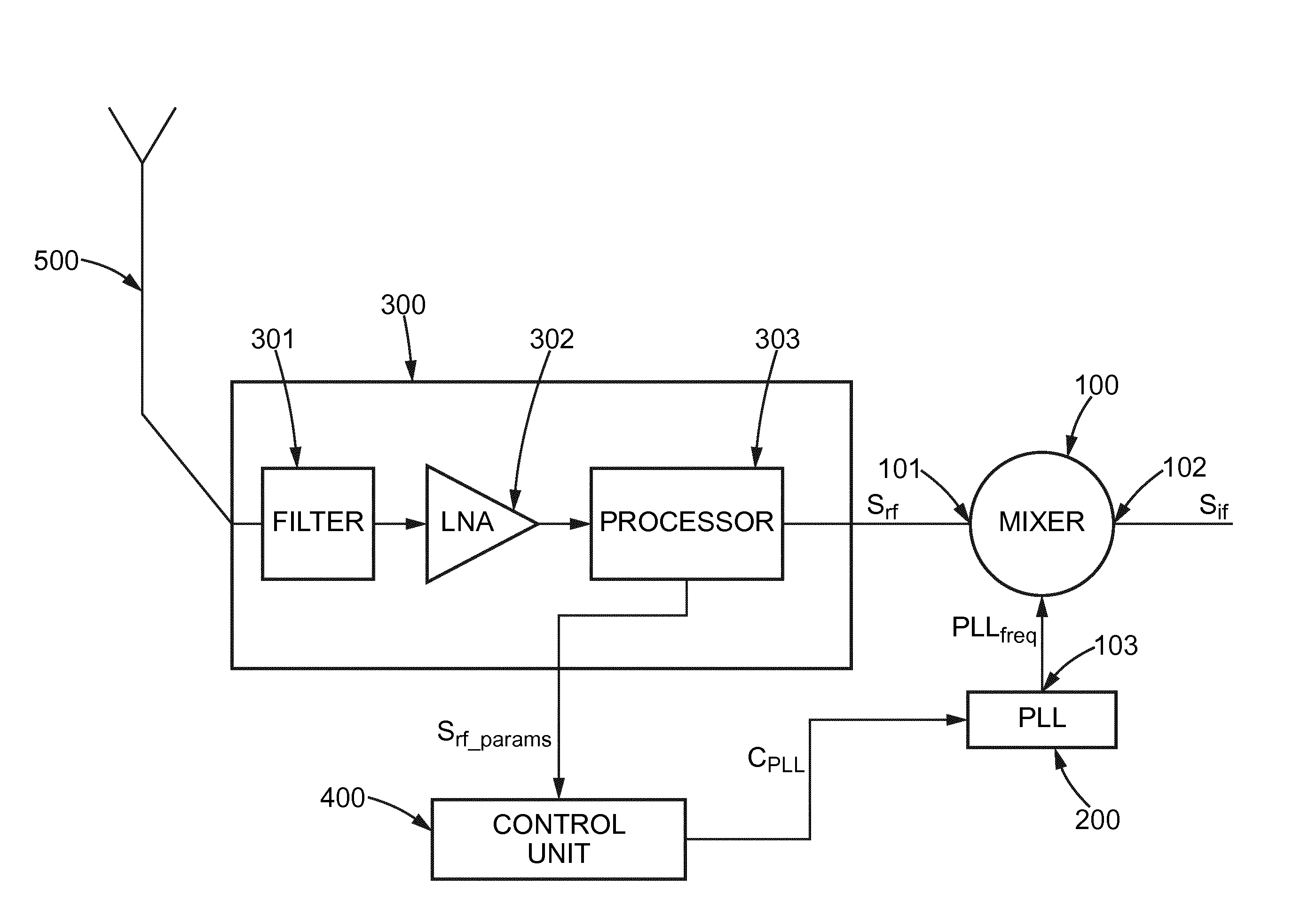
  • Figure 1
    Figure 1
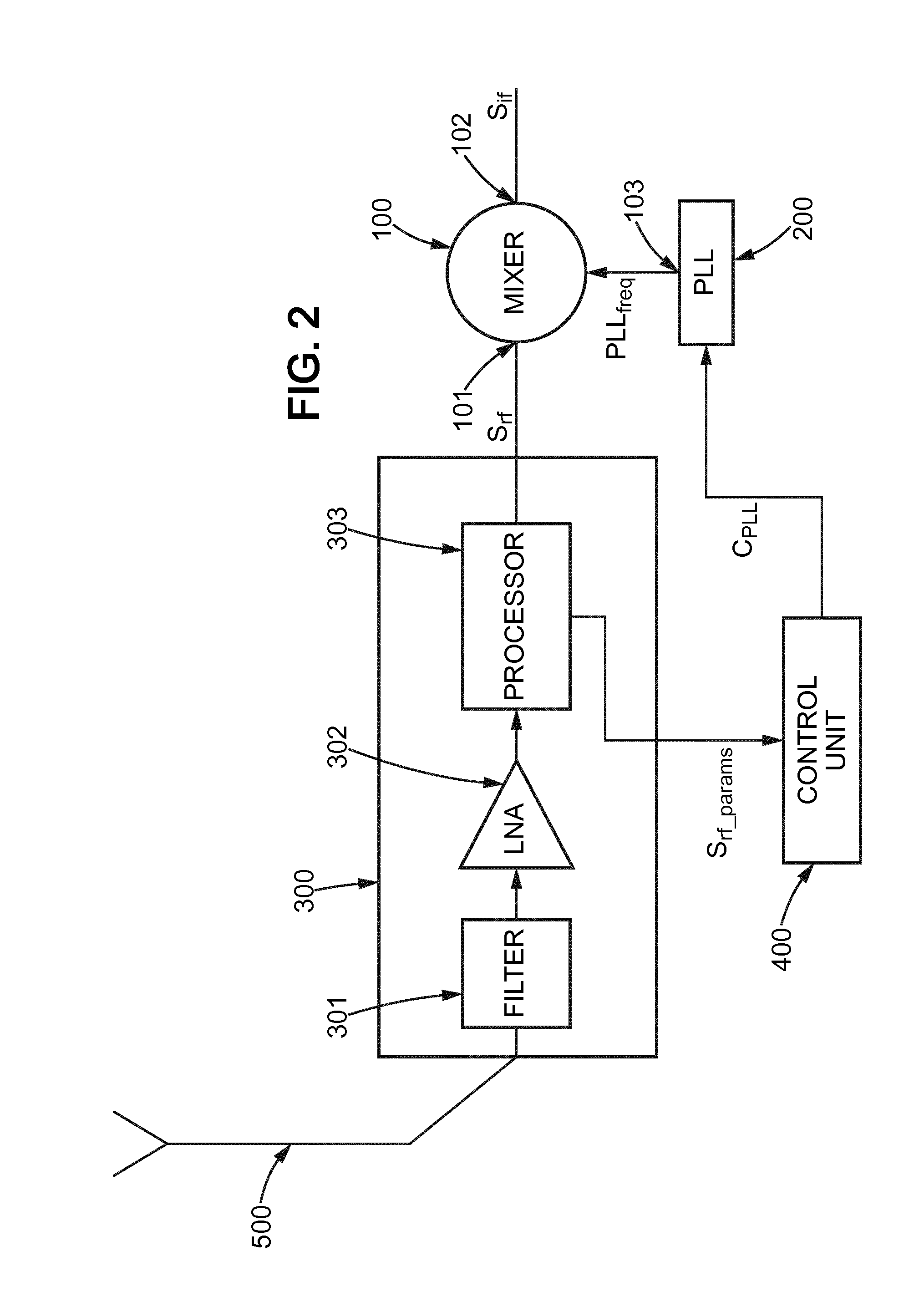
  • Figure 2
    Figure 2
  • Figure 3
    Figure 3
Patent Text Reader

Abstract

A method of controlling a frequency selection of a PLL used in cooperation with a device of a wireless communication network, such as a Universal Mobile Telecommunication System (UMTS) network, the method comprising:—receiving a first set of signal measurements;—comparing the first set of signal measurements with a first threshold and, selectively switching the PLL frequency from a first value to a second value as a result of the comparison of the first set of signal measurements with the first threshold;—further receiving a second set of signal measurements; and,—comparing the second set of signal measurements with a second threshold, different from the first threshold, and selectively switching the PLL frequency from the second value to the first value as a result of the comparison of the second set of signal measurements with the second threshold.
Need to check novelty before this filing date? Find Prior Art

Description

FIELD OF THE INVENTION

[0001] This invention relates to phase locked loops (PLL) in wireless communication networks and, more particularly, to a method and a device for controlling PLL frequency selection allowing reduction of spurious frequencies in a serving cell of such a network.BACKGROUND OF THE INVENTION

[0002] The PLL technique has been around for a long time and has a wide variety of applications in wireless communication networks. It is frequently used for implementing operations such as demodulation, decoding, synchronisation, frequency synthesis or sampling.

[0003] In a frequency synthesiser, for instance, the PLL technique may be used for generating one or many accurate signal oscillation frequencies from one or more reference sources. In e.g. a radiofrequency (RF) receiver, a PLL may be associated with a signal mixer. A signal mixer is a circuit capable of translating a signal from a given frequency within the RF band to another, lower frequency known as an intermediate frequ...

Examples

Embodiment Construction

[0020]In the drawings, like reference numbers designate like parts in various Figures. Expressions such as “comprise”, “include”, “incorporate”, “contain”, “is” and “have” are to be construed in a non-exclusive manner when interpreting the description and its associated claims, namely construed to allow for other items or components that are not explicitly defined also to be present. Reference to the singular is also to be construed in being a reference to the plural, and vice versa.

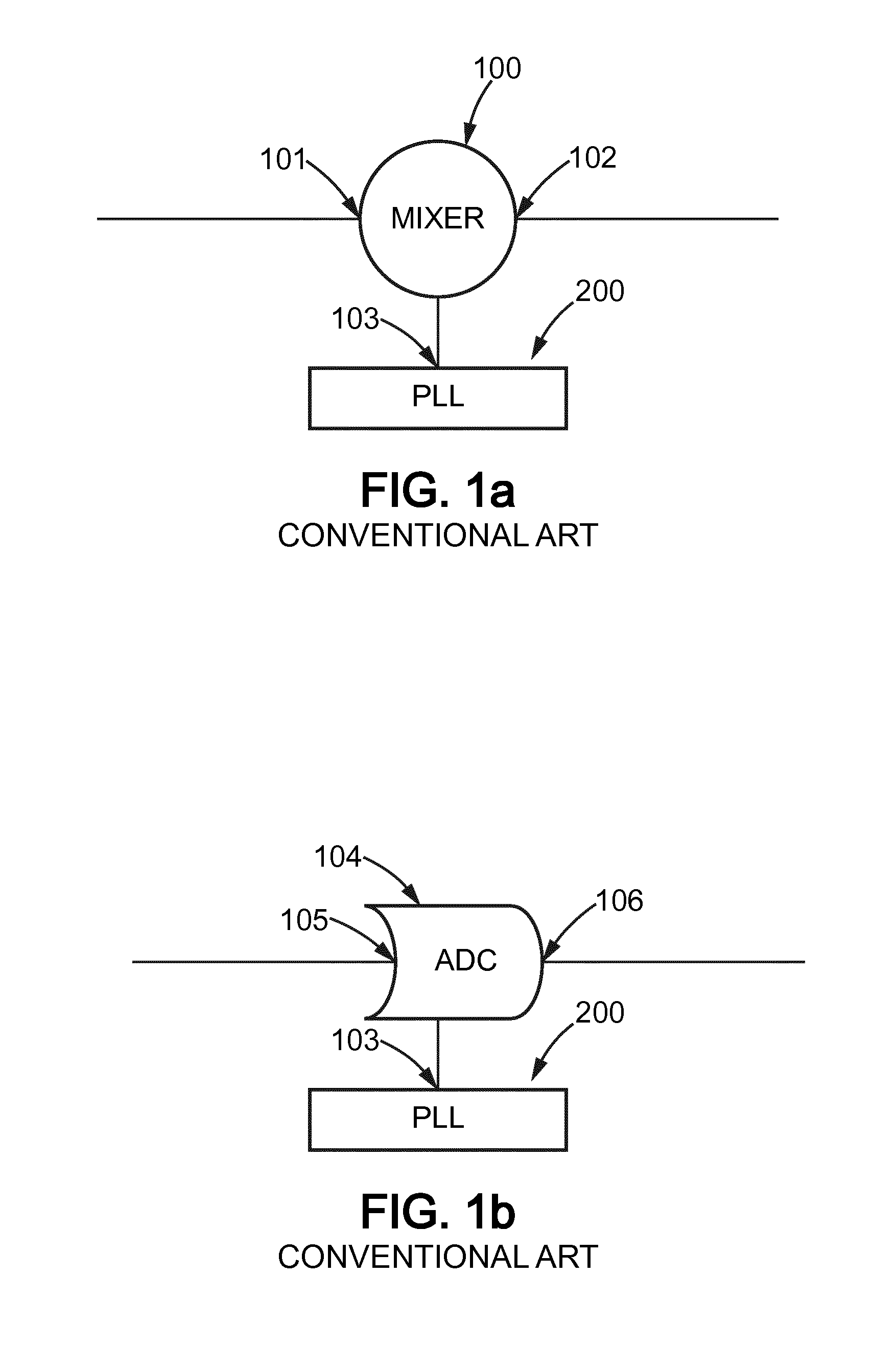
[0021]FIG. 1a is a block diagram illustrating a conventional art usage of the PLL technique associated with a mixer 100. In this example, a PLL 200 is configured for generating one or many accurate signal oscillation frequencies at the output 103 of the PLL from one or more reference sources that would be combined with the input 101 of the mixer 100. This would generate a mixed output signal at the output 102 of the mixer 100. In this example, the oscillation frequencies generated by operation of the PLL...