Traffic and load aware dynamic queue management

a dynamic queue and traffic management technology, applied in the field of traffic and load aware dynamic queue management, can solve problems such as rebalancing queues amongst existing ones

US20150055456A1Inactive Publication Date: 2015-02-26VMWARE INC
5 Cites 32 Cited by

Patent Information

Authority / Receiving Office
US · United States
Patent Type
Applications(United States)
Current Assignee / Owner
Publication Date
2015-02-26
Estimated Expiration
Not applicable · inactive patent

Smart Images

  • Figure 1
    Figure 1
  • Figure 2
    Figure 2
  • Figure 3
    Figure 3
Patent Text Reader

Abstract

Some embodiments provide a queue management system that efficiently and dynamically manages multiple queues that process traffic to and from multiple virtual machines (VMs) executing on a host. This system manages the queues by (1) breaking up the queues into different priority pools with the higher priority pools reserved for particular types of traffic or VM (e.g., traffic for VMs that need low latency), (2) dynamically adjusting the number of queues in each pool (i.e., dynamically adjusting the size of the pools), (3) dynamically reassigning a VM to a new queue based on one or more optimization criteria (e.g., criteria relating to the underutilization or overutilization of the queue).
Need to check novelty before this filing date? Find Prior Art

Description

BACKGROUND

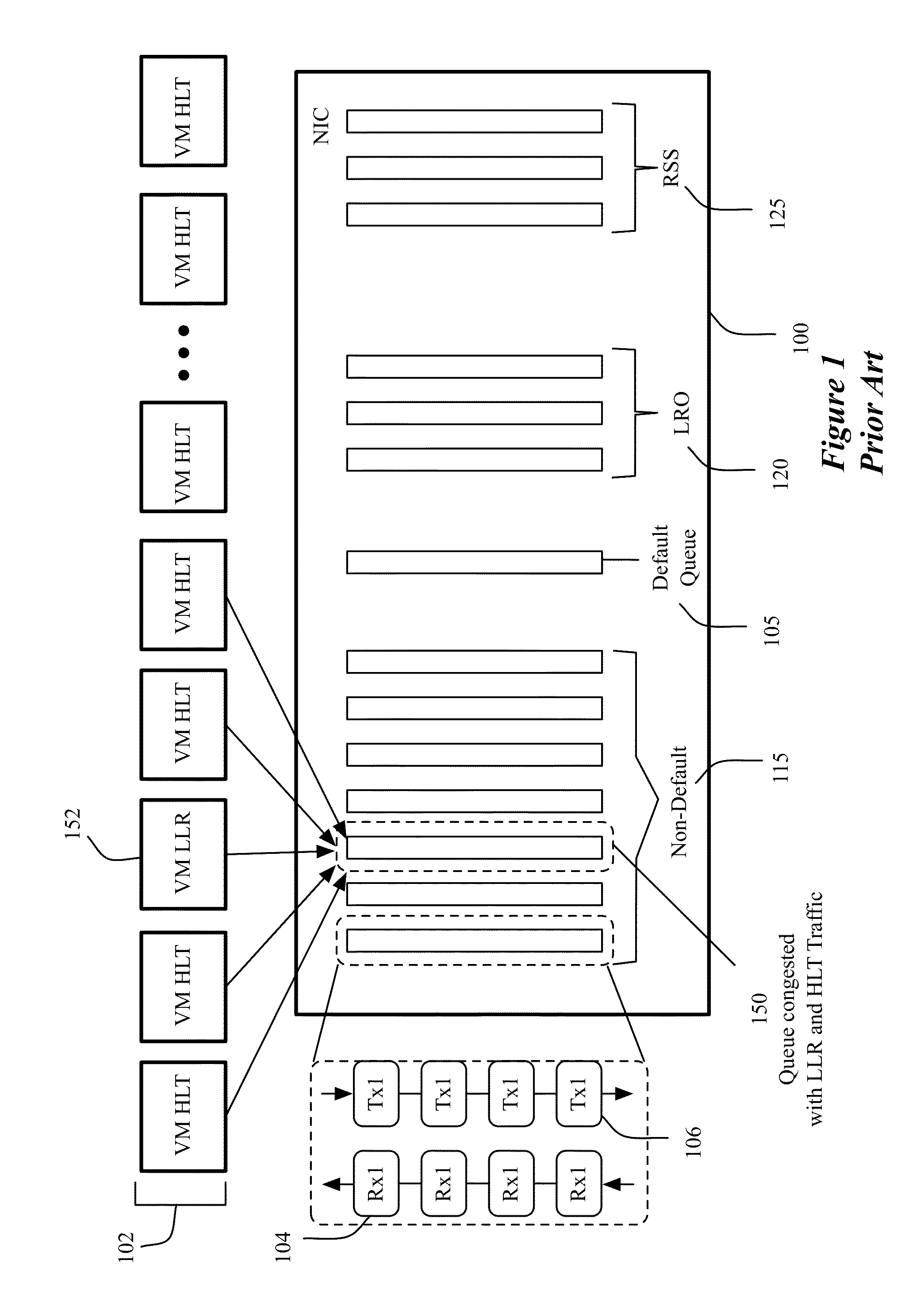
[0001] In the last few years, queue management systems have been proposed for distributing incoming and outgoing traffic to and from a host through a network interface card (NIC) with multiple queues. FIG. 1 illustrates one such system. Specifically, it illustrates (1) multiple virtual machines (VMs) 102 that execute on a host computer (not shown), and (2) a NIC 100 that has multiple queues. As shown in this figure, each queue has a receive side set 104 of buffers and a transmit side set 106 of buffers to handle respectively incoming and outgoing traffic. The system has four types of queues, which are: a default queue 105, several non-default queues 115, LRO (large receive offload) queues 120 and RSS (receive side scaling) queues 125. The latter two types of queues are specialty queues tied to specific hardware LRO and RSS functionalities supported by the NIC.

[0002] The queue management system of FIG. 1 distributes traffic to and from the virtual machines (VMs) across multip...

Examples

Embodiment Construction

[0031]In the following detailed description of the invention, numerous details, examples, and embodiments of the invention are set forth and described. However, it will be clear and apparent to one skilled in the art that the invention is not limited to the embodiments set forth and that the invention may be practiced without some of the specific details and examples discussed.

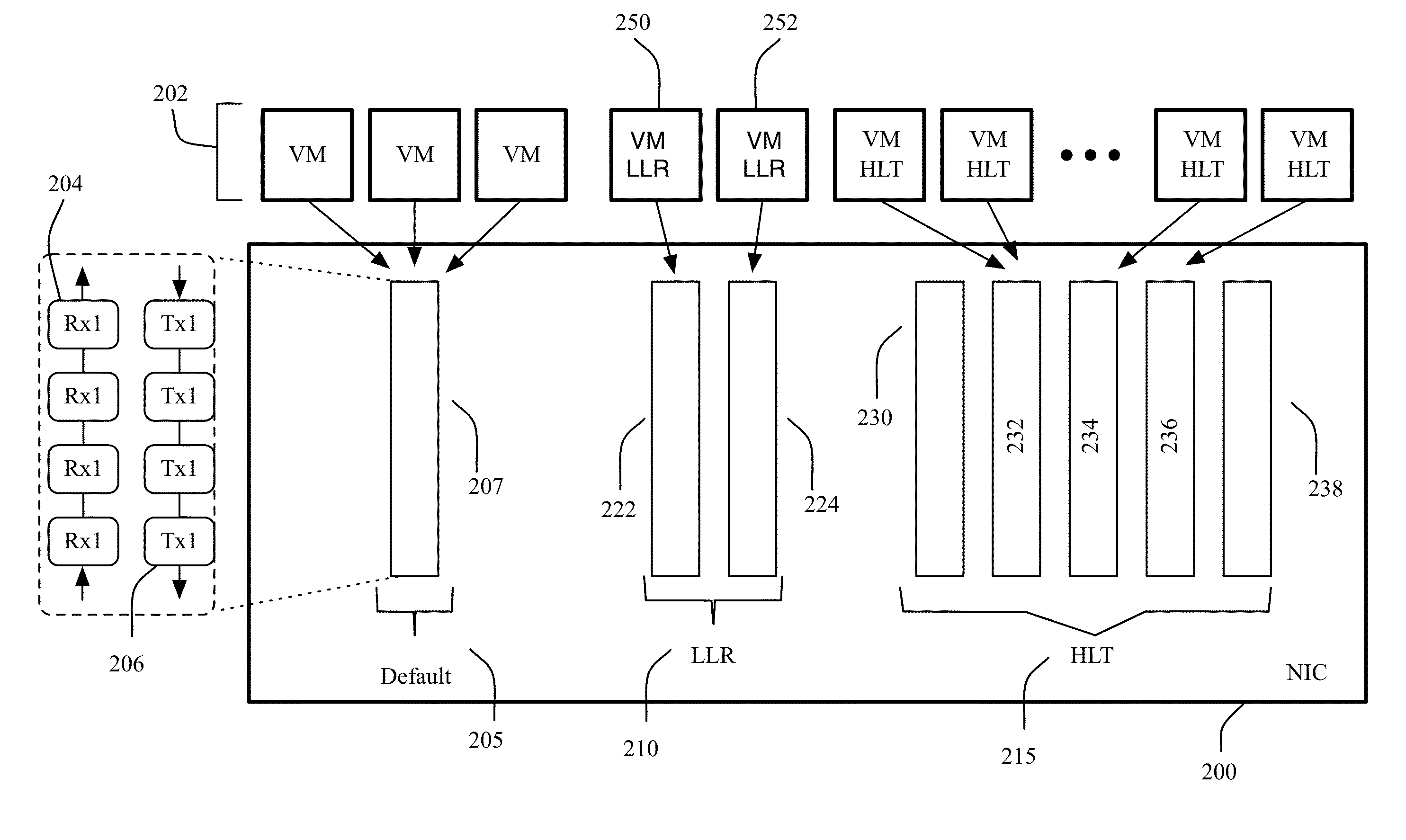
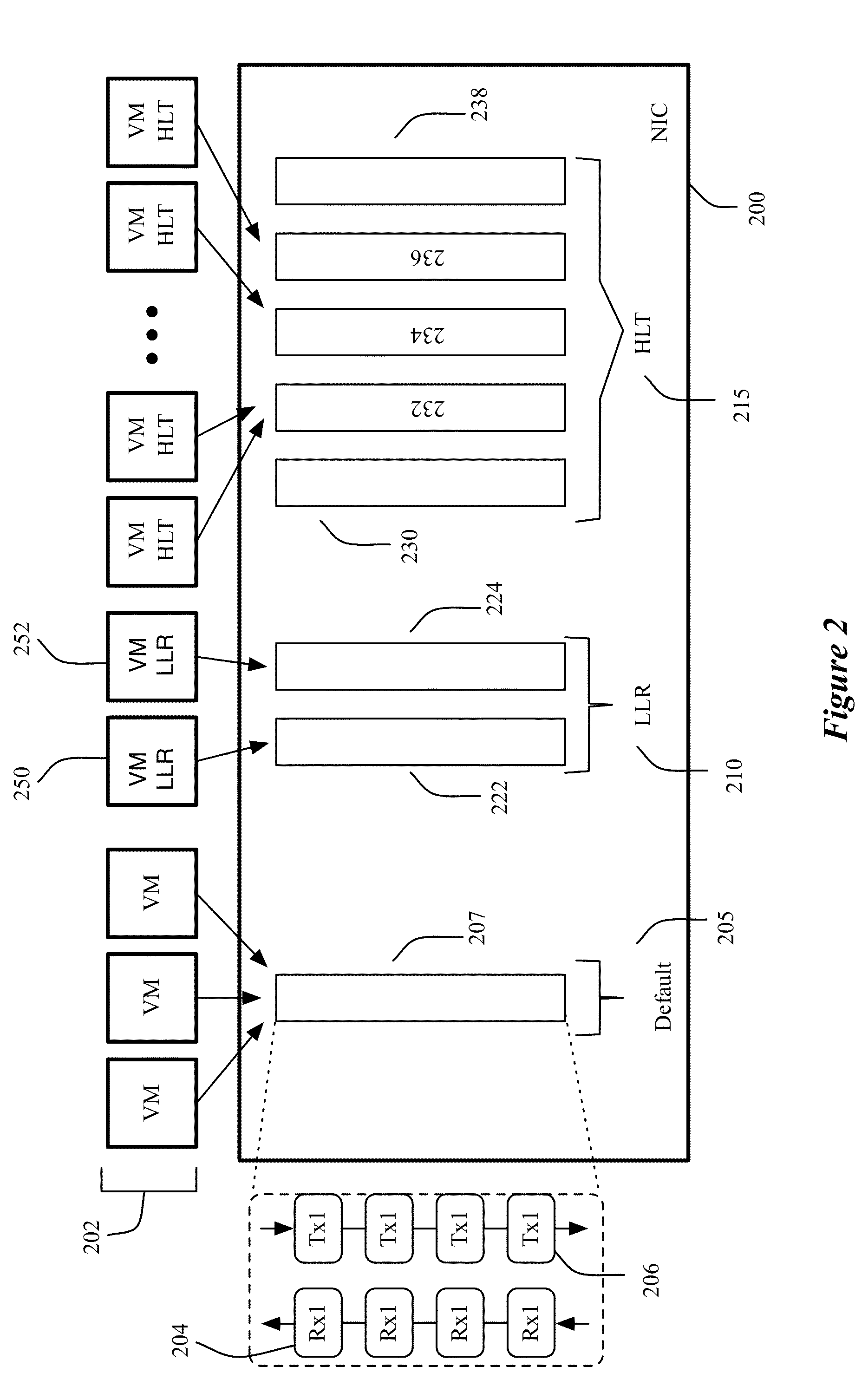
[0032]Some embodiments provide a queue management system that efficiently and dynamically manages multiple queues that process traffic to and from multiple virtual machines (VMs) executing on a host. This system manages the queues by (1) breaking up the queues into different priority pools with the higher priority pools reserved for particular types of traffic or VMs (e.g., traffic for VMs that need low latency), (2) dynamically adjusting the number of queues in each pool (i.e., dynamically adjusting the size of the pools), (3) dynamically reassigning a VM to a new queue based on one or more optimization crite...