

Position detection device
- Summary
- Abstract
- Description
- Claims
- Application Information
AI Technical Summary
Benefits of technology
Problems solved by technology
Method used
Image


Examples
first embodiment
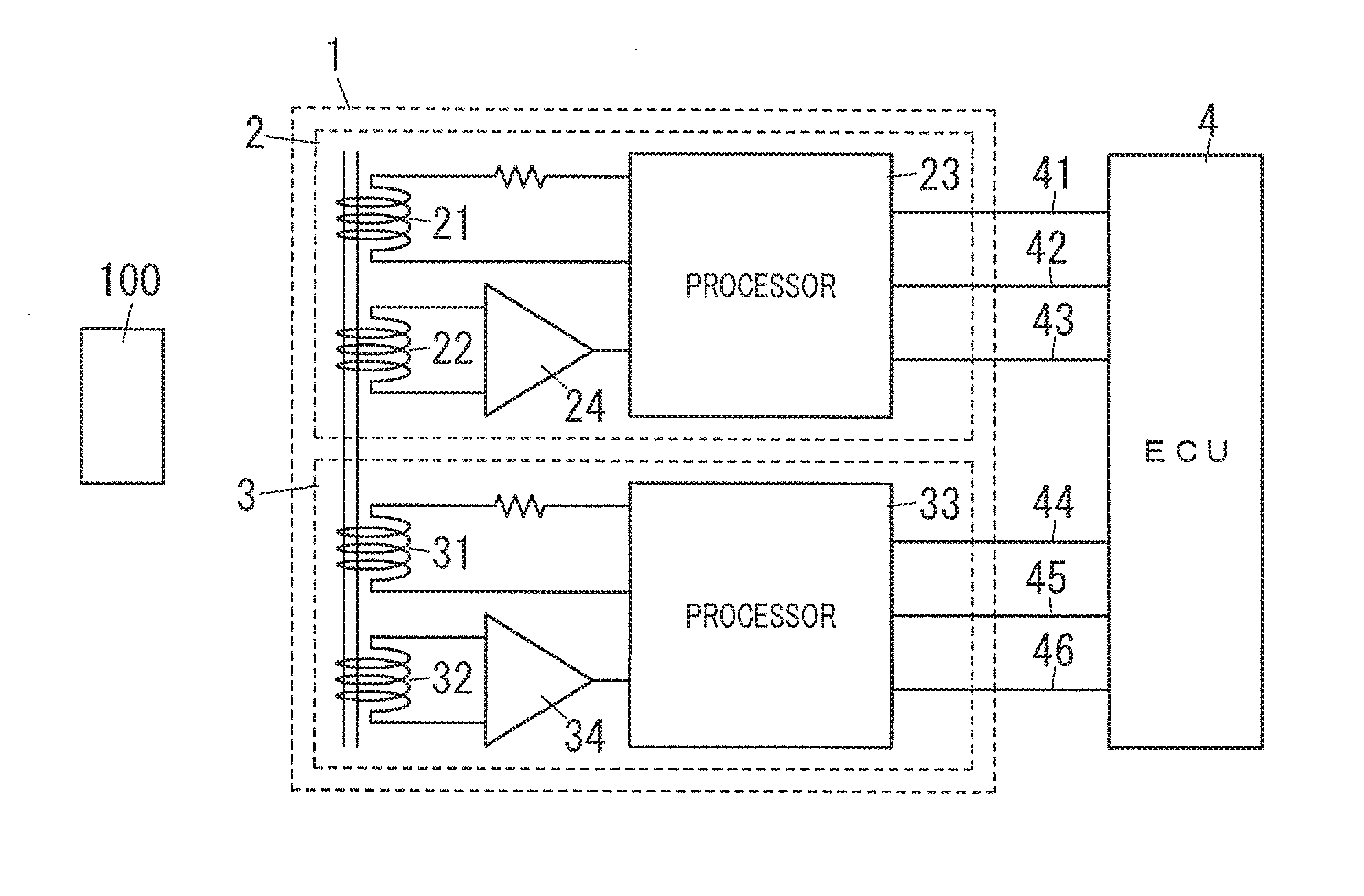
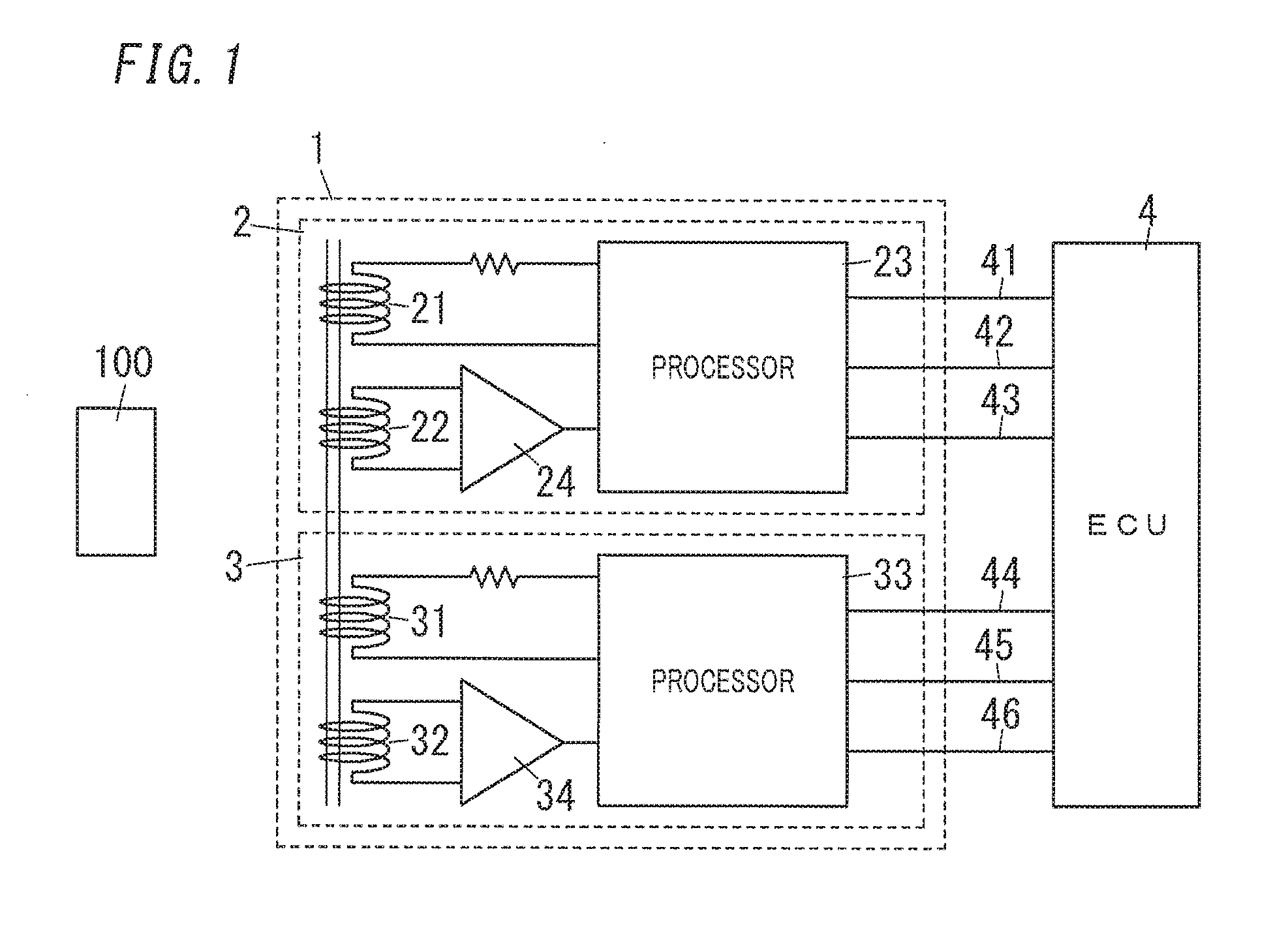
[0025]As illustrated in FIG. 1, a position detection device according to a first embodiment of the present invention includes a detector 2 (here, first detector) and a detector 3 (here, second detector). The detector 2 includes a (first) excitation coil 21, a (first) detection coil 22, and a (first) processor 23. The detector 3 includes a (second) excitation coil 31, a (second) detection coil 32, and a (second) processor 33. The excitation coil 21 is magnetically coupled to the detection coil 22 and the detection coil 32. The excitation coil 31 is magnetically coupled to the detection coil 22 and the detection coil 32.
[0026]The processor 23 is configured to intermittently execute a (first) acquisition process during a measurement period of the processor 23. The (first) acquisition process is a process of driving the excitation coil 21 and acquiring a (first) detection signal Y1 (see FIG. 2) induced in the detection coil 22 depending on the position of an object 100 by the driving th...
second embodiment
[0111]While in the position detection device 1 of the first embodiment, the processor 23 (processor 33) monitors whether or not the detection signal Y4 (detection signal Y3) is induced in the detection coil 22 (detection coil 32) during the monitoring period, other configurations may be possible. A position detection device 1 according to a second embodiment of the present invention will be described below with reference to the drawings. The description of elements of the position detection device 1 of the present embodiment which are shown in the position detection device 1 of the first embodiment is accordingly omitted.
[0112]As illustrated in FIG. 12, the position detection device 1 of the present embodiment includes a (first) processor 23 and a (second) processor 33 which are electrically connected to each other via one communication line 5. The (first) processor 23 and the (second) processor 33 can perform bidirectional communication via the one communication line 5.
[0113]Specif...
third embodiment
[0121]A position detection device 1 according to a third embodiment of the present invention will be described below with reference to the drawings. The description of elements of the position detection device 1 of the present embodiment which are shown in the position detection device 1 of the first embodiment is accordingly omitted.
[0122]
[0123]It is possible, although very rare, that due to, for example, a temporal abnormality of a processor 23 (processor 33), a time period during which the processor 23 executes the acquisition process and a time period during which the processor 33 executes the acquisition process partly overlap each other. The time period during which the processor 23 (processor 33) executes the acquisition process is hereinafter referred to as an “execution time period DP1.” That is, as an example illustrated in FIG. 15A, an event occurs in which the execution time period DP1 of the processor 23 and the execution time period DP1 of the processor 33 partly overl...
PUM
 Login to View More
 Abstract
Description
Claims
Application Information
 Login to View More