Deep learning based processing of motion artifacts in magnetic resonance imaging data

a magnetic resonance imaging and deep learning technology, applied in the field of deep learning based processing of motion artifacts in magnetic resonance imaging data, can solve the problems of reducing patient throughput, affecting patient diagnosis, and affecting patient diagnosis, so as to reduce the level of motion artifacts

a magnetic resonance imaging and deep learning technology, applied in the field of deep learning based processing of motion artifacts in magnetic resonance imaging data, can solve the problems of reducing patient throughput, affecting patient diagnosis, and affecting patient diagnosis, so as to reduce the level of motion artifacts

US20210181287A1Active Publication Date: 2021-06-17KONINKLILJKE PHILIPS NV

Image

Smart Image Click on the blue labels to locate them in the text.
Viewing Examples
Smart Image
  • Deep learning based processing of motion artifacts in magnetic resonance imaging data
  • Deep learning based processing of motion artifacts in magnetic resonance imaging data
  • Deep learning based processing of motion artifacts in magnetic resonance imaging data

Examples

Experimental program
Comparison scheme
Effect test

Embodiment Construction

[0108]Like numbered elements in these figures are either equivalent elements or perform the same function. Elements which have been discussed previously will not necessarily be discussed in later figures if the function is equivalent.

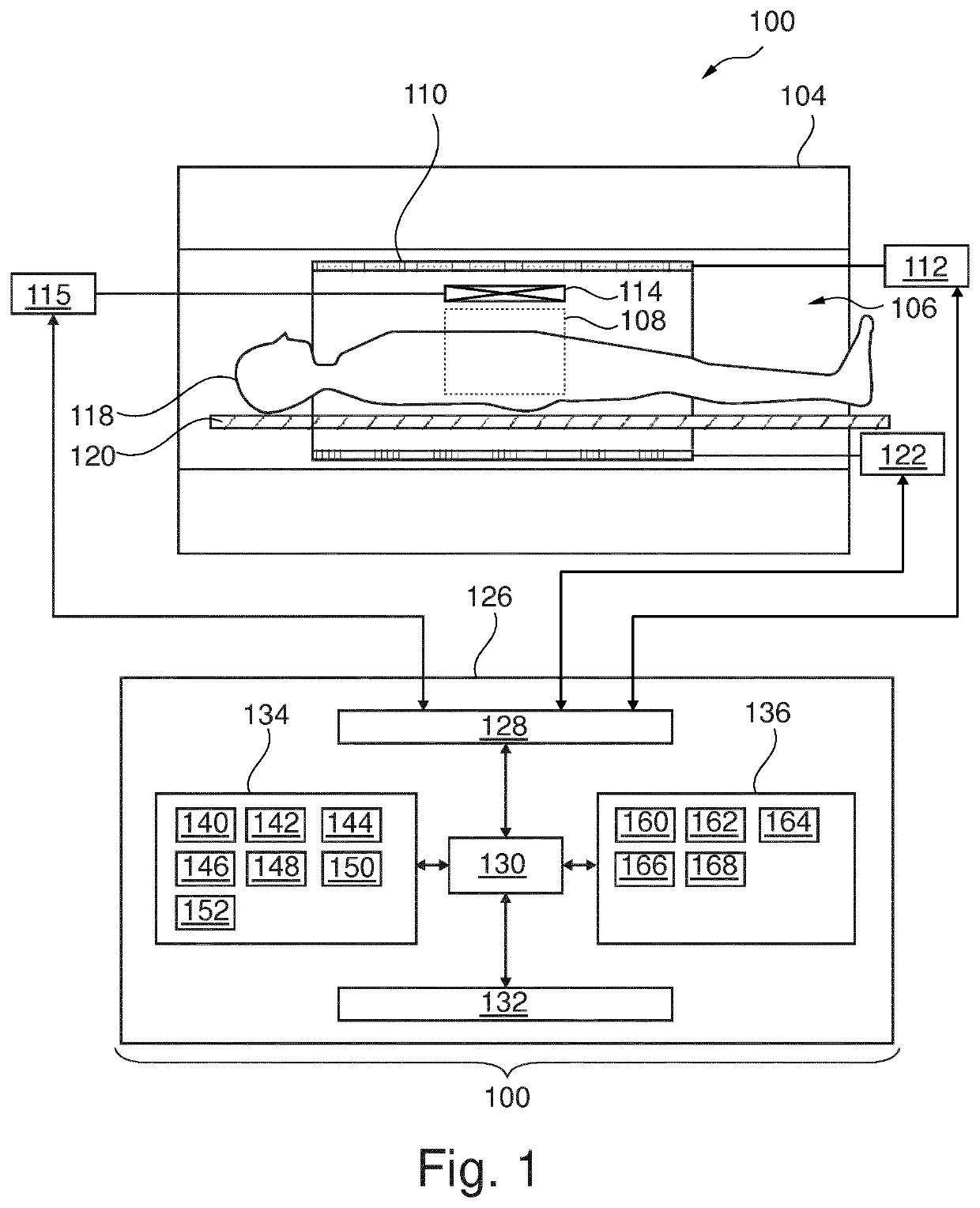
[0109]FIG. 1 shows an example of a magnetic resonance imaging system 100 with a magnet 104. The main magnet 104 is a superconducting cylindrical type magnet 104 with a bore 106 through it. The use of different types of magnets is also possible. For instance, it is also possible to use both a split cylindrical magnet and a so called open magnet. A split cylindrical magnet is similar to a standard cylindrical magnet, except that the cryostat has been split into two sections to allow access to the iso-plane of the magnet, such magnets may for instance be used in conjunction with charged particle beam therapy. An open magnet has two magnet sections, one above the other with a space in-between that is large enough to receive a subject: the arrangement of the...

the structure of the environmentally friendly knitted fabric provided by the present invention; figure 2 Flow chart of the yarn wrapping machine for environmentally friendly knitted fabrics and storage devices; image 3 Is the parameter map of the yarn covering machine
Login to View More

PUM

No PUM Login to View More

Abstract

The invention relates to a magnetic resonance imaging data processing system (126) for processing motion artifacts in magnetic resonance imaging data sets using a deep learning network (146, 502, 702) trained for the processing of motion artifacts in magnetic resonance imaging data sets. The magnetic resonance imaging data processing system (126) comprises a memory (134, 136) storing machine executable instructions (161, 164) and the trained deep learning network (146, 502, 702). Furthermore, the magnetic resonance imaging data processing system (126) comprises a processor (130) for controlling the magnetic resonance imaging data processing system. Execution of the machine executable instructions (161, 164) causes the processor (130) to control the magnetic resonance imaging data processing system (126) to: receive a magnetic resonance imaging data set (144, 500, 800), apply the received magnetic resonance imaging data set (144, 500, 800) as an input to the trained deep learning network (146, 502, 702), process one or more motion artifacts present in the received magnetic resonance imaging data set (144, 500, 800) using the trained deep learning network (146, 502, 702).

Description

FIELD OF THE INVENTION[0001]The invention relates to processing motion artifacts in magnetic resonance imaging data, in particular it relates to methods and apparatuses for processing motion artifacts in magnetic resonance imaging data using deep learning.BACKGROUND OF THE INVENTION[0002]Due to typically long data acquisition times of magnetic resonance imaging (MRI) procedures, motion artifacts caused by patient motion are one of the most frequent causes of image degradation of magnetic resonance images in clinical applications of MRI. Despite the severity of the problems associated with such image degradations, detection of these artifacts usually requires manual assessment by an experienced radiologist. Possible problems associated with motion artifacts may for example comprise that the respective magnetic resonance images may be of little or even no use for medical diagnosis due to the image degradation. This may also complicate the clinical workflow, e.g. if a radiologic techno...

Claims

the structure of the environmentally friendly knitted fabric provided by the present invention; figure 2 Flow chart of the yarn wrapping machine for environmentally friendly knitted fabrics and storage devices; image 3 Is the parameter map of the yarn covering machine
Login to View More

Application Information

Patent Timeline
17 Jun 2021
Publication
US20210181287A1
IPC
G01R33/565; G01R33/56; G06T5/00; G06T7/00; G06T5/50; G06T5/20; G06N3/08; G06N3/04
CPC
G01R33/56509; G01R33/5608; G06T5/001; G06T7/0012; G06T5/50; G06T5/20; G06T2207/20224; G06N3/04
Inventors
SOMMER, KARSTEN; BROSCH, TOM