Antenna steering for an access point based upon probe signals

a technology of access points and probe signals, applied in the direction of diversity/multi-antenna systems, transmission monitoring, wireless communication, etc., can solve the problems of monopolizing antennas and degrading the quality of communication between the remote station and the access point, so as to improve the throughput of individual remote stations and support more users in the network

US7047046B2Inactive Publication Date: 2006-05-16IPR LICENSING INC
39 Cites 47 Cited by

Patent Information

Authority / Receiving Office
US · United States
Patent Type
Patents(United States)
Current Assignee / Owner
Publication Date
2006-05-16
Estimated Expiration
Not applicable · inactive patent

Smart Images

  • Figure 1
    Figure 1
  • Figure 2
    Figure 2
  • Figure 3
    Figure 3
Patent Text Reader

Abstract

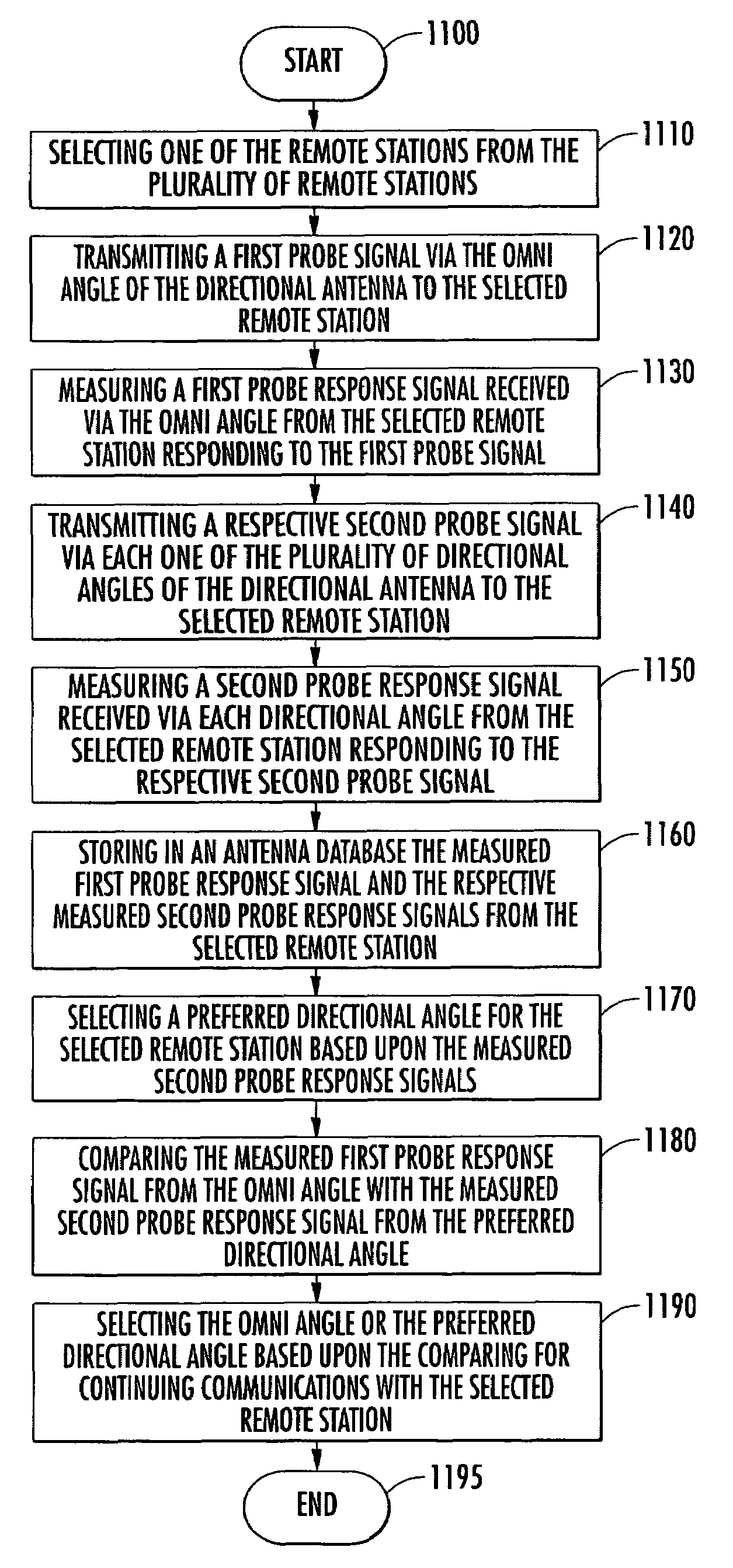
A method for operating an access point in a wireless local area network (WLAN) is provided. The access point includes a directional antenna for communicating with a plurality of remote stations, and the directional antenna includes an omni angle and a plurality of directional angles. The method determines a preferred direction to the point the directional antenna from the access point to a desired remote station. This determination is based on a sequence of probe signals exchanged between the access point and the remote station. The probe response signals are measured by the access point, and are stored in an antenna database.
Need to check novelty before this filing date? Find Prior Art

Description

RELATED APPLICATION

[0001] This application claims the benefit of U.S. provisional application Ser. No. 60 / 479,701, filed Jun. 19, 2003, the entire contents of which are incorporated herein by reference.FIELD OF THE INVENTION

[0002] The present invention relates to the field of wireless local area networks, and in particular, to an antenna steering algorithm for an access point operating within a wireless local area network.BACKGROUND OF THE INVENTION

[0003] Various standards allow remote stations, such as portable computers, to be moved within a wireless local area network (WLAN) and connect via radio frequency (RF) transmissions to an access point (AP) that is connected to a wired network. The wired network is often referred to as a distribution system. The various standards include the IEEE 802.11 standard and its corresponding letter revisions thereof, such as 802.11b and 802.11g, for example.

[0004] A physical layer in the remote stations and in the access point provides low level tran...

Examples

Embodiment Construction

[0041]The present invention will be described more fully hereinafter with reference to the accompanying drawings, in which preferred embodiments of the invention are shown. This invention may, however, be embodied in many different forms and should not be construed as limited to the embodiments set forth herein; rather, these embodiments are provided so that this disclosure will be thorough and complete, and will fully convey the scope of the invention to those skilled in the art. Like numbers refer to like elements throughout, and prime notation is used to indicate similar elements in alternate embodiments.

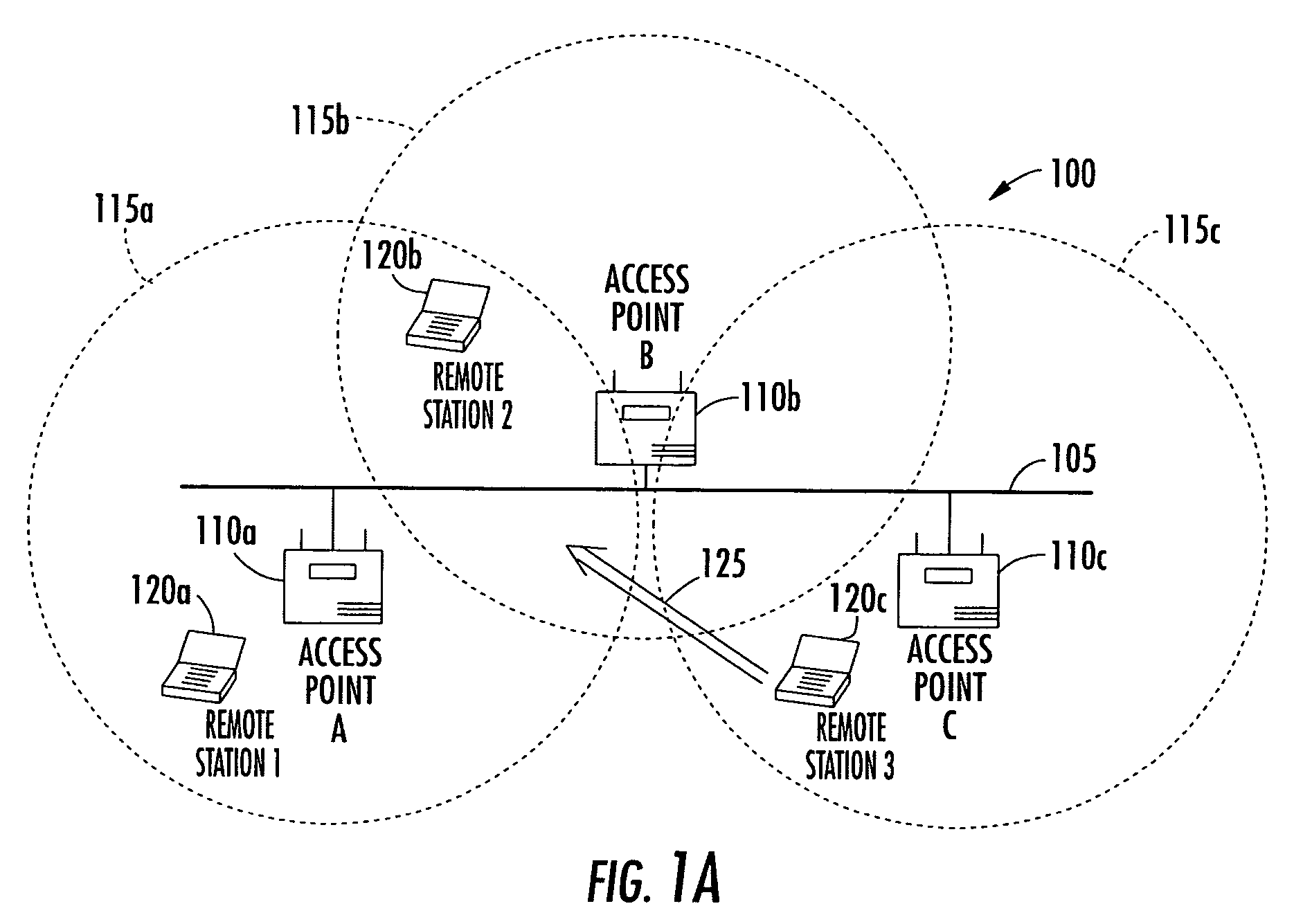
[0042]Referring initially to FIG. 1A, a wireless local area network (WLAN) 100 having a distribution system 105 will initially be discussed. Access points 110a, 10b and 110c are connected to the distribution system 105 via wired connections, such as wired data network connections. Each of the access points 110a, 110b and 110c has a respective zone 115a, 115b, 115c in which it is ...