
Adult T cell leukemia model animal
a model animal and adult t cell technology, applied in the field of adult t cell leukemia model animals, can solve the problems of limited application range, no immunological studies, and difficulty in simultaneously performing oncological and immunological studies
- Summary
- Abstract
- Description
- Claims
- Application Information
AI Technical Summary
Benefits of technology
Problems solved by technology
Method used
Image

Examples
example 1
Transplantation of HTLV-1 Infected Cell Line
[0025]Various existing HTLV-1 infected cell lines (2×10⁶ cells) were subcutaneously or intraperitoneally transplanted into neonatal rats (within 24 hours after the birth). The same cell lines (10×107) were also subcutaneously, intraperitoneally or intravenously transplanted into the rats of age four week.
[0026]The HTLV-1 infected cell lines used were a lymphocyte cell line TARS-1 and TART-1 derived from WKA rats (J. Exp. Med., 176:981–989, 1992), a lymphocyte cell line F344-S1 derived from F344 rats (J. Exp. Med., 159:1105–1116, 1984), a HTLV-1 infected cell line W7TM-1 derived from WKA rats (J. Immunol., 144:4202–4211, 1990), and a HTLV-1 infected human cell line MT2 (Nature, 294:770–771, 1981).
[0027]The rats used were female F344 / N Jcl-rnu / rnu nude rats (nu / nu) and F344 / N Jcl-rnu / + (nu / +) rats belonging to the same strain as the rats above (both of which were purchased from Clea Japan Co.), and female F344 / Slc (F344) rats and WKA / KinSlc ...
example 2
Establishment of HTLV-1 Infected T Cell Line FPM1 and Transplantation thereof into Rat
[0041]Spleen cells of rat F344 / N Jcl-rnu / +nu / + were cultivated together with HTLV-1 infected human cell line MT-2 in a RPMI1640 medium (containing FCS, penicillin, streptomycin; 10 U / ml of interleukin 2 was added at initiation of culture) to establish the HTLV-1 infected T cell line FPM1. This cell line FPM1 expresses CD4, CD5, CD25, MHC-1 and MHC-II as the cells of the human ATL patient do.
[0042]The established HTLV-1 infected T cell line FPM-1 was cultivated in a RPMI1640 medium (containing 10% FCS and antibiotics).
[0043]The cell line FPM1 (1×10⁷ cells) was subcutaneously transplanted in the 4-week-old rats. The cell line FPM1 (2×10⁶ cells) was also subcutaneously a transplanted in neonatal rats (within 24 hours after the birth).
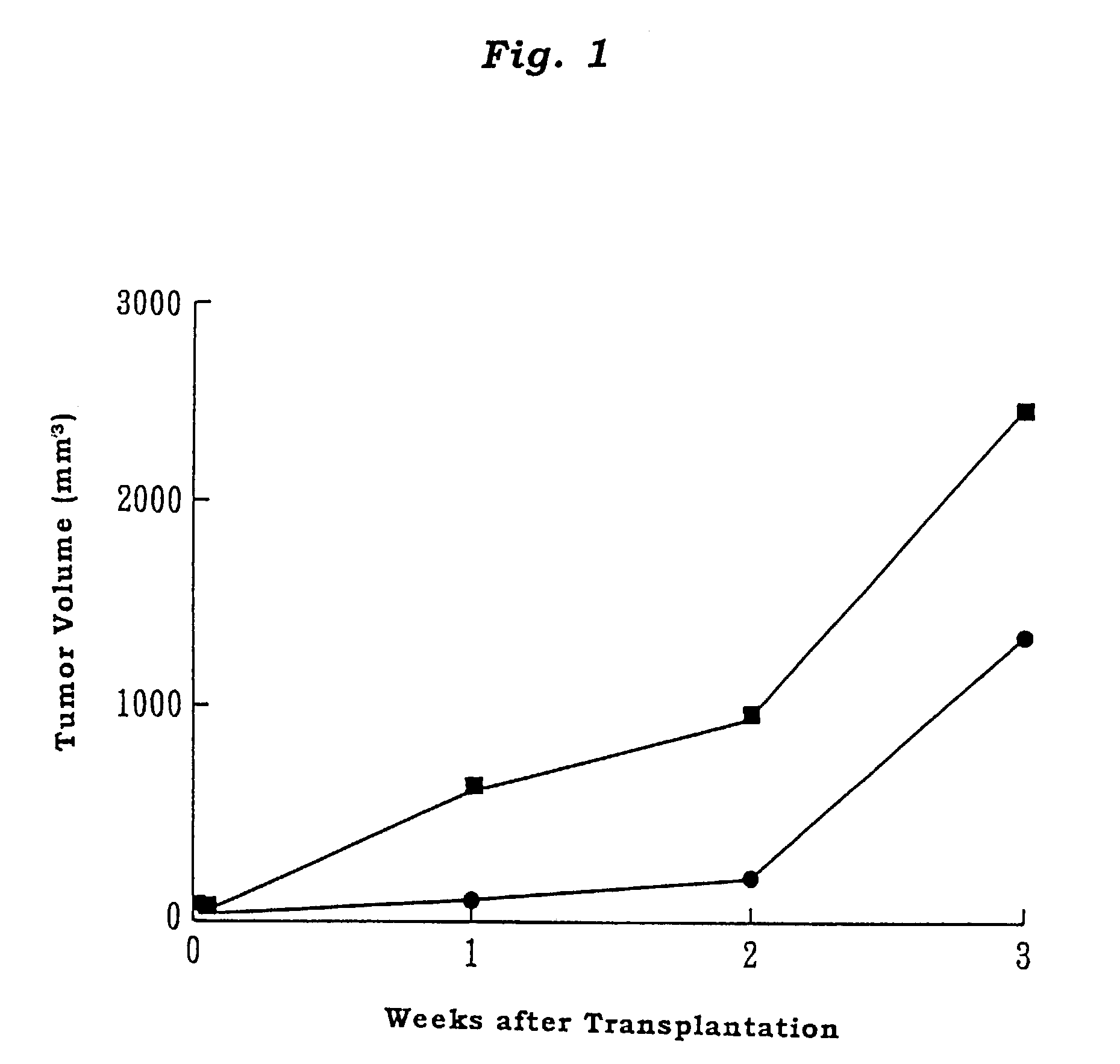
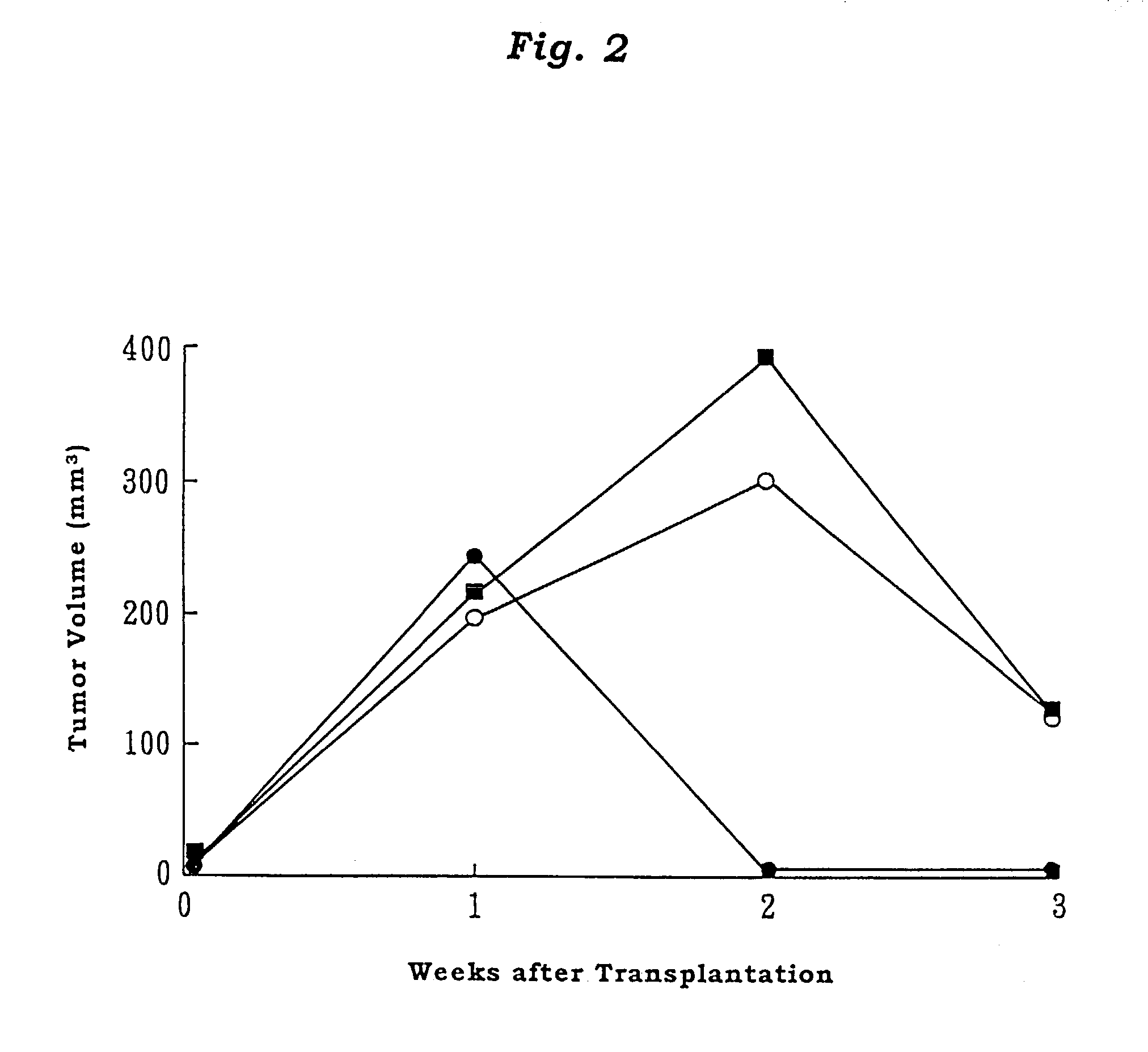
[0044]While growth of the subcutaneous tumor was observed in two week after the first transplantation in the 4-week old nude rat received subcutaneous transplantation of ...
example 3
Establishment of HTLV-1 Infected T Cell Line FPM1-V1AX and Transplantation into Rat
[0046]FPM1 cells proliferated in the natal nude rat were isolated to establish the cell line FPM1-N2. The cell line was then subcutaneously transplanted into the natal nude rat (nu / nu) and the syngeneic rat (nu / +) thereof having mormal immunity. Although the transplanted cells did not proliferate in the rats of normal immunity (five rats), the transplanted cells proliferated in the four nude rats. Three of these rats died two week after the transplantation, and the remaining one was allowed to commit euthanasia. Thickening of the lymph node was observed by autopsy. The thickened cells were isolated, and were cultivated to establish the cell line FPM1-V1AX. The results are shown in Table 3.
[0047]
TABLE 3cell linecriginrecipientnumberrootdiagnosisaFMP1in vitronu / + (NBb)2sccNSdtransformationnu / nu (NB)2scprogressive tumornu / + (NB)5ipeNSnu / nu (NB)3ipdeath (2Wf)nu / nu (4W)4sctransient tumornu / nu (4W)2ipNSFPM1...
PUM
| Property | Measurement | Unit |
|---|---|---|
| weight | aaaaa | aaaaa |
| surface lengths | aaaaa | aaaaa |
| width | aaaaa | aaaaa |
Abstract
Description
Claims
Application Information
 Login to View More