Method of accommodating fragmentation and burst in a wireless protocol

US7289535B2Inactive Publication Date: 2007-10-30MANN HUMMEL GMBH +1
1 Cites 15 Cited by

Patent Information

Authority / Receiving Office
US · United States
Patent Type
Patents(United States)
Current Assignee / Owner
Publication Date
2007-10-30
Estimated Expiration
Not applicable · inactive patent

Smart Images

  • Figure 1
    Figure 1
  • Figure 2
    Figure 2
  • Figure 3
    Figure 3
Patent Text Reader

Abstract

A method is provided for sending information in a wireless network. A service data unit is broken up by a transmitter into multiple fragments that are sent as the payloads of respective data frames transmitted to a receiver. Each of these frames includes a service data unit identifier identifying the service data unit the fragment is associated with, a fragment number indicating the position of the fragment within the associated service data unit, and a total fragment value indicating the total number of fragments in the service data unit. The receiver extracts the service data unit fragments, buffers them, and uses the fragments to reconstruct the service data unit. The receiver is able to efficiently buffer the fragments because of the service data unit identifier, fragment number, and total fragment value contained in each frame.
Need to check novelty before this filing date? Find Prior Art

Description

CROSS-REFERENCE TO RELATED PATENT DOCUMENTS

[0001] This application relies for priority on U.S. provisional application Ser. No. 60 / 364,116, by Knut T. Odman, filed Mar. 15, 2002, entitled “METHOD OF ACCOMMODATING FRAGMENTATION AND BURST IN A WIRELESS PROTOCOL,” the contents of which are hereby incorporated by reference in their entirety.BACKGROUND OF THE INVENTION

[0002] The present invention relates to wireless personal area networks and wireless local area networks. More particularly, the present invention relates to a method for more efficiently handling fragmentation and burst transmissions in a wireless network.

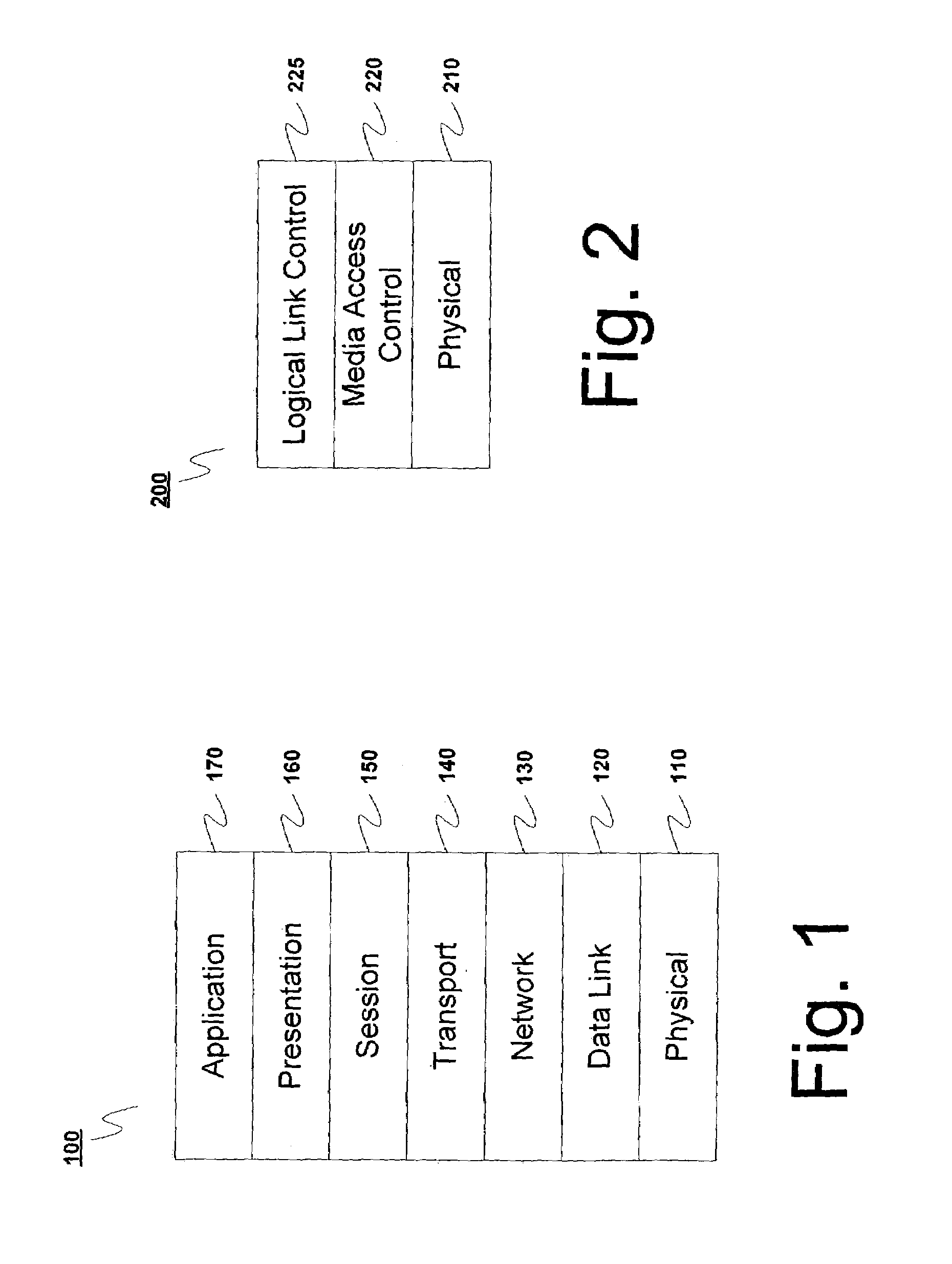
[0003] The International Standards Organization's (ISO) Open Systems Interconnection (OSI) standard provides a seven-layered hierarchy between an end user and a physical device through which different systems can communicate. Each layer is responsible for different tasks, and the OSI standard specifies the interaction between layers, as well as between devices complying with...

Examples

Embodiment Construction

[0046]Preferred embodiments of the present invention will now be described with reference to the drawings. Throughout the several views, like reference numerals designate identical or corresponding parts.

Superframes

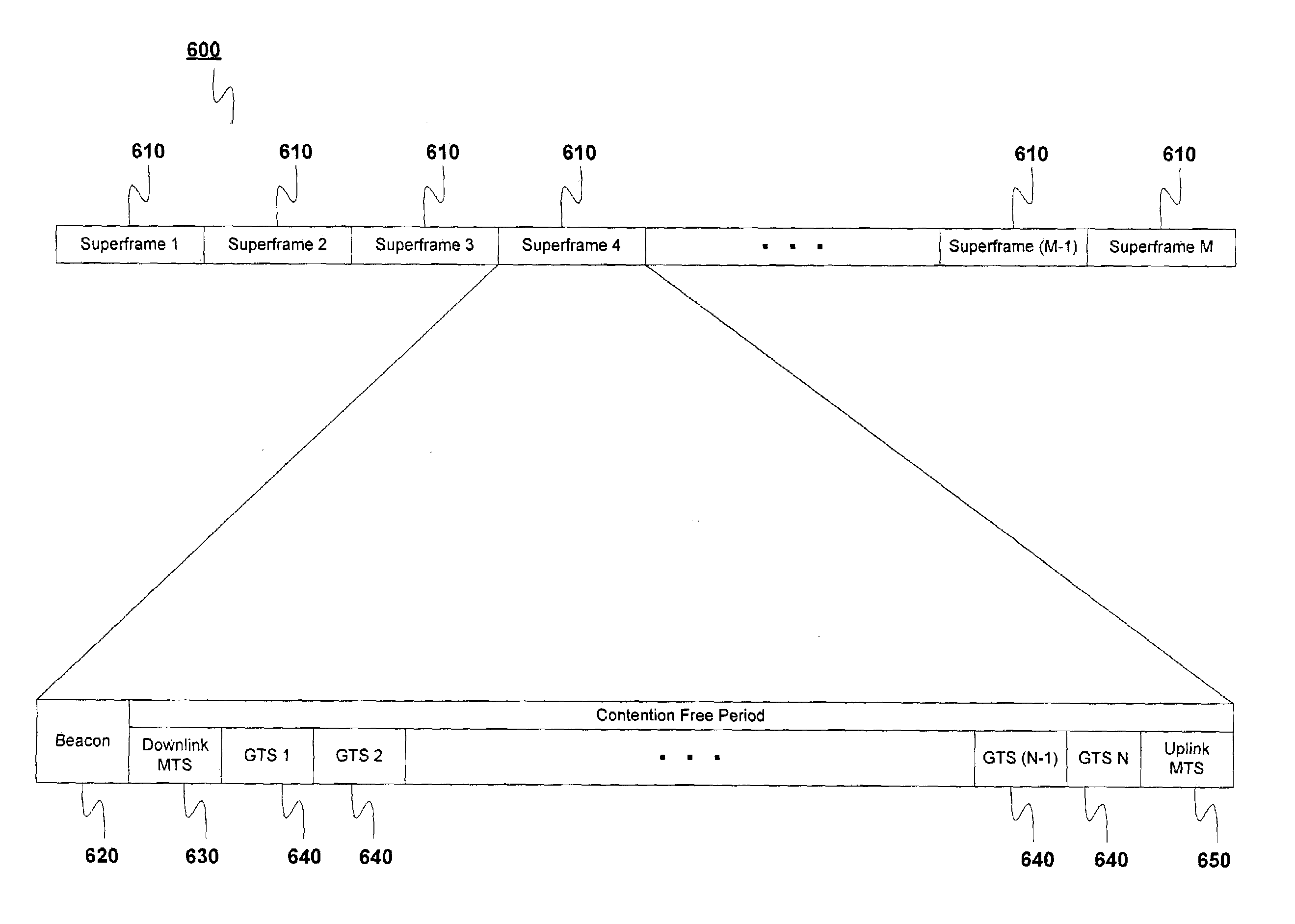
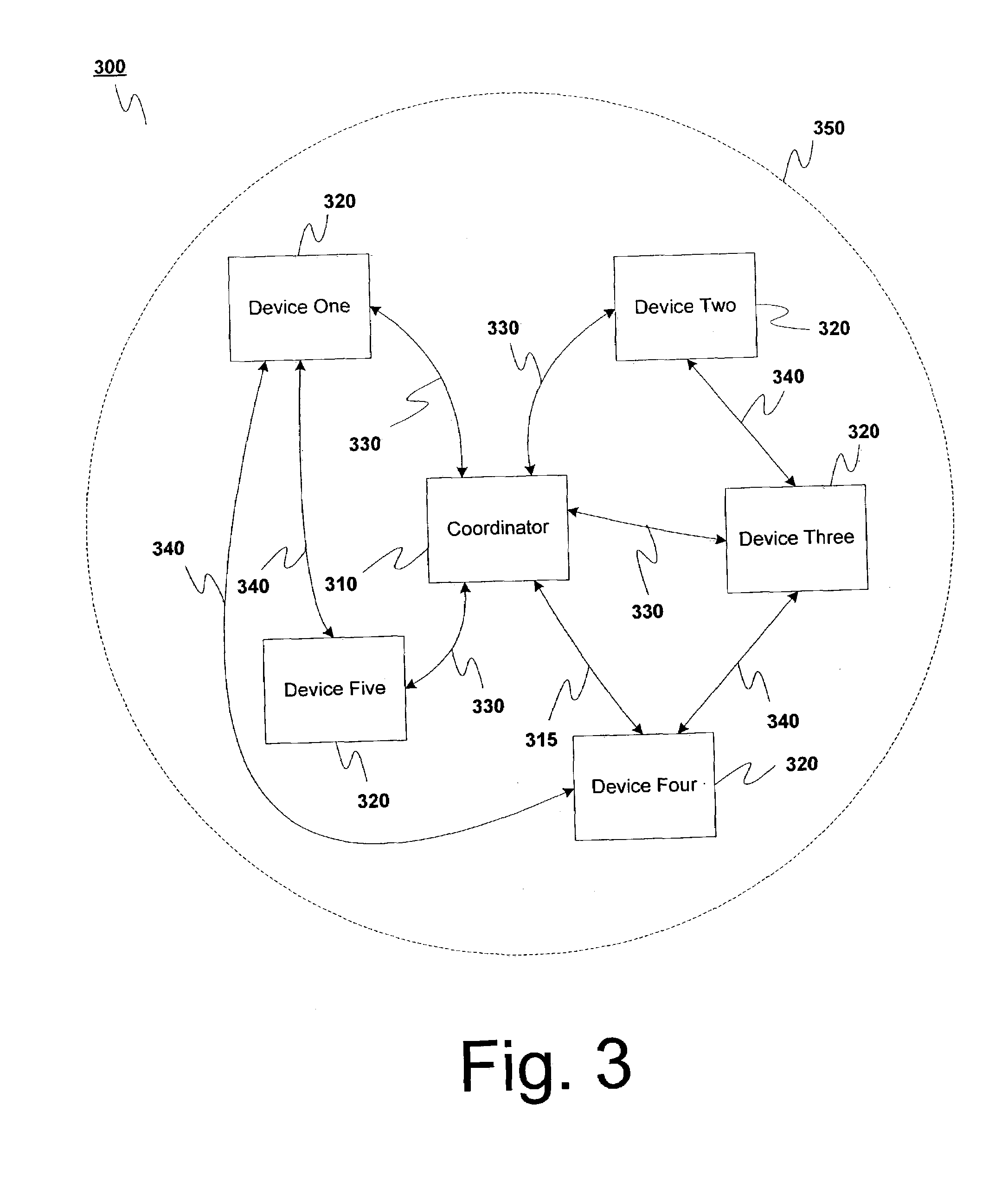
[0047]The available bandwidth in a given network 300 is split up in time by the coordinator 310 into a series of repeated superframes. These superframes define how the available transmission time is split up among various tasks. Individual frames of data are then transferred within these superframes in accordance with the timing set forth in the superframe.

[0048]FIG. 5 is a block diagram of a superframe according to preferred embodiments of the present invention. As shown in FIG. 5, each superframe 500 may include a beacon period 510, a contention access period (CAP) 520, and a contention free period (CFP) 530.

[0049]The beacon period 510 is set aside for the coordinator 310 to send a beacon frame out to the non-coordinator devices 320 in the network 300. Such a beacon fra...