

Wet electrophotographic image forming apparatus and method for controlling the same
a technology of electrophotographic image and forming apparatus, which is applied in the direction of electrographic process apparatus, instruments, optics, etc., can solve the problems of adding cost and complexity to the printing apparatus, insufficient circulation of developing solutions, and over-consumption of carriers, so as to minimize carrier consumption, increase density, and minimize the effect of carrier volum
- Summary
- Abstract
- Description
- Claims
- Application Information
AI Technical Summary
Benefits of technology
Problems solved by technology
Method used
Image

Examples
Embodiment Construction
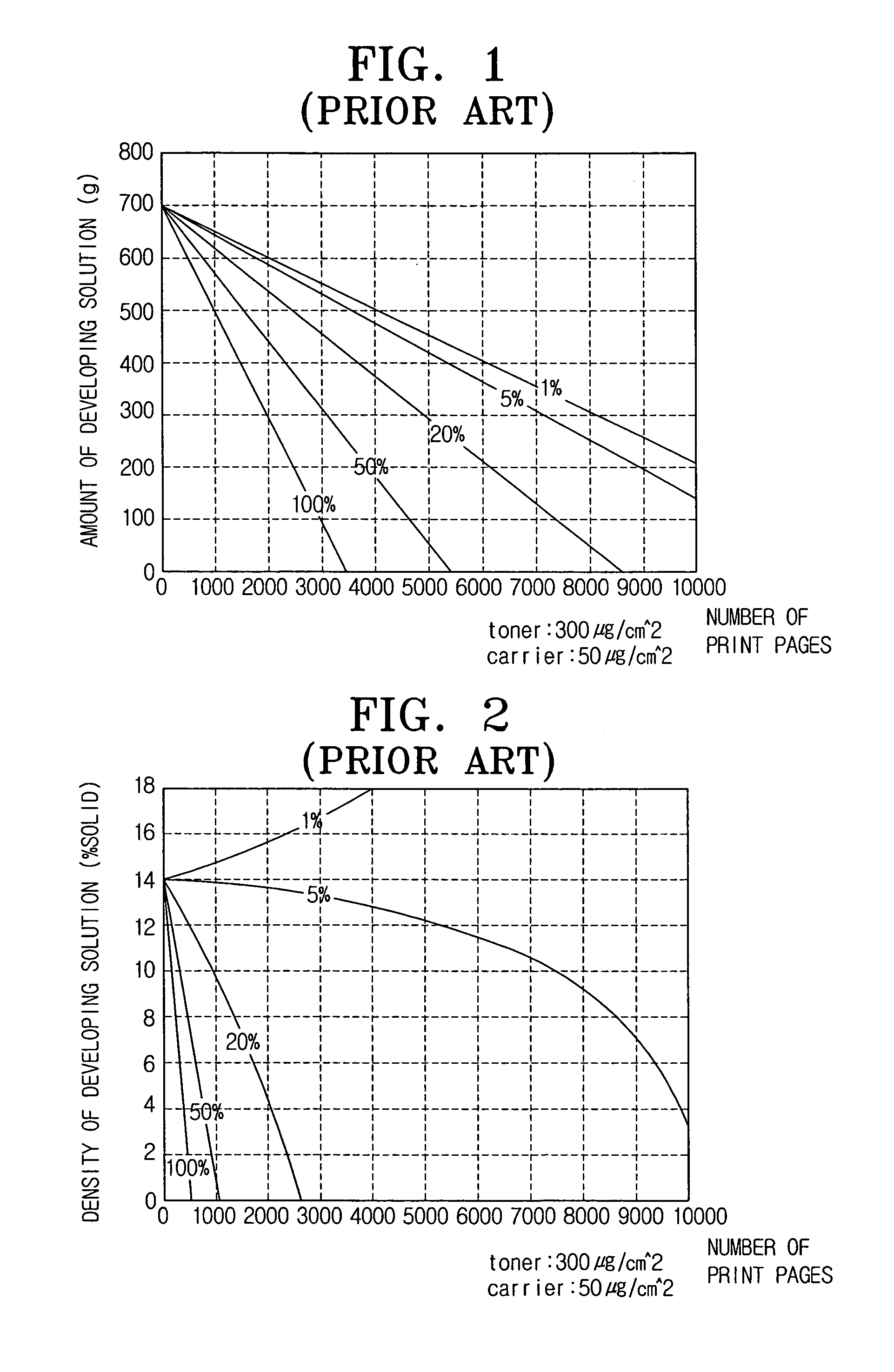
[0041]Hereinafter, exemplary embodiments of the present invention will be described in detail with reference to FIGS. 1-3, where phenomena of a carrier being consumed during the printing are studied through experiments in order to accomplish the objects of the present invention to minimize the consumption of the carrier during the printing.
[0042]FIG. 1 illustrates a relationship between the number of printed pages and consumption of the developing solution in relation to a print coverage per printed page. An experiment was made with developing solution of 700 grams with a density of 12% solid, and it was presumed that weights of toner and carrier consumed per unit area are respectively 300 μg / cm2 and 50 μg / cm2.
[0043]As shown in FIG. 1, the developing solution was decreased as the number of printed pages was increased. In the case where a print coverage per printed page (hereinafter referred to as ‘print coverage’) was 1%, approximately 200 grams of developing solution remained when ...
PUM
 Login to View More
 Abstract
Description
Claims
Application Information
 Login to View More