System and method for managing virtual user domains

a virtual user and domain technology, applied in the field of system and method for managing virtual user domains, can solve the problems of missing subscriber elements that cannot allow the paying subscriber to monitor, control, or manage the usage of his broadband connection, and achieve the effect of increasing the customization of services and enhancing ip

US7765583B2Active Publication Date: 2010-07-27MONARCH NETWORKING SOLUTIONS LLC
55 Cites 43 Cited by

Patent Information

Authority / Receiving Office
US · United States
Patent Type
Patents(United States)
Current Assignee / Owner
Publication Date
2010-07-27

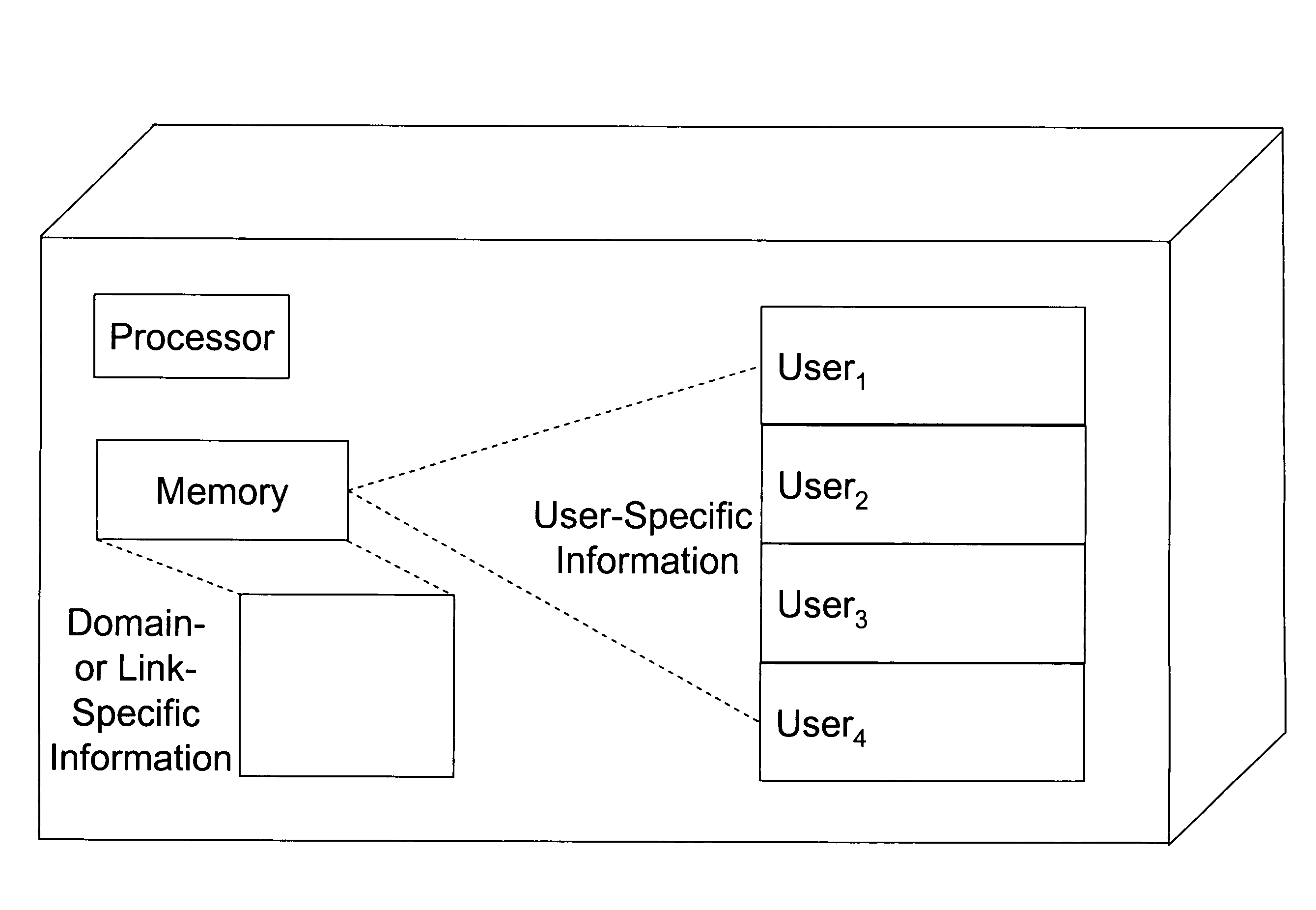
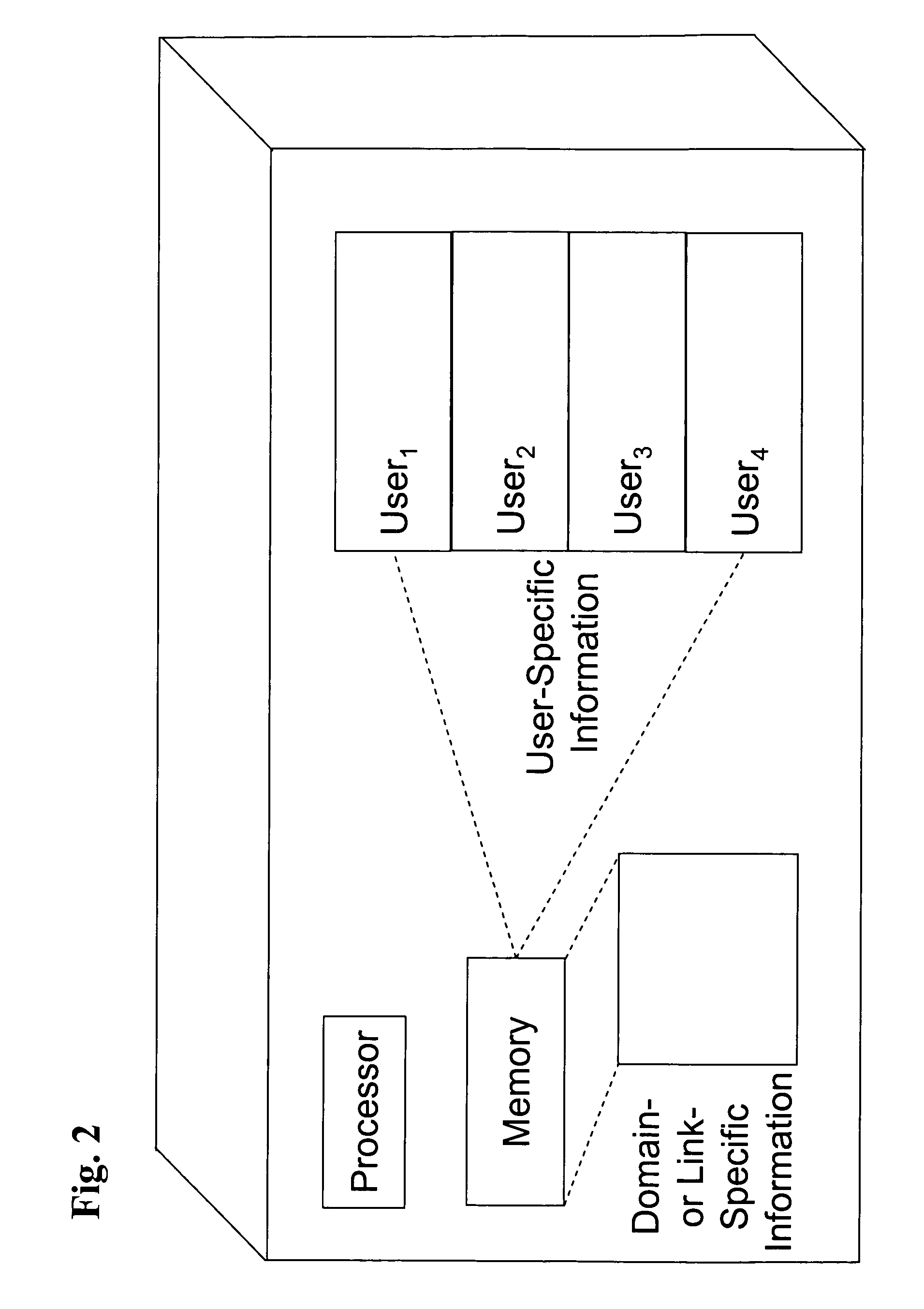
Smart Images

  • Figure 1
    Figure 1
  • Figure 2
    Figure 2
  • Figure 3
    Figure 3
Patent Text Reader

Abstract

The present invention addresses the previous of lack of subscriber identity tracking and management for residential broadband lines and provides customized access and enhanced IP services for a subscriber's household members (virtual user domain) and his / her circle of extended families, relatives, and friends (multiple virtual user domains). Rather than treating a broadband link as a single connection with a single set of services and quality constraints, the present invention enables the subscriber to create multiple user profiles per broadband link; tailor activities such as web services to a specific user and group profile; provide restricted access to minors (e.g. allow only age appropriate content to be viewed); and facilitate connection at multiple access points on a carrier's edge network.
Need to check novelty before this filing date? Find Prior Art

Description

BACKGROUND OF THE INVENTION

[0001] 1. Field of the Invention

[0002] The present invention is directed to a method and system for managing configurable services provided to a group of users, and in one embodiment to a method and system for managing user-centric services in a virtual user domain.

[0003] 2. Discussion of the Background

[0004] Currently, residential users login in to a network (e.g., a telephone-, cable- or DSL-based network) of a carrier or service provider by creating an active session (e.g., a DSL pppoa or pppoe session). Often, because of the underlying technology (e.g., DSL and ATM), the residential connection requires neither a login name nor password. The circuit is simply provisioned at the central office without requiring much set up at the customer premise. The customer premise equipment, usually a standalone DSL or cable modem, is either preconfigured or requires minimum configuration and plugs into a provisioned RJ-11 line (WAN interface) or coaxial cable connection...

Examples

Embodiment Construction

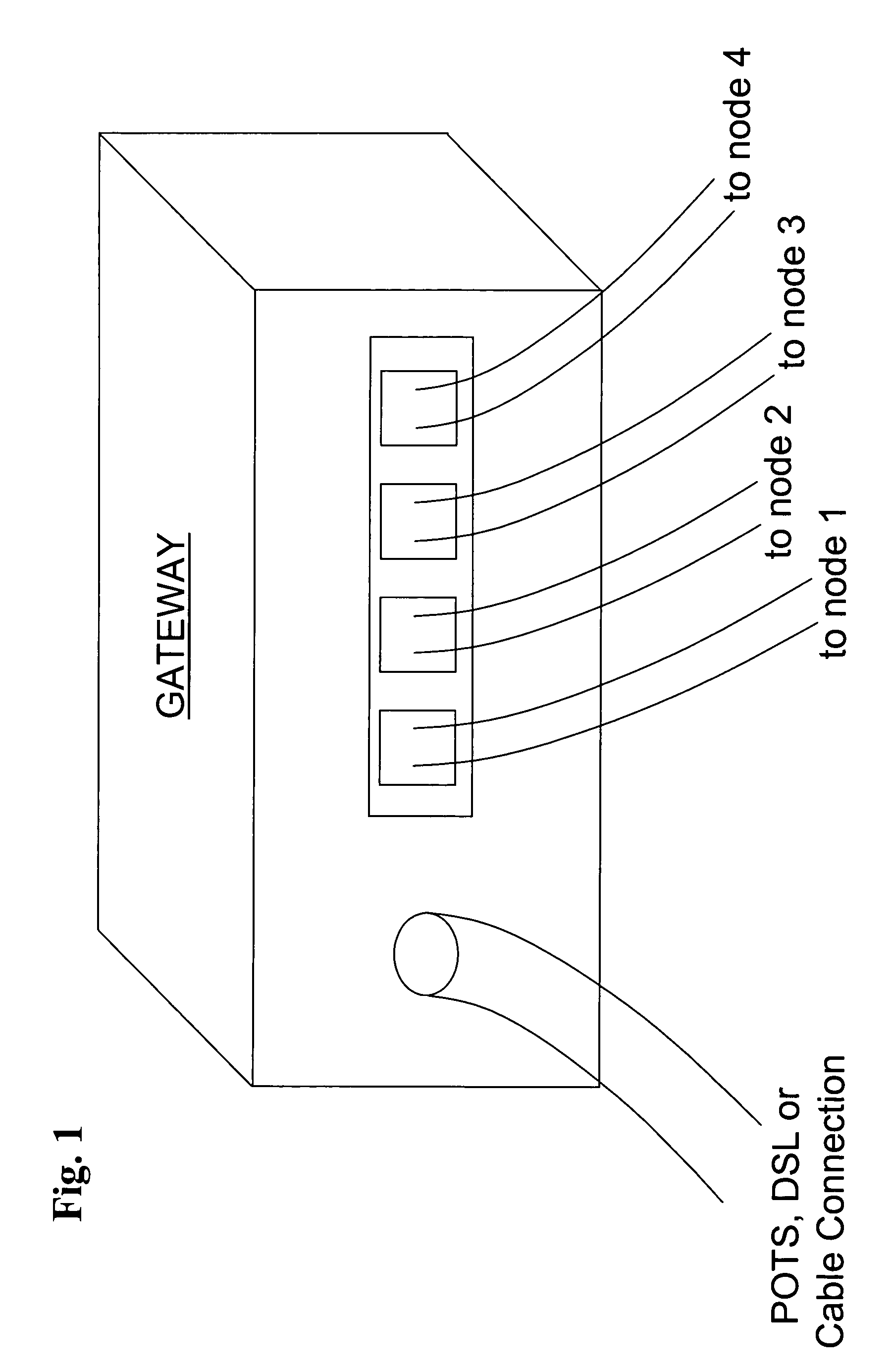
[0014]Turning now to a description of exemplary embodiments and features of the present invention, FIG. 1 is an illustration of an exemplary residential gateway for performing translation and domain services according to the present invention. The gateway includes an outgoing data link that can be in the form of (1) a physical connection to the outside world (e.g., a coaxial cable, a DSL line or a standard telephone line) or (2) a data communications link (e.g., an Ethernet or USB link) that connects the gateway to a modem that is in turn connected to a physical connection to the outside world (e.g., a coaxial cable, a DSL line or a standard telephone line). The outgoing data link is typically, but not always, a broadband link to the external world.

[0015]The gateway also includes at least one incoming link that connects the gateway to various nodes internal to the network. Such incoming links are generally in the form of a wired connection (e.g., such as an Ethernet link) or a wirel...