
Optical layered body, polarizer and image display device
a polarizer and optical layer technology, applied in the direction of polarising elements, instruments, synthetic resin layered products, etc., can solve the problems of low refractive index, insufficient anti-reflection properties of low-refractive-index layers including hollow-silica fine particles, and insufficient refractive-index, etc., to achieve excellent anti-reflection properties, low refractive-index, and excellent hardness and surface evenness
- Summary
- Abstract
- Description
- Claims
- Application Information
AI Technical Summary
Benefits of technology
Problems solved by technology
Method used
Image

Examples
preparation example 1
[0259]The components shown below were mixed to prepare a composition for a low refractive index layer (1).
Hollow treated silica fine particles (solid content: 20% by mass; solution: methyl isobutyl ketone, average particle size: 50 nm)
[0260]73 parts by mass
Fluorine atom-containing polymer (produced by JSR Corp.; Opster JN35, refractive index: 1.41, weight-average molecular weight: 30,000)
[0261]1 part by mass based on the solid content
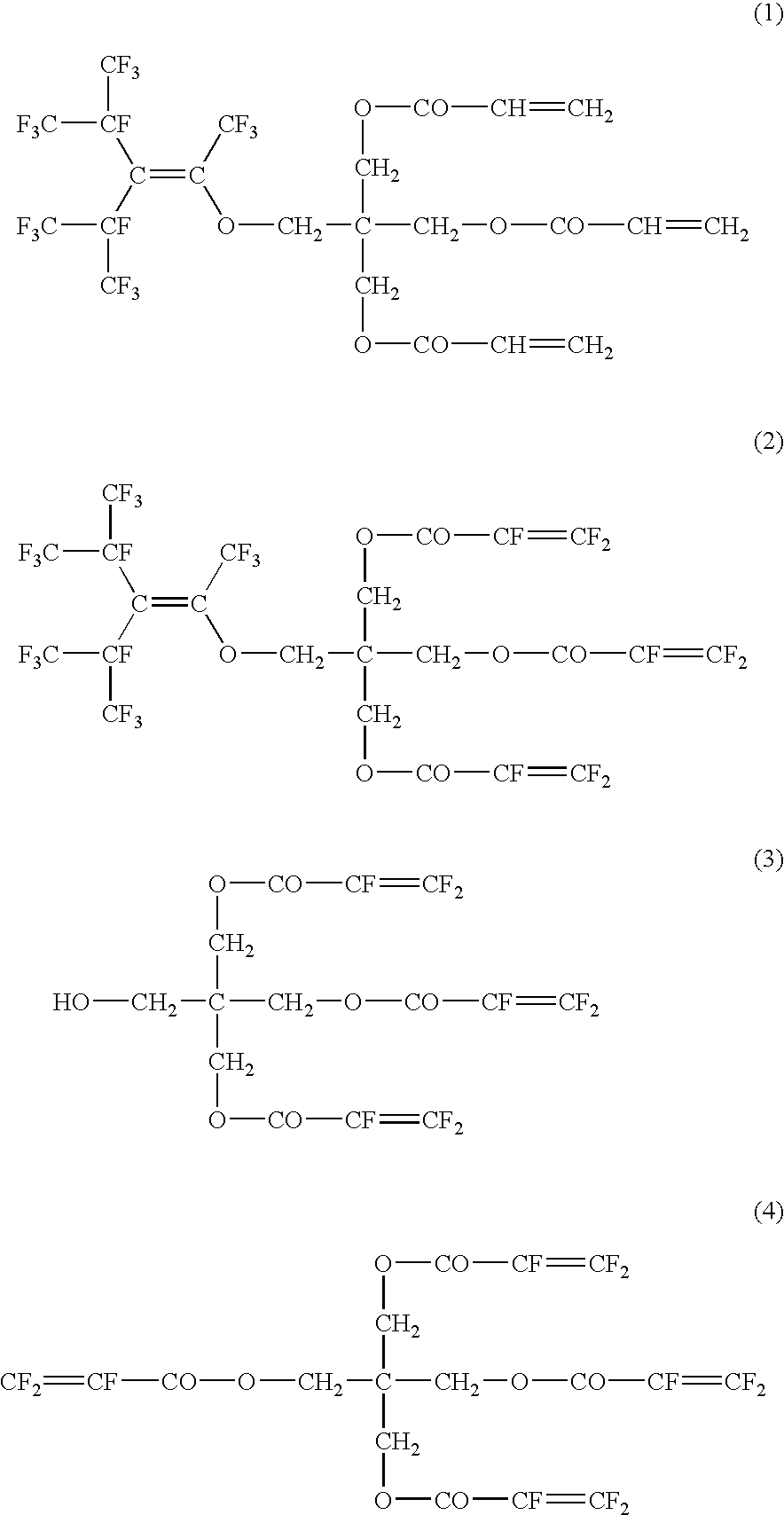
Fluorine atom-containing monomer (produced by Kyoeisha Chemical Co., Ltd.; LINC3A, refractive index: 1.42)
[0262]7 parts by mass
Pentaerythritol triacrylate (PETA)
[0263]2 parts by mass
Polymerization initiator (Irgacure 127; produced by Ciba Specialty Chemicals Inc.)
[0264]0.35 parts by mass
Modified silicone oil (X22164E; produced by Shin-Etsu Chemical Co., Ltd.)
[0265]0.5 parts by mass
Modified silicone oil (FM7711; produced by Chisso Corporation)
[0266]0.5 parts by mass
MIBK
[0267]320 parts by mass
PGMEA
[0268]161 parts by mass
[0269]It is to be noted that “LINC3...
preparation example 2
[0271]The components shown below were mixed to prepare a composition for a low refractive index layer (2).
Hollow treated silica fine particles (solid content: 20% by mass; solution: methyl isobutyl ketone, average particle size: 50 nm)
[0272]73 parts by mass
Fluorine atom-containing polymer (produced by JSR Corp.; Opster JN35, refractive index: 1.41, weight-average molecular weight: 30,000)
[0273]6 parts by mass based on the solid content
Fluorine atom-containing monomer (produced by Kyoeisha Chemical Co., Ltd.; LINC3A, refractive index: 1.42)
[0274]3 parts by mass
Pentaerythritol triacrylate (PETA)
[0275]1 part by mass
Polymerization initiator (Irgacure 127; produced by Ciba Specialty Chemicals Inc.)
[0276]0.35 parts by mass
Modified silicone oil (X22164E; produced by Shin-Etsu Chemical Co., Ltd.)
[0277]0.5 parts by mass
Modified silicone oil (FM7711; produced by Chisso Corporation)
[0278]0.5 parts by mass
MIBK
[0279]320 parts by mass
PGMEA
[0280]161 parts by mass
preparation example 3
[0281]The components shown below were mixed to prepare a composition for a low refractive index layer (3).
Hollow treated silica fine particles (solid content: 20% by mass; solution: methyl isobutyl ketone, average particle size: 50 nm)
[0282]73 parts by mass
Fluorine atom-containing polymer (produced by JSR Corp.; Opster JN35, refractive index: 1.41, weight-average molecular weight: 30,000)
[0283]7 parts by mass based on the solid content
Fluorine atom-containing monomer (produced by Kyoeisha Chemical Co., Ltd.; LINC3A, refractive index: 1.42)
[0284]1 part by mass
Pentaerythritol triacrylate (PETA)
[0285]2 parts by mass
Polymerization initiator (Irgacure 127; produced by Ciba Specialty Chemicals Inc.)
[0286]0.35 parts by mass
Modified silicone oil (X22164E; produced by Shin-Etsu Chemical Co., Ltd.)
[0287]0.5 parts by mass
Modified silicone oil (FM7711; produced by Chisso Corporation)
[0288]0.5 parts by mass
MIBK
[0289]320 parts by mass
PGMEA
[0290]161 parts by mass
PUM
| Property | Measurement | Unit |
|---|---|---|
| refractive index | aaaaa | aaaaa |
| refractive index | aaaaa | aaaaa |
| refractive index | aaaaa | aaaaa |
Abstract
Description
Claims
Application Information
 Login to View More