
Aqueous ink for producing high-temperature electrochemical cell electrodes
a technology of electrochemical cell and ink, which is applied in the direction of organic conductors, metal/alloy conductors, conductive materials, etc., can solve the problems of non-negligible disadvantages and emission of irritant vapors, and achieve the effect of simplifying its preparation, its use, and its us
- Summary
- Abstract
- Description
- Claims
- Application Information
AI Technical Summary
Benefits of technology
Problems solved by technology
Method used
Image

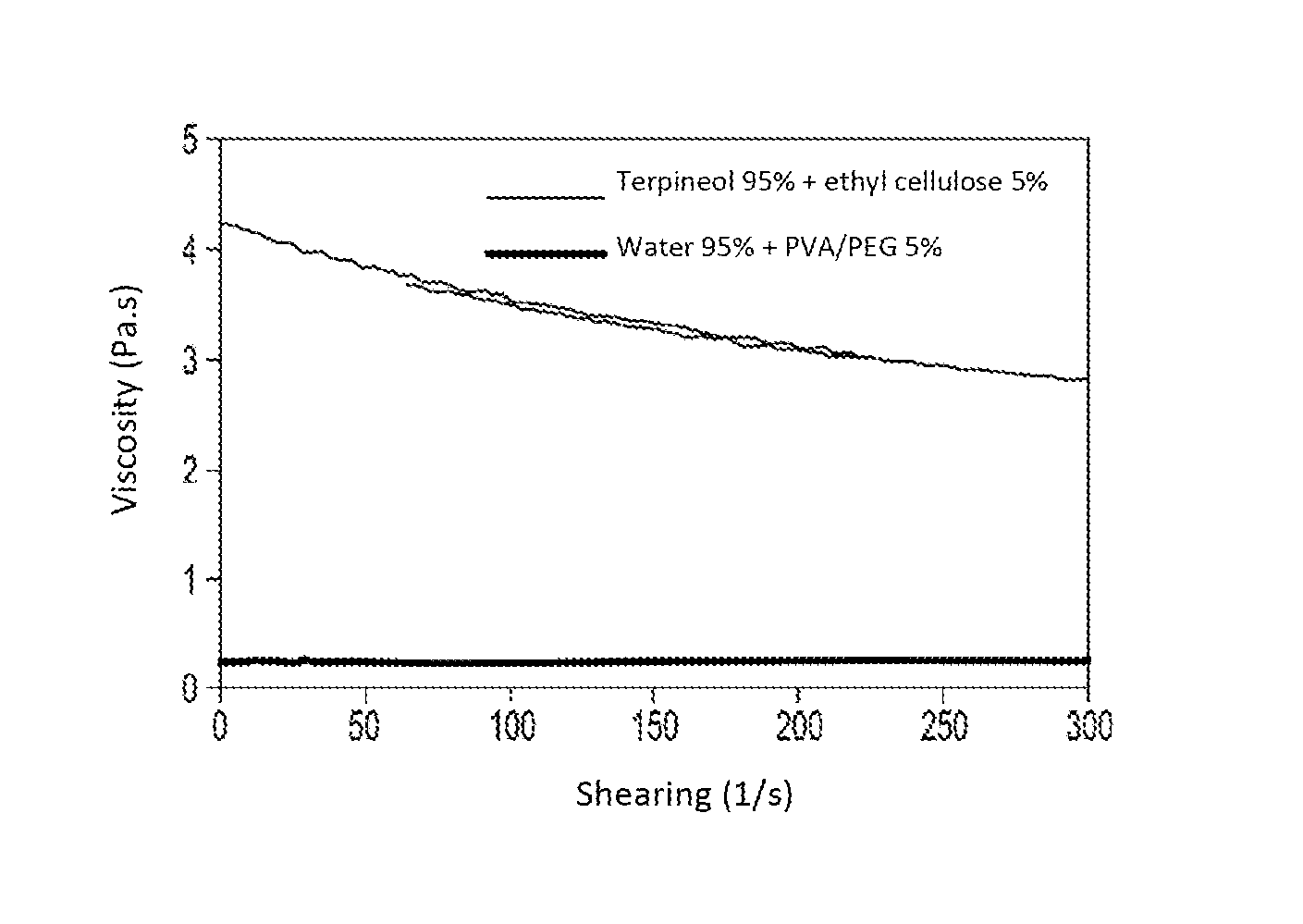
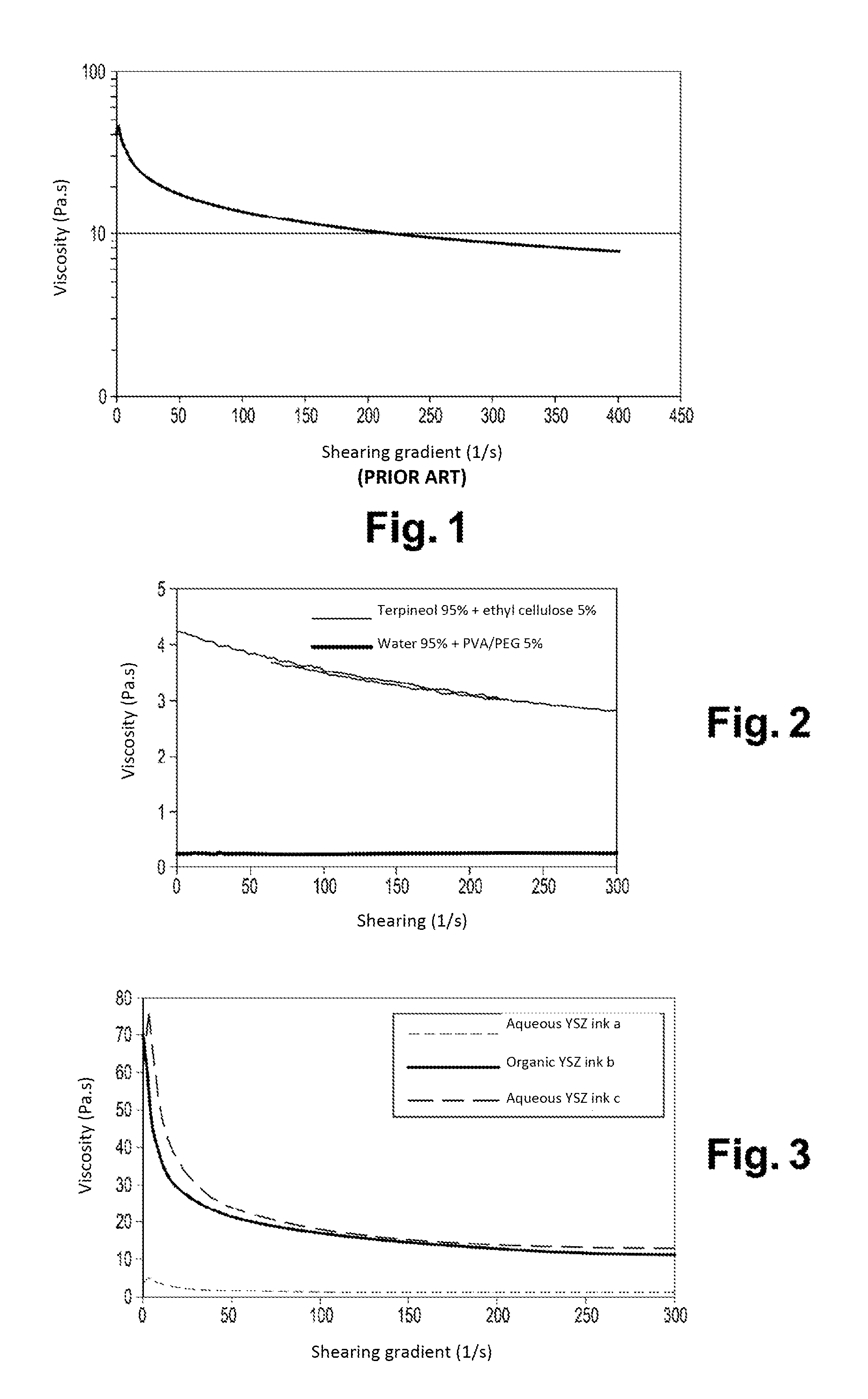
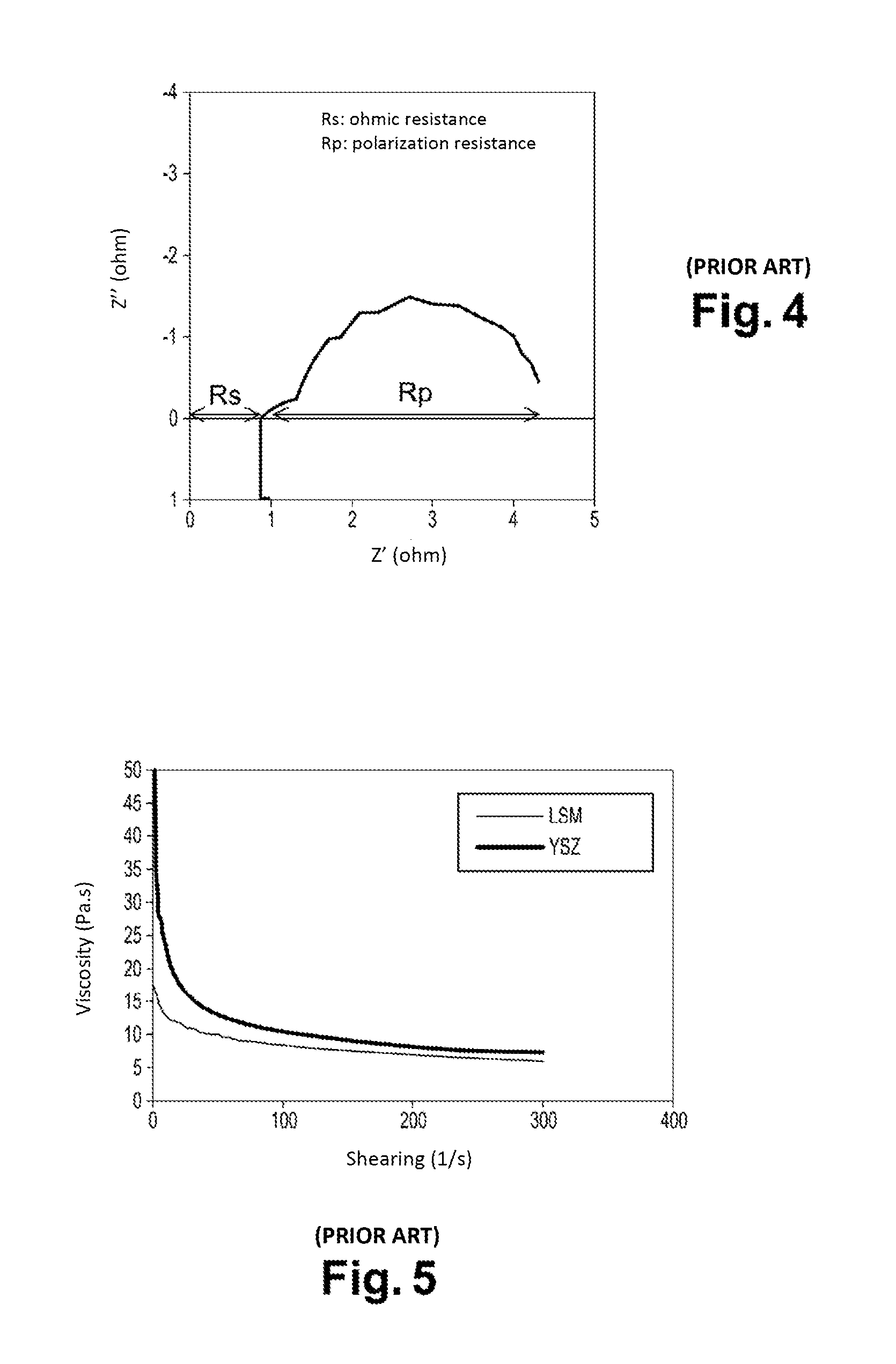
Examples
example 1
Composite Air Electrode Containing LSM / YSZ
[0090]a) Organic Inks (Prior Art):
[0091]A so-called symmetrical cell is prepared by means of two organic inks having a composition according to table 3.
[0092]
TABLE 3Composition of organic inks containing LSM (prior art)% vol.% vol.mineral% vol.ethylViscosity (i)Ink referencefillerterpineolcellulose(Pa · s)LSM / YSZ19.3%77.4%3.3%850 / 50% pdsLSM19.3%77.4%3.3%6.5(i) Viscosity measured at the printing shearing (250 s−1) (FIG. 5)
[0093]The shearing during the screen printing can be calculated from the screen characteristics, that is, the thread diameter (e) and the distance between threads (d) as well as from certain parameters of the machine (printing scraper advancing speed (v)) according to the following formula:
Shearing (s−1)=2*e*v / d2
[0094]The ink containing LSM / YSZ is deposited symmetrically (2 faces) on a dense YSZ electrolyte with a 30-micrometer thickness per screen printing to obtain the functional layer of the electrode.
[0095]The ink conta...
example 2
Composite Hydrogen Electrode Containing NiO / YSZ
[0104]a) Organic Inks (Prior Art):
[0105]A so-called symmetrical cell is prepared by means of three organic inks having a composition according to table 5.
[0106]
TABLE 5Composition of organic inks containing YSZ and NiO (prior art)% vol.% vol.mineral% vol.ethylViscosity (i)Ink referencefillerterpineolcellulose(Pa · s)YSZ 20%76.7%3.3%12.5YSZ / NiO19.0%77.7%3.3%8.550 / 50% weightNiO19.3%77.4%3.3%7(i) Viscosity measured at the printing shearing (250 s−1) (FIG. 11)
[0107]The ink containing YSZ is deposited symmetrically (2 faces) on a dense YSZ electrolyte with a 5-micrometer thickness by screen printing to obtain the electrode bonding layer necessary to have a fine bonding between the functional layer and the electrolyte.
[0108]The functional layer based on a YSZ / NiO mixture (50 / 50% by weight) is deposited in the same way on the bonding layers with a 20-micrometer thickness, after which the 10-micrometer collector layer containing NiO is added.
[01...
PUM
| Property | Measurement | Unit |
|---|---|---|
| diameter | aaaaa | aaaaa |
| diameter | aaaaa | aaaaa |
| diameter | aaaaa | aaaaa |
Abstract
Description
Claims
Application Information
 Login to View More