Method of removing blocking artifacts in a coding system of a moving picture

a technology of coding system and moving picture, applied in the field of coding data, can solve the problems of large calculation amount, difficult to effectively remove blocking artifacts, and disturbing the eyes of human beings

Inactive Publication Date: 2011-09-13
VIDEO ENHANCEMENT SOLUTIONS
View PDF103 Cites 0 Cited by
  • Summary
  • Abstract
  • Description
  • Claims
  • Application Information

AI Technical Summary

Benefits of technology

Effectively removes blocking artifacts in real-time without increasing bit transmission, improving image quality in both complex and smooth regions while maintaining efficient processing.

Problems solved by technology

However, the individual process causes blocking artifacts that disturb the eyes of human beings at boundaries between blocks.
However, it is difficult to effectively remove the blocking artifacts with the above with a small operation capacity in a real time operation.
In other words, to completely remove the blocking artifacts, a large calculation amount is needed, which is undesirable in efficiency.
However, this method is applied only to a still picture because of an iteration structure and long convergence time.
Thus, the related art methods for removing blocking artifacts in a coding system of a moving picture have several problems.
First, in performing an algorithm for removing the blocking artifacts, a calculation is complicated and the calculation amount and time become correspondingly large.

Method used

the structure of the environmentally friendly knitted fabric provided by the present invention; figure 2 Flow chart of the yarn wrapping machine for environmentally friendly knitted fabrics and storage devices; image 3 Is the parameter map of the yarn covering machine
View more

Image

Smart Image Click on the blue labels to locate them in the text.
Viewing Examples
Smart Image
  • Method of removing blocking artifacts in a coding system of a moving picture
  • Method of removing blocking artifacts in a coding system of a moving picture
  • Method of removing blocking artifacts in a coding system of a moving picture

Examples

Experimental program
Comparison scheme
Effect test

Embodiment Construction

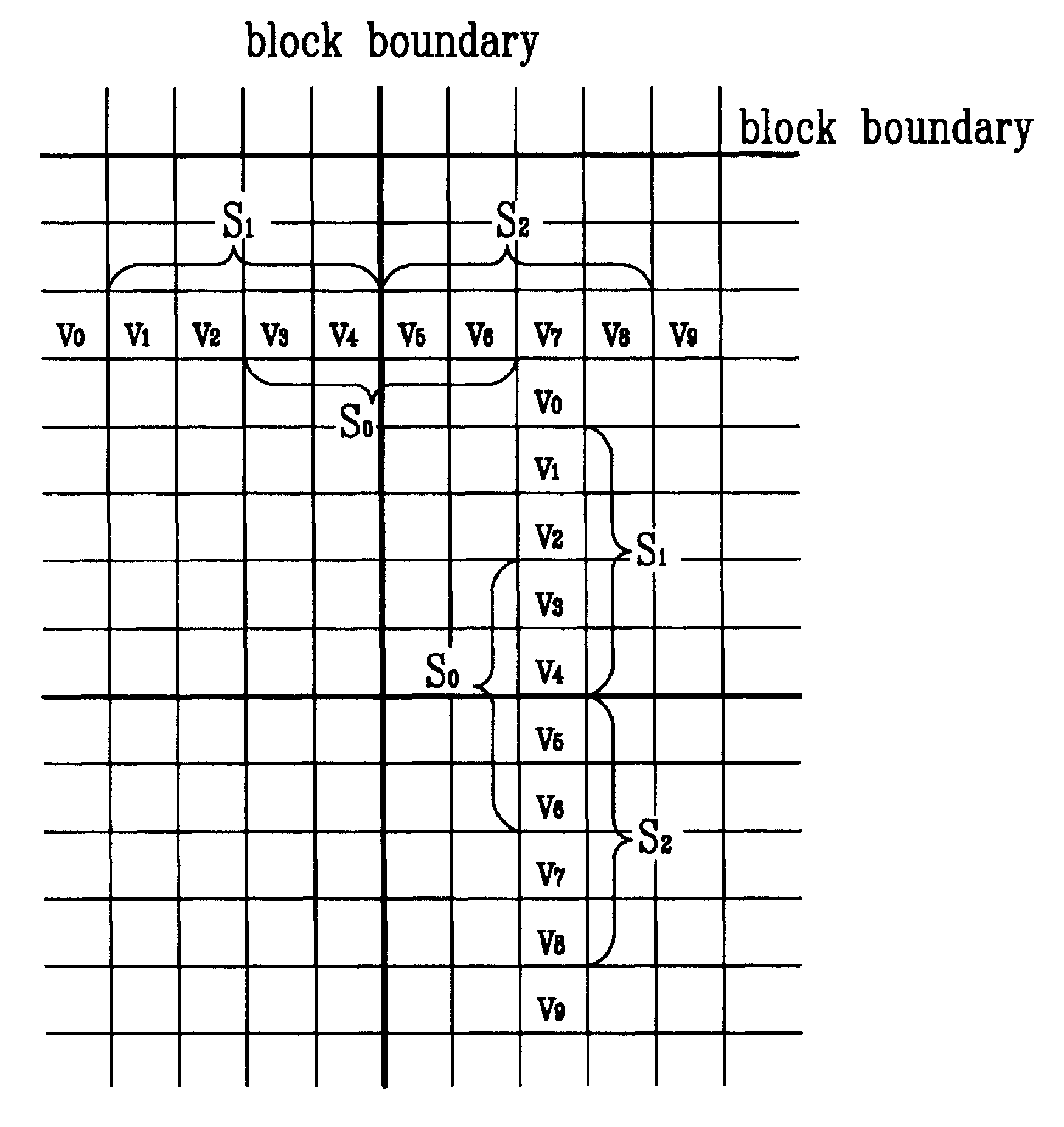
[0037]In a preferred embodiment of the present invention, blocking artifacts at a block boundary are removed in a frequency domain not a spatial domain. Frequency features around the block boundary are preferably obtained using a 4-point DCT kernel, which can be easily calculated. Thus, a complex region at the block boundary can effectively be processed by extending the smoothness of a picture from the frequency domain to the spatial domain.

[0038]Using the 4-point DCT kernel has advantages that frequency analysis is possible and deblocking can easily be processed. Therefore, the 4-point DCT Kernel can efficiently remove the blocking artifacts of a real time moving picture.

[0039]The blocking artifacts appear at the block boundary between fixed block patterns in the form of a line of discontinuity. Accordingly, removal of the blocking artifacts involves transformation of the discontinuity of the block boundary region to continuity.

[0040]FIG. 2 shows a block boundary region in a horizo...

the structure of the environmentally friendly knitted fabric provided by the present invention; figure 2 Flow chart of the yarn wrapping machine for environmentally friendly knitted fabrics and storage devices; image 3 Is the parameter map of the yarn covering machine
Login to View More

PUM

No PUM Login to View More

Abstract

A method of coding a moving picture reduces blocking artifacts. The method includes defining pixel sets S0, S1, S2 around a block boundary, selectively determining a deblocking mode as a default mode or a DC offset mode depending on the degree of blocking artifacts. If the default mode is selected, frequency information is obtained around the block boundary per pixel using a 4-point DCT kernel, for example, a magnitude of a discontinuous component belonging to the block boundary is replaced with a minimum magnitude of discontinuous components belonging to the surroundings of the block boundary in the frequency domain and the replacing step is applied to the spatial domain. If the DC offset mode is selected and a determination is made to perform DC offset mode, the blocking artifacts in a smooth region are removed in the DC offset mode.

Description

[0001]Notice: More than one reissue application has been filed for the reissue of U.S. Pat. No. 6,240,135. The reissue applications are application Ser. Nos. 11 / 834,312; 11 / 834,347; 11 / 851,551; 11 / 851,529 (the present application); and application Ser. No. 11 / 851,517, all of which are divisional reissues of U.S. Pat. No. 6,240,135.BACKGROUND OF THE INVENTION[0002]1. Field of the Invention[0003]The present invention relates to a method of coding data, and more particularly, to a method of removing blocking artifacts when coding image signals such as in a moving picture at low-bit-rate.[0004]2. Background of the Related Art[0005]Generally, to efficiently compress a time variable video sequence, it is necessary to remove redundancy in the temporal domain as well as in the two-dimensional spatial domain. In moving picture experts group (MPEG), discrete cosine transform (DCT) is used to remove the redundancy in the two-dimensional spatial domain while a motion compensation method is used...

Claims

the structure of the environmentally friendly knitted fabric provided by the present invention; figure 2 Flow chart of the yarn wrapping machine for environmentally friendly knitted fabrics and storage devices; image 3 Is the parameter map of the yarn covering machine
Login to View More

Application Information

Patent Timeline
no application Login to View More
Patent Type & AuthorityPatents(United States)
IPC IPC(8): H04B1/66G06K9/40H04N7/24G06T9/00H04N1/41H04N19/102H04N19/167H04N19/176H04N19/189H04N19/196H04N19/44H04N19/51H04N19/60H04N19/625H04N19/80H04N19/86
CPCH04N19/134H04N19/117H04N19/14H04N19/182H04N19/48H04N19/80H04N19/86
InventorKIM, HYUN MUNRA, JONG BEOMKIM, SUNG DEUKLEE, YOUNG SU
OwnerVIDEO ENHANCEMENT SOLUTIONS