
Heat resistant beta-amylase-trehalose synthase fusion enzyme, expression gene of heat resistant beta-amylase-trehalose synthase fusion enzyme, engineering bacterium secreting fusion enzyme, and application
A trehalose synthase and gene expression technology, applied in the field of genetic engineering, can solve the problem of high production cost, achieve the effects of fast reaction speed, simplified production process and reduced production cost
Patent Information
- Authority / Receiving Office
- CN · China
- Patent Type
- Applications(China)
- Current Assignee / Owner
- Publication Date
- 2017-10-17
- Estimated Expiration
- Not applicable · inactive patent
Smart Images
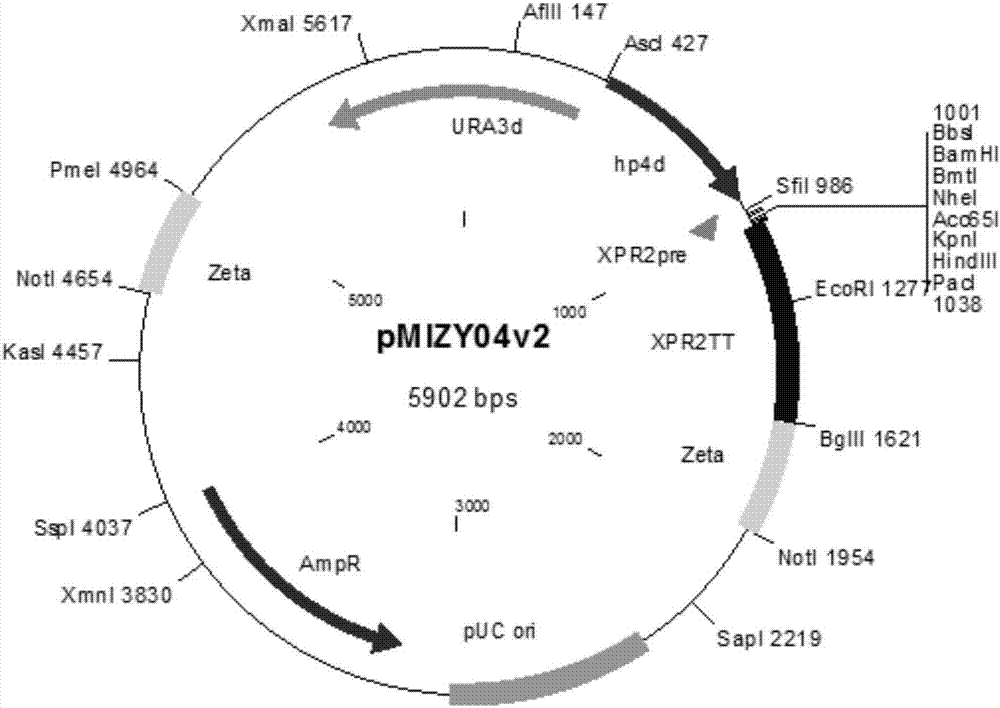
Figure 1 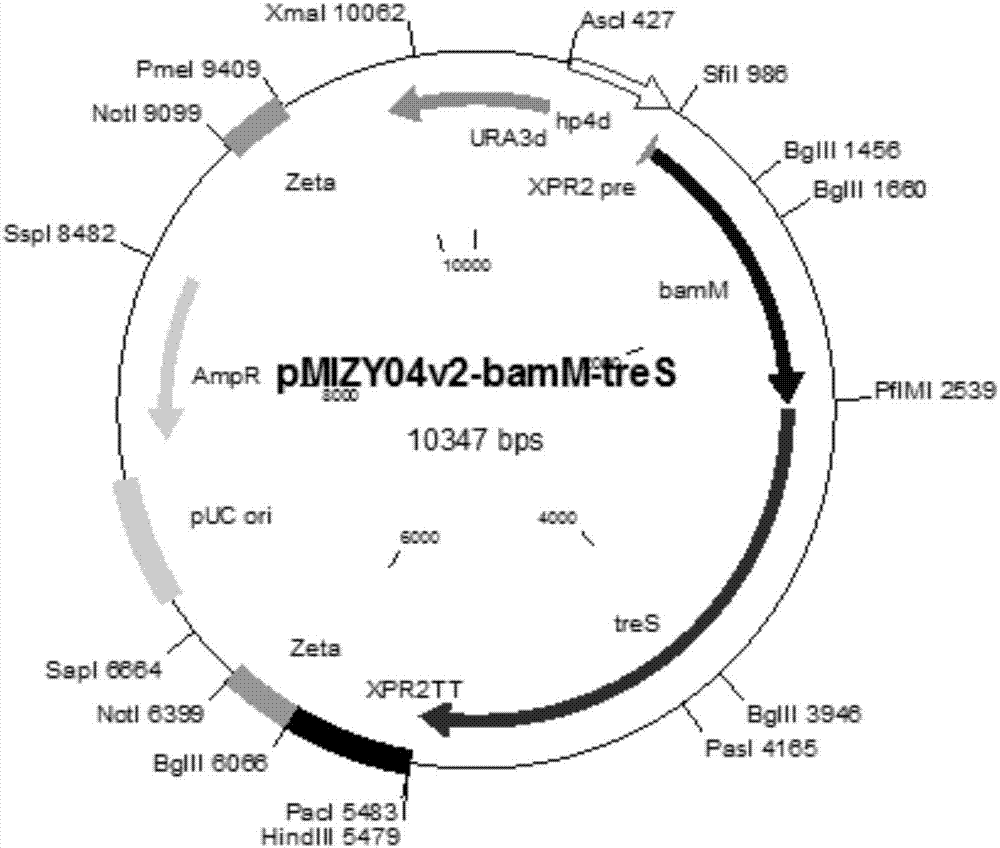
Figure 2 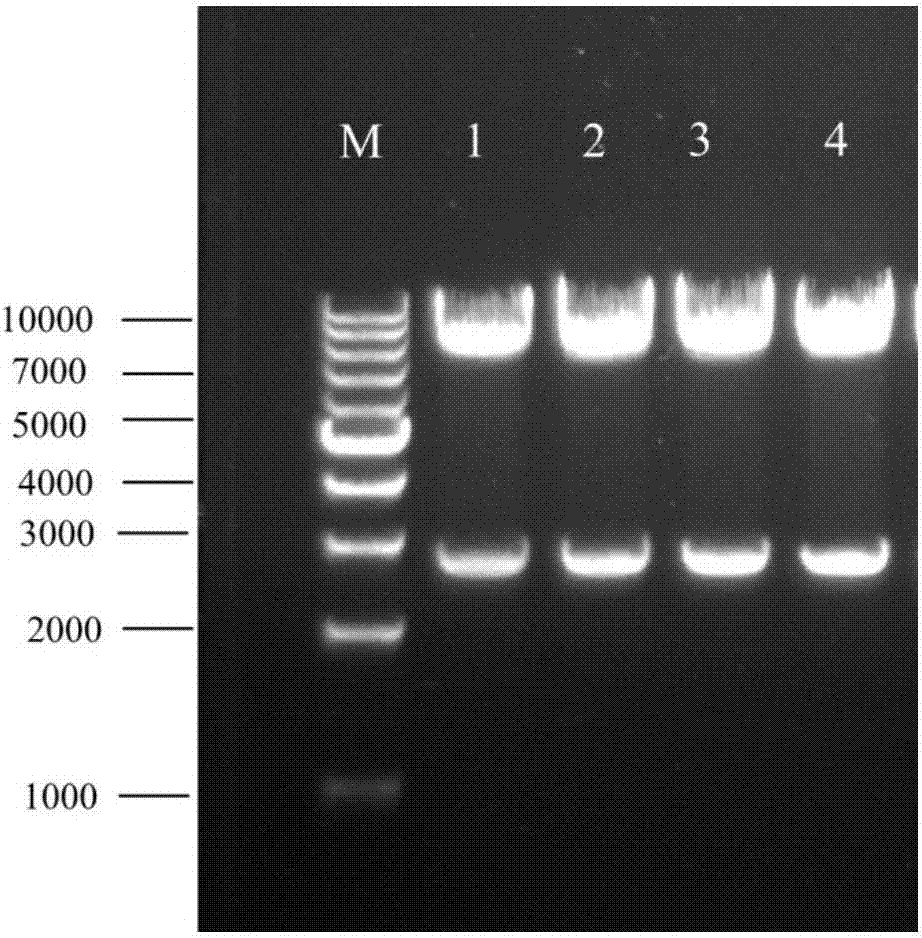
Figure 3
Abstract
Description
technical field
[0001] The invention relates to a heat-resistant β-amylase-trehalose synthase fusion enzyme, an expression gene thereof, an engineering bacterium that secretes the fusion enzyme and its application, and belongs to the technical field of genetic engineering. Background technique
[0002] Trehalose (trehalose) is also known as glucosylose, mushroom sugar, etc., and its chemical name is α-D-glucopyranosyl α-D-glucopyranoside. It is composed of 2 glucose molecules through α,α-1,1- A natural non-reducing disaccharide composed of glycosidic bonds, the molecular formula is C 12 h 22 o 11 2H 2 O, molecular weight 378.33. Trehalose is widely found in many edible animals, plants and microorganisms in nature, such as mushrooms, seaweed, beans, shrimp, bread, beer and yeast fermented foods have a high content of trehalose. Trehalose has non-specific protective effects on a variety of organisms. Scientists have discovered that trehalose has created a variety of mira...
Examples
Embodiment 1
[0045] Thermostable β-amylase-trehalose synthase recombinant plasmid construction, the steps are as follows:
[0046] Design the nucleotide sequence shown in SEQ ID No.2 (encoding the amino acid sequence shown in SEQ ID No.1), synthesized by a third-party company and cloned into the pUC57-simple vector to obtain the pUC57S-bamM-treS plasmid, After being digested by BbsI / HindIII restriction endonuclease, the target fragment was recovered and connected to the corresponding site of the pMIZY04v2 expression vector digested by BbsI / HindIII restriction endonuclease, and the obtained recombinant plasmid was as follows: figure 2 shown.
[0047] The amino acid sequence shown in SEQ ID No.1 is as follows:
[0048] SIAPNFKVFVMGPLEKVTDFNAFKDQLITLKNNGVYGITTDIWWGYVENAGENQFDWSYYKTYADTVRAAGLKWVPIMSTHACGGNVGDTVNIPIPSWVWTKDTQDNMQYKDEAGNWDNEAVSPWYSGLTQLYNEFYSSFASNFSSYKDIITKIYISGGPSGELRYPSYNPSHGWTYPGRGSLQCYSKAAITSFQNAMKSKYGTIAAVNSAWGTSLTDFSQISPPTDGDNFFTNGYKTTYGNDFLTWYQSVLTNELANIASVAHSCFDPVFNVPI...
Embodiment 2
[0070] Obtaining of recombinant strains, the steps are as follows:
[0071] (1) Preparation of recombinant fragments The pMIZY04v2-bamM-treS recombinant vector was digested with NotI restriction endonuclease, detected by agarose gel electrophoresis, and the large fragment was recovered for future use. After digestion of pMIZY04v2-bamM-treS, two fragments are expected to appear, the sizes of which are 7.6kb and 2.7kb respectively. Recombinant vector NotI digestion and electrophoresis results are as follows: image 3 As shown, the two fragments are consistent with expectations.
[0072] (2) Yeast Competent Cell Preparation Inoculate the Yarrowia lipolytica PO1h strain on YPD solid medium and culture overnight at 28°C; pick a single colony and inoculate it in 5.0mL liquid YPD medium, and culture overnight at 28°C with shaking ; at a final concentration of 5.0×10 6 Cells / mL were inoculated in 50.0mL liquid YPD medium, cultured at 28°C with shaking at 200rpm for 4h;) at 4°C, cen...
Embodiment 3
[0076] To verify the ability of recombinant strains to produce trehalose, the steps are as follows:
[0077] (1) Pick a single colony of the recombinant bacteria and inoculate it in 5.0 mL of YPD liquid medium, culture it with shaking at 28°C overnight, and this is the seed solution.
[0078] (2) Take 1.0 mL of seed liquid, transfer to 50.0 mL of PPB medium, and culture with shaking at 25°C for 3-5 days.
[0079] (3) Centrifuge at 1500×g for 5 minutes, collect 40 mL of the supernatant to obtain a crude enzyme solution, add amylose at a final concentration of 1%, adjust the pH to 6.5, and react at 65° C. for 12 hours.
[0080] (4) Dilute the reacted solution by 10 times, filter it with a 0.22 μM aqueous phase membrane, and detect it by thin-layer chromatography (TLC) and high-pressure liquid chromatography (HPLC), respectively. TLC and HPLC detection results such as Figure 4~5 shown. Figure 4 Among them, lanes G, M, T and S are glucose, maltose, trehalose and amylose respe...