
A composite remediation agent for soil heavy metal pollution and its application
A composite restoration and heavy metal technology, applied in the field of soil improvement and environmental protection, can solve the problems of affecting the growth of soil flora, unsuitable for large-scale promotion, and the passivation effect is not long-lasting, and achieves a significant passivation effect, high economic benefits and ecological Social effect, excellent passivation effect
Patent Information
- Authority / Receiving Office
- CN · China
- Patent Type
- Patents(China)
- Current Assignee / Owner
- Publication Date
- 2018-12-04
- Estimated Expiration
- Not applicable · inactive patent
Smart Images
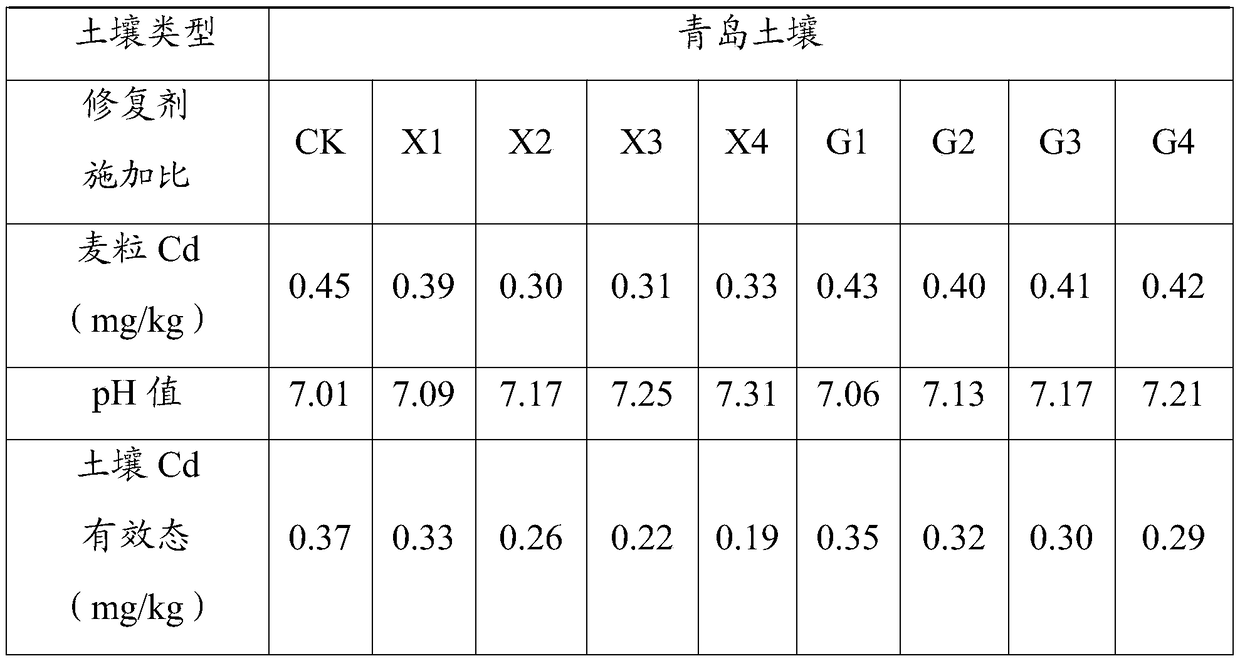
Figure 1 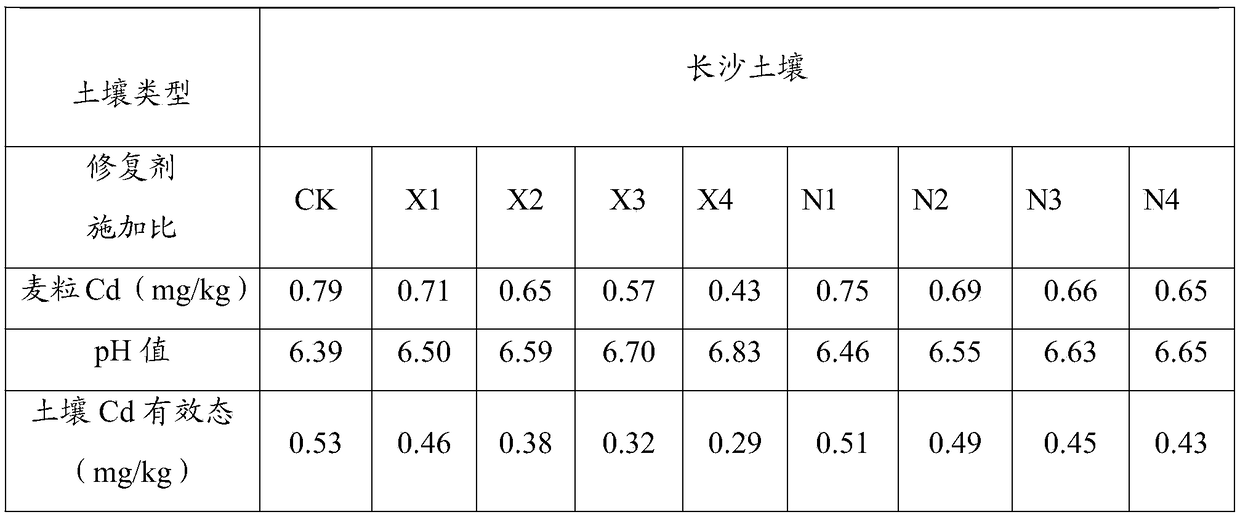
Figure 2 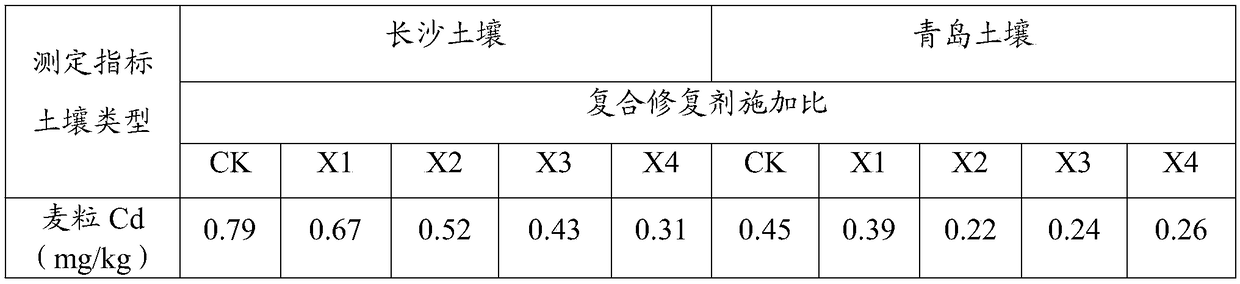
Figure 3
Abstract
Description
technical field
[0001] The invention belongs to the technical field of soil improvement and environmental protection, and in particular relates to a composite restoration agent for soil heavy metal pollution and its application. Background technique
[0002] In recent years, due to the excessive discharge of industrial wastewater and the widespread use of various fertilizers and pesticides, heavy metal pollution has become increasingly serious. With the development of industrial and mining industries, human activities have become more and more involved in the soil environment, and heavy metal pollution has become increasingly serious. The heavy metals that have the greatest impact on the ecological environment and human health mainly include Hg, Cd, Pb, and As. Cadmium (Cadmium, Cd) is one of the most important heavy metal pollutants. It has strong chemical activity in the soil. Compared with other heavy metals, it is more easily absorbed by plants, remains in the edible par...
Examples
preparation example Construction
[0038] In the present invention, the preparation method of the microbial bacterial agent preferably comprises the following steps:
[0039] The bacterial concentration was 9×10 7 ~1×10 9 1 CFU / mL Rhodotorula japonicus OP11 suspension, according to the inoculum amount of 2% to 3%, was added to the auxiliary material, mixed and stirred to obtain the microbial inoculum. In the present invention, the auxiliary material is preferably bagasse, rice bran or crushed corn stalks. The particle size of the auxiliary material is preferably 60-100 mesh, more preferably 80 mesh. Bacterial liquid source: Under sterile conditions, inoculate the activated Rhodotorula japonicus OP11 strain into a shaker flask containing sterilized wort liquid medium, shake at 28°C, 180rpm for 18h (OD ≈ 1.0), and collect by centrifugation cells and washed with saline to make 9×10 7 ~1×10 9 Rhodotorula japonicus OP11 suspension of 1 CFU / mL 。
[0040] The composite restoration agent provided by the present ...
Embodiment 1
[0064] A composite restoration agent suitable for soil cadmium pollution, including chitosan 18kg, sodium bentonite 30kg, bone meal 15kg, oyster shell powder 30kg, bio-organic fertilizer 20kg, nano-FeO 12kg, nano-carbon tube 8kg, graphene-modified biological Charcoal 25kg, microbial agent 10kg, sodium silicate 30kg.
[0065] Prepare as follows:
[0066] (1) Preparation of graphene-modified biochar: the rape straw was washed with distilled water, dried at 90°C, crushed and passed through a 20-mesh (0.85mm) sieve to obtain a powdery material for future use. Weigh 5% graphene and mix well with the prepared rape straw powder, place the weighed mixed powder in a muffle furnace, first carbonize at 100°C for 1h, then raise the temperature to 550°C for 4h, Then cool to room temperature, weigh, and obtain the first product of graphene-modified biochar. Then use 1mol / L dilute hydrochloric acid to remove ash and rinse with distilled water until neutral. Dry the finished biochar with a...
Embodiment 2
[0071] A composite restoration agent suitable for soil cadmium pollution, including chitosan 25kg, sodium bentonite 20kg, bone meal 5kg, oyster shell powder 20kg, bio-organic fertilizer 30kg, nano-FeO 10kg, nano-carbon tube 4kg, graphene modified biological Charcoal 40kg, microbial agent 5kg, sodium silicate 45kg. Prepare as follows:
[0072] (1) Preparation of graphene-modified biochar: the rape straw was washed with distilled water, dried at 90°C, crushed and passed through a 20-mesh (0.85mm) sieve to obtain a powdery material for future use. Weigh 5% graphene and mix well with the prepared rape straw powder, place the weighed mixed powder in a muffle furnace, first carbonize at 100°C for 1h, then raise the temperature to 550°C for 4h, Then cool to room temperature, weigh, and obtain the first product of graphene-modified biochar. Then use 1mol / L dilute hydrochloric acid to remove ash and rinse with distilled water until neutral. Dry the finished biochar with ash removed ...