
Method of inhibiting production of osteopontin
a technology of inhibiting the production of osteopontin and osteopontin, which is applied in the direction of biocide, antibacterial agents, drug compositions, etc., can solve the problem that not many compounds have the inhibiting effect of osteopontin, and achieve the effect of preventing and treating diseases
Patent Information
- Authority / Receiving Office
- US · United States
- Current Assignee / Owner
- Publication Date
- 2007-01-25
- Estimated Expiration
- Not applicable · inactive patent
Smart Images
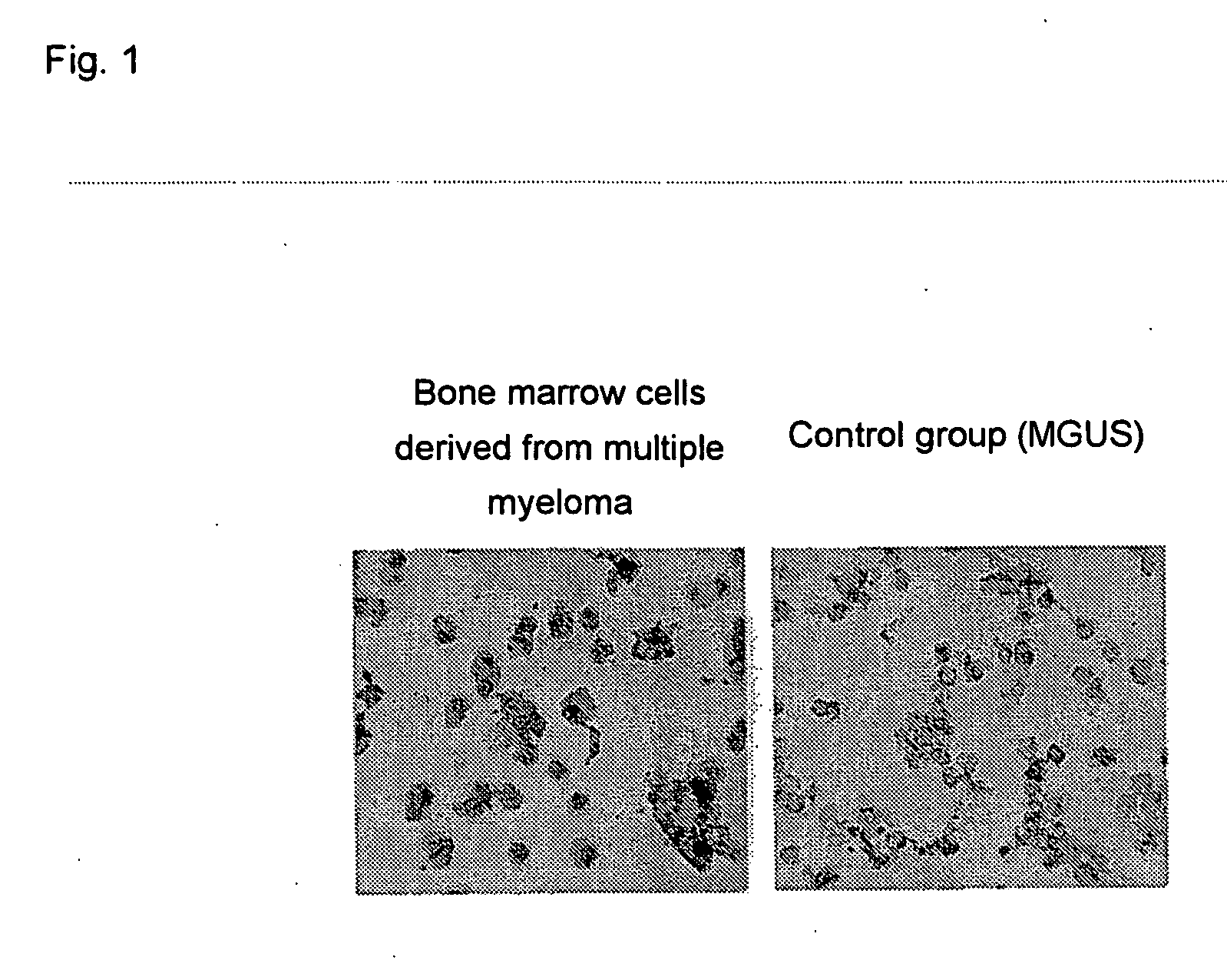
Figure 1 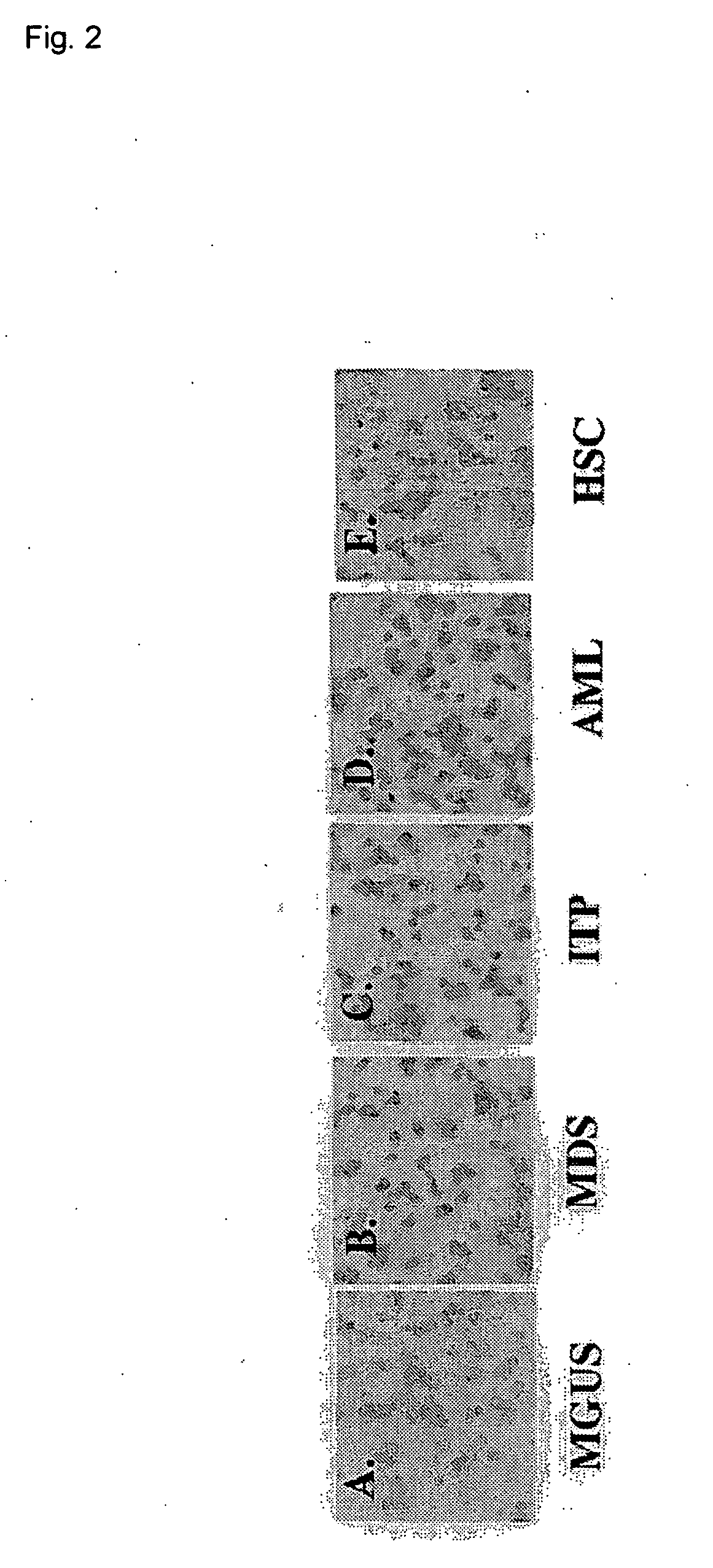
Figure 2 
Figure 3
Abstract
Description
TECHNICAL FIELD
[0001] This invention relates to a method of inhibiting the production of osteopontin, and specifically to a preventive and therapeutic method of diseases resulting from enhanced production of osteopontin, for example, multiple myeloma, urinary calculus and the like. BACKGROUND ART
[0002] Ostepontin (hereinafter abbreviated as “OPN”) is a secretory phosphoglycoprotein identified as an extracellular substrate of bone at first, and is expressed in cells such as osteoclasts, macrophages, activating T cells, smooth muscle cells and epicytes and also in tissues such as bones, the kidney, the placenta, smooth muscles and secretory epithelia. OPN has an arginin-glycin-aspartic acid (RGD) sequence, and in various cells, binds via αvβ1, β3 and β5 integrin to induce adhesion, chemotaxis and signal transduction. As effects of OPN, known physiological effects include promotion of bone resorption, promotion of vascularization, wound healing, and normal tissue repair processes in ...
Examples
synthesis example 1
[0049] Synthesis of [0050] 5-(4-chlorophenyl)-6-[4-(methylthio)phenyl]-2-(2-pyridylmethyl)-2H-pyridazine-3-thione methanesulfonate [0051] Synthesis of [0052] 5-(4-chlorophenyl)-6-[4-(methylthio)phenyl]-2-(2-pyridylmethyl)-2H-pyridazin-3-one
[0053] Potassium carbonate (525 mg, 3.78 mmol) and 2-picolylchloride hydrochloride (300 mg, 1.83 mmol) were added to a solution of [0054] 5-(4-chlorophenyl)-6-[4-(methylthio)phenyl]-2H-pyridazin-3-one (500 mg, 1.52 mmol) in N,N-dimethylformamide (10 mL), followed by stirring at 80° C. for 12 hours. Chloroform (50 mL) was added to the reaction mixture. The mixture was washed successively with water and saturated brine, and was dried over anhydrous sodium sulfate. The solvent was distilled off under reduced pressure. The residue was isolated and purified by column chromatography on silica gel (ethyl acetate / hexane=1 / 1 to 2 / 1) to afford the title compound as a slightly-yellow amorphous (623 mg, 97.5%).
[0055]1H-NMR (CDCl3) δ: 2.45 (3H, s), 5.58 (2H,...
synthesis example 2
[0071] Synthesis of [0072] 5-(4-chlorophenyl)-6-[4-(methylthio)phenyl]-2-(3-pyridylmethyl)-2H-pyridazin-3-one methanesulfonate
[0073] Following the procedure of Example 1-3) and conducting crystallization from methanol-ether, the title compound was afforded as a slightly-brown crystalline powder (268 mg, 96.5%) from 5-(4-chlorophenyl)-6-[4-(methylthio)phenyl]-2-(3-pyridylmethyl)-2H-pyridazin-3-one (226 mg, 0.583 mmol) and 1 mmol / mL methanesulfonic acid-dioxane solution (0.59 mL, 0.59 mmol).
[0074] Melting point: 184.4-187.1° C.
[0075]1H-NMR(DMSO-d6)δ: 2.35 (3H, s), 2.45 (3H, s), 5.53 (2H, s), 7.06 (1H, s), 7.10 (2H, d, J=8.6 Hz), 7.17 (2H, d, J=8.6 Hz), 7.25 (2H, d, J=8.6 Hz), 7.44 (2H, d, J=8.6 Hz), 7.93 (1H, dd, J=5.6, 8.1 Hz), 8.42 (1H, m), 8.66 (1H, dd, J=1.2, 5.6 Hz), 8.94 (1H, d, J=2. 0 Hz).
[0076] IR(KBr) cm−1: 1665, 1227, 1212, 1194, 1156.
example 1
Immunocytochemistry for Osteopontin
[0077] The expressions of osteopontin in bone marrow cells collected from three typical multiple myeloma patients were studied by an immunocytochemical procedure making use of the avidin-biotin-peroxidase method. As the control, bone marrow cells from five patients with different hematologic diseases including monoclonal gammopaties with uncertain significance (MGUS: an increase in a monoclonal immunoglobulin is observed, but not to such an extent as meeting a diagnostic standard for multiple myeloma) were usued. Bone marrow cells were isolated by density-gradient centrifugation. Bone marrow cells (1×10⁵) derived from each patient and prepared from the isolated bone marrow cells were fixed with Cytospin 2 (Shandon Soutern Products Ltd., Cheshire, UK) on a glass slide. The slide was stored at −80° C. until use. A mouse anti-human osteopontin monoclonal IgG antibody (4C1) prepared by Kon, et al. (J. Cellular Biochemistry, 84, 420-432, 2002) was used...