
Reduced overflow metabolism and methods of use
Patent Information
- Authority / Receiving Office
- US · United States
- Current Assignee / Owner
- Publication Date
- 2007-10-25
- Estimated Expiration
- Not applicable · inactive patent
Smart Images
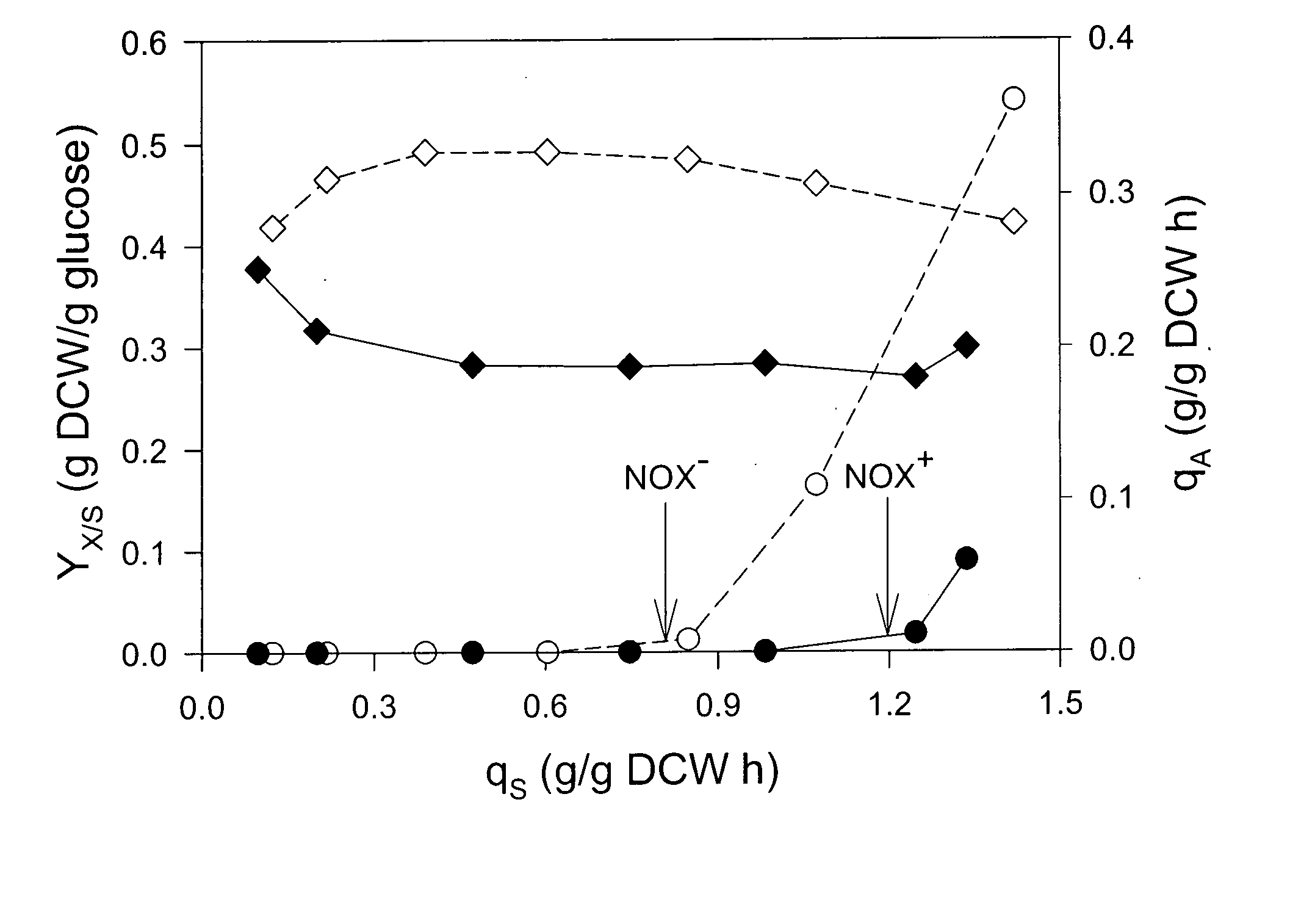
Figure 1 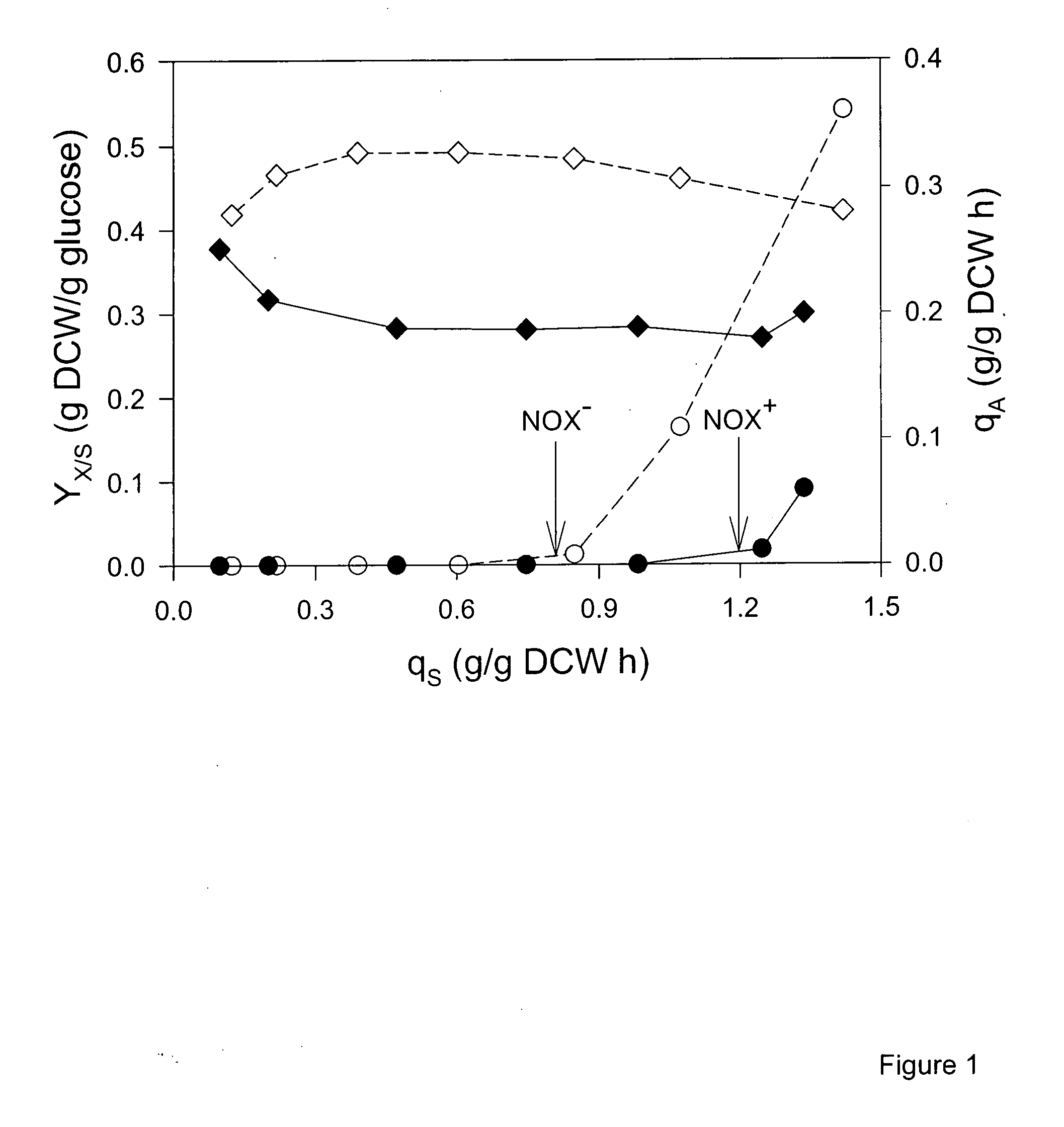
Figure 2 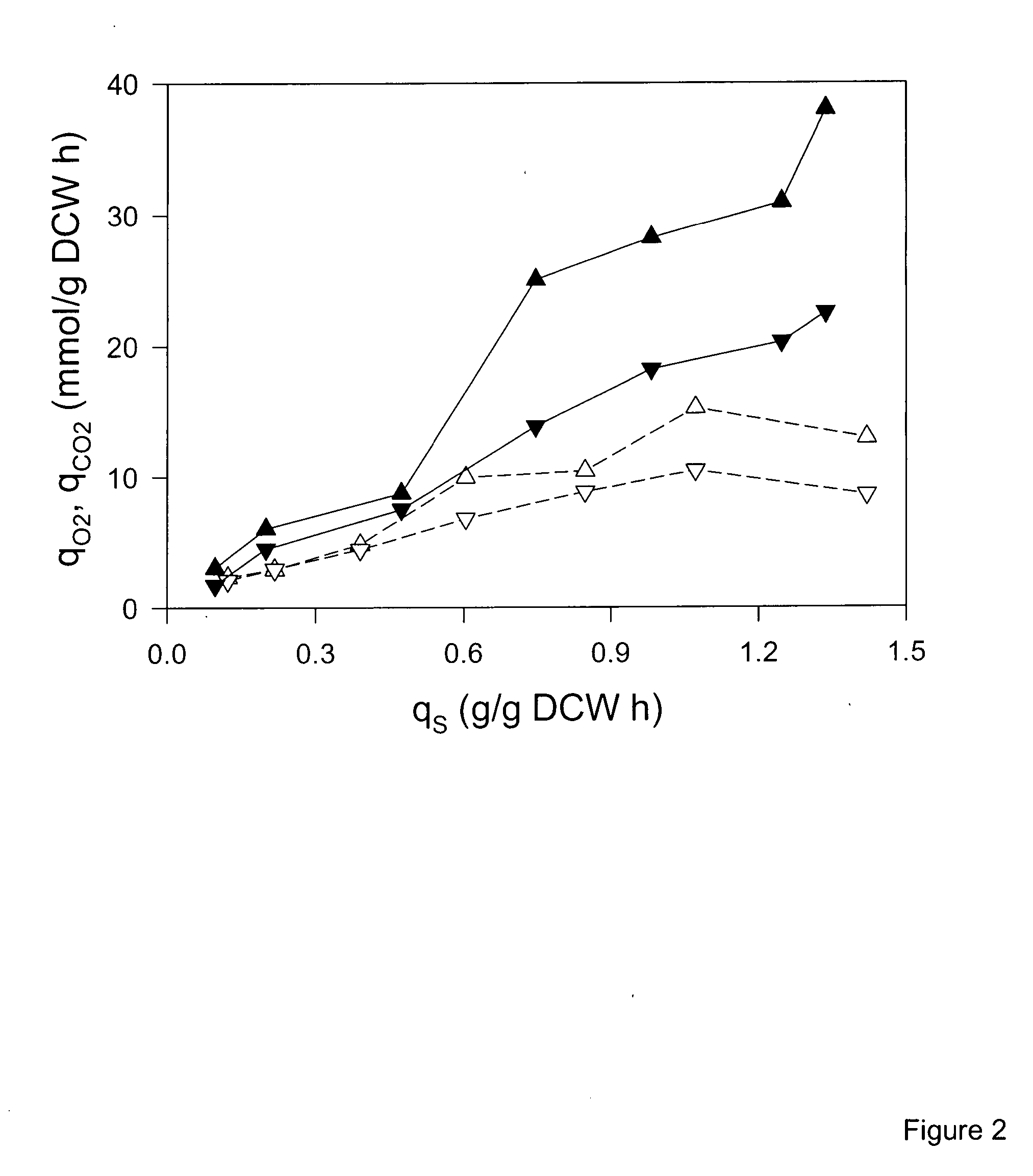
Figure 3
Abstract
Description
CONTINUING APPLICATION DATA
[0001] This application claims the benefit of U.S. Provisional Application Ser. No. 60 / 776,032, filed Feb. 23, 2006, which is incorporated by reference herein.GOVERNMENT FUNDING
[0002] The present invention was made with government support under Grant No. DE-FG36-01ID14007, awarded by the U.S. Department of Energy, and Grant No. QSB 0222636, awarded by the National Science Foundation. The Government has certain rights in this invention.BACKGROUND
[0003] Acetate formation in aerobically grown cultures of Escherichia coli continues to be a major problem in the industrial application of this organism. E. coli accumulates acetic acid when growing at a high rate of glucose consumption even in the presence of ample oxygen (Andersen et al., 1980, J. Bacteriol. 144:114-123, Hollywood et al., 1976, Microbios. 17:23-33; Meyer et al., 1984, J. Biotechnol. 1:355-358). This phenomenon is known as overflow metabolism. Acetate is generated when carbon flux from acetyl-c...
Examples
example 1
[0062] Overflow metabolism in the form of aerobic acetate excretion by Escherichia coli is an important physiological characteristic of this and other common industrial microorganisms. Although acetate formation occurs under conditions of high glucose consumption, the genetic mechanisms that trigger this phenomenon are not clearly understood. This Example describes the role of the NADH / NAD ratio (redox ratio) in overflow metabolism. The redox ratio in E. coli was modulated through the expression of a water-forming NADH oxidase. Using steady-state chemostat cultures, a strong correlation was demonstrated between acetate formation and this redox ratio. A genome-wide transcription analyses of a control E. coli strain and an E. coli strain overexpressing NADH oxidase was completed. The transcription results showed that in the control strain, several genes involved in the tricarboxylic acid (TCA) cycle and respiration were repressed as the glucose consumption rate increased. Moreover, th...
example 2
[0090] Glycolytic flux is increased and acetate production is reduced in Escherichia coli by the expression of heterologous NADH-oxidase (NOX) from Streptococcus pnetinioniae coupled with the deletion of the arcA gene which encodes the ArcA regulatory protein. In this study, the overproduction of a model recombinant protein was examined in strains of E. coli expressing NOX with or without an arcA mutation. The presence of NOX or the absence of ArcA reduced acetate by about 50% and increased β-galactosidase production by 10-20%. The presence of NOX in the arcA strain eliminated acetate production entirely in batch fermentations and resulted in a 120% increase in β-galactosidase production (Vermuri et al., Biotechnol. Bioeng., 2006, 94(3):538-542, Eiteman and Altman, Trends Biotechnol., 2006, 24(11):530-536).
Materials and Methods
[0091]E. coli MG1655 was the host strain used in this study. QC2575 (MG1655 arcA::tet) was kindly provided by D. Touati (l'Institut Jacques Monod, Paris, F...