
1, 2, 4-triazole-based derivative, production process and use thereof, and organic electroluminescent device
Patent Information
- Authority / Receiving Office
- US · United States
- Current Assignee / Owner
- Publication Date
- 2014-11-20
Smart Images
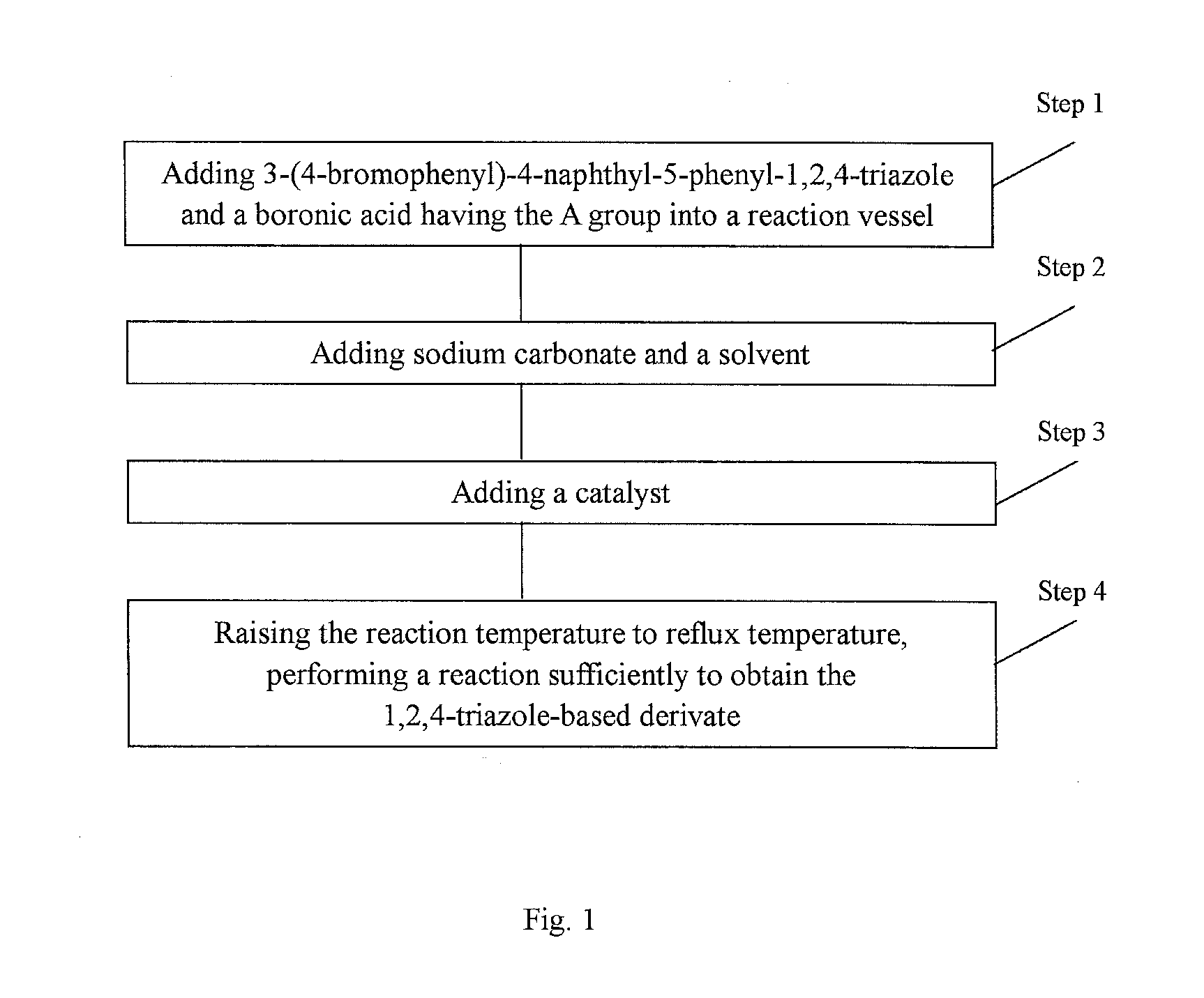
Figure 1 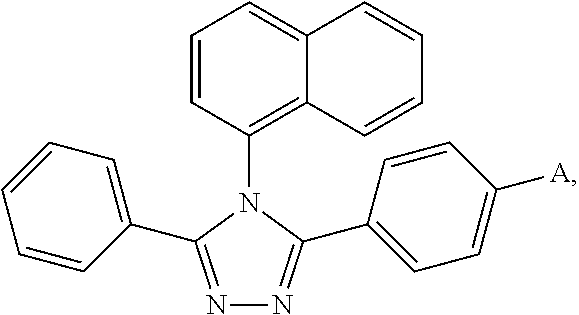
Figure 2 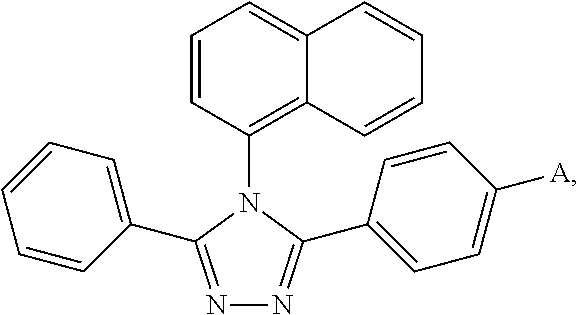
Figure 3
Abstract
Description
FIELD OF THE INVENTION
[0001] The invention relates to the technical field of organic electroluminescence, particularly, to a 1,2,4-triazole-based derivative, a production process and use thereof, and an organic electroluminescent device.BACKGROUND OF THE INVENTION
[0002] The organic electroluminescence is a phenomenon that an organic material emits light by being excitated by electric energy. The organic electroluminescence technology is considered as a new generation of the flat panel display technology due to its low driving voltage, wide viewing angle, low cost, high brightness, and capability to display in large area. Particularly, since 1987 when a low-voltage-driven small molecular light-emitting device was prepared by Tang, et al, the organic light-emitting diode has been developed greatly and brought into the industrialization progress.
[0003] One of the key technologies in the field of the organic light-emitting diode is the selection of the organic electroluminescent material. ...
Examples
example 1
Synthesis of Compound 001
[0065]Under a nitrogen environment, 3-(4-bromophenyl)-4-naphthyl-5-phenyl-1,2,4-triazole (21.32 g, 50 mmol) and N-phenyl-3-carbazyl boronic acid (21.53 g, 75 mmol) were added into a three-necked flask equipped with a heating means, a refluxing means and a stirring means. Then sodium carbonate (15.90 g, 150 mmol), toluene (250 ml) and water (125 ml) were added. Finally, tetrakis(triphenylphosphine)palladium (0.57 g, 0.5 mmol) was added. The temperature was raised to 70° C., and the mixture was reacted for 24 hours while refluxing. After the mixture was cooled to the room temperature and a solid was precipitated, vacuum filtration was carried out. After the resultant filter cake was washed with water, ethanol and diethyl ether in this order, it was purified by column chromatography (petroleum ether:ethyl acetate=1:8). The mixed solvent was recovered. After drying, an off-white Compound 001 (27.37 g) was obtained, and the yield thereof was 93% or more.
[0066]The...
example 2
Synthesis of Compound 002
[0069]Under a nitrogen environment, 3-(4-bromophenyl)-4-naphthyl-5-phenyl-1,2,4-triazole (21.32 g, 50 mmol) and 4-(4-triphenylamine)naphthyl boronic acid (31.52 g, 90 mmol) were added into a three-necked flask equipped with a heating means, a refluxing means and a stirring means. Then sodium carbonate (16.56 g, 160 mmol), toluene (250 ml) and water (125 ml) were added. Finally, tetrakis(triphenylphosphine)palladium (0.69 g, 0.6 mmol) was added. The temperature was raised to 75° C., and the mixture was reacted for 25 hours while refluxing. After the mixture was cooled to the room temperature and a solid was precipitated, vacuum filtration was carried out. After the resultant filter cake was washed with water, ethanol and diethyl ether in this order, it was purified by column chromatography (petroleum ether:ethyl acetate=1:8). The mixed solvent was recovered. After drying, an off-white Compound 002 (27.47 g) was obtained, and the yield thereof was 93% or more....
example 3
Synthesis of Compound 003
[0073]Under a nitrogen environment, 3-(4-bromophenyl)-4-naphthyl-5-phenyl-1,2,4-triazole (21.32 g, 50 mmol) and 10-(2-naphthyl)anthracyl boronic acid (40.40 g, 115 mmol) were added into a three-necked flask equipped with a heating means, a refluxing means and a stirring means. Then sodium carbonate (25.4 g, 190 mmol), toluene (250 ml) and water (125 ml) were added. Finally, tetrakis(triphenylphosphine)palladium (0.45 g, 0.9 mmol) was added. The temperature was raised to 80° C., and the mixture was reacted for 28 hours while refluxing. After the mixture was cooled to the room temperature and a solid was precipitated, vacuum filtration was carried out. After the resultant filter cake was washed with water, ethanol and diethyl ether in this order, it was purified by column chromatography (petroleum ether:ethyl acetate 1:8). The mixed solvent was recovered. After drying, an off-white Compound 003 (22.26 g) was obtained, and the yield thereof was 94% or more.
[00...