
Time-to-digital converter using stochastic phase interpolation
a time-to-digital converter and stochastic phase technology, applied in the field of time-to-digital converters, can solve problems such as unstable operations, and achieve the effect of high-resolution operations
Patent Information
- Authority / Receiving Office
- US · United States
- Patent Type
- Applications(United States)
- Current Assignee / Owner
- Publication Date
- 2016-06-02
Smart Images
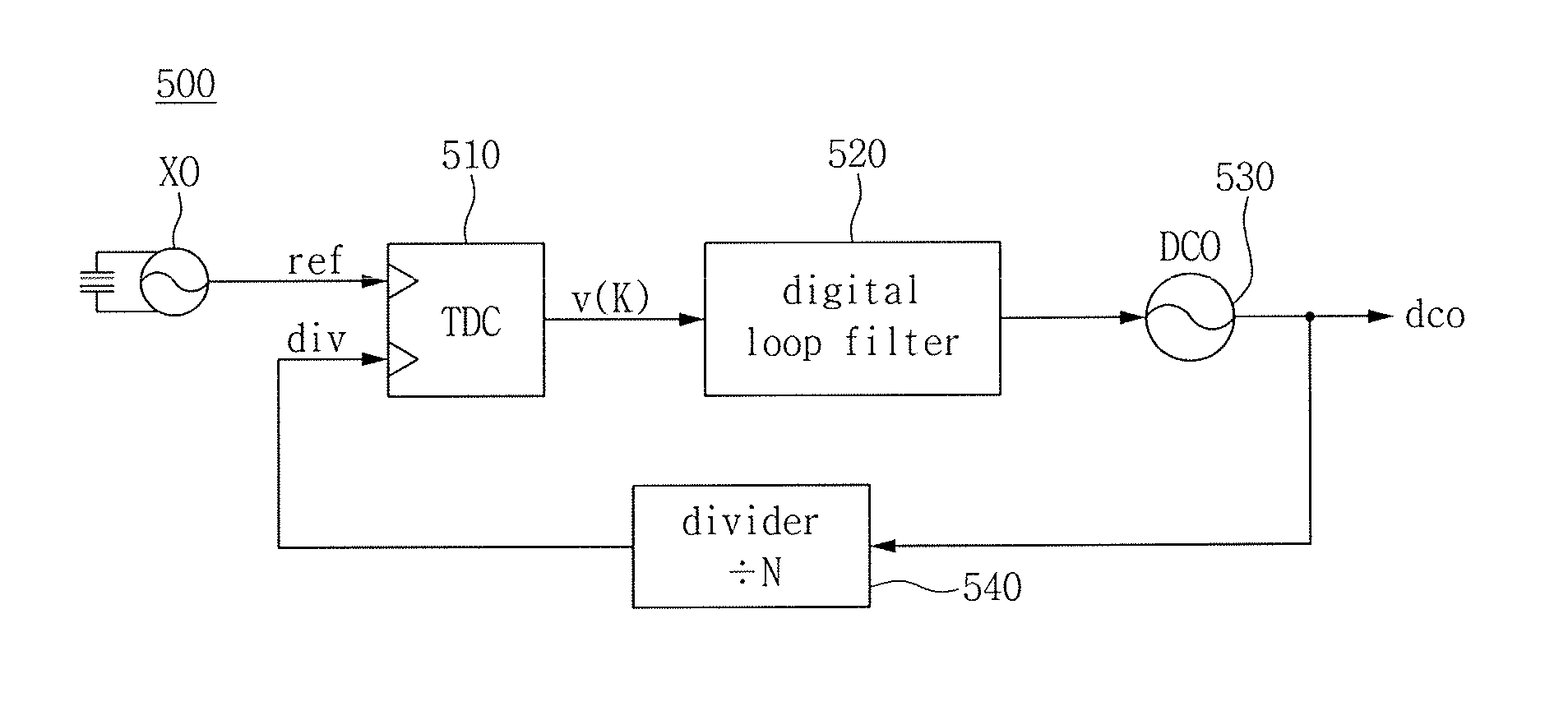
Figure 1 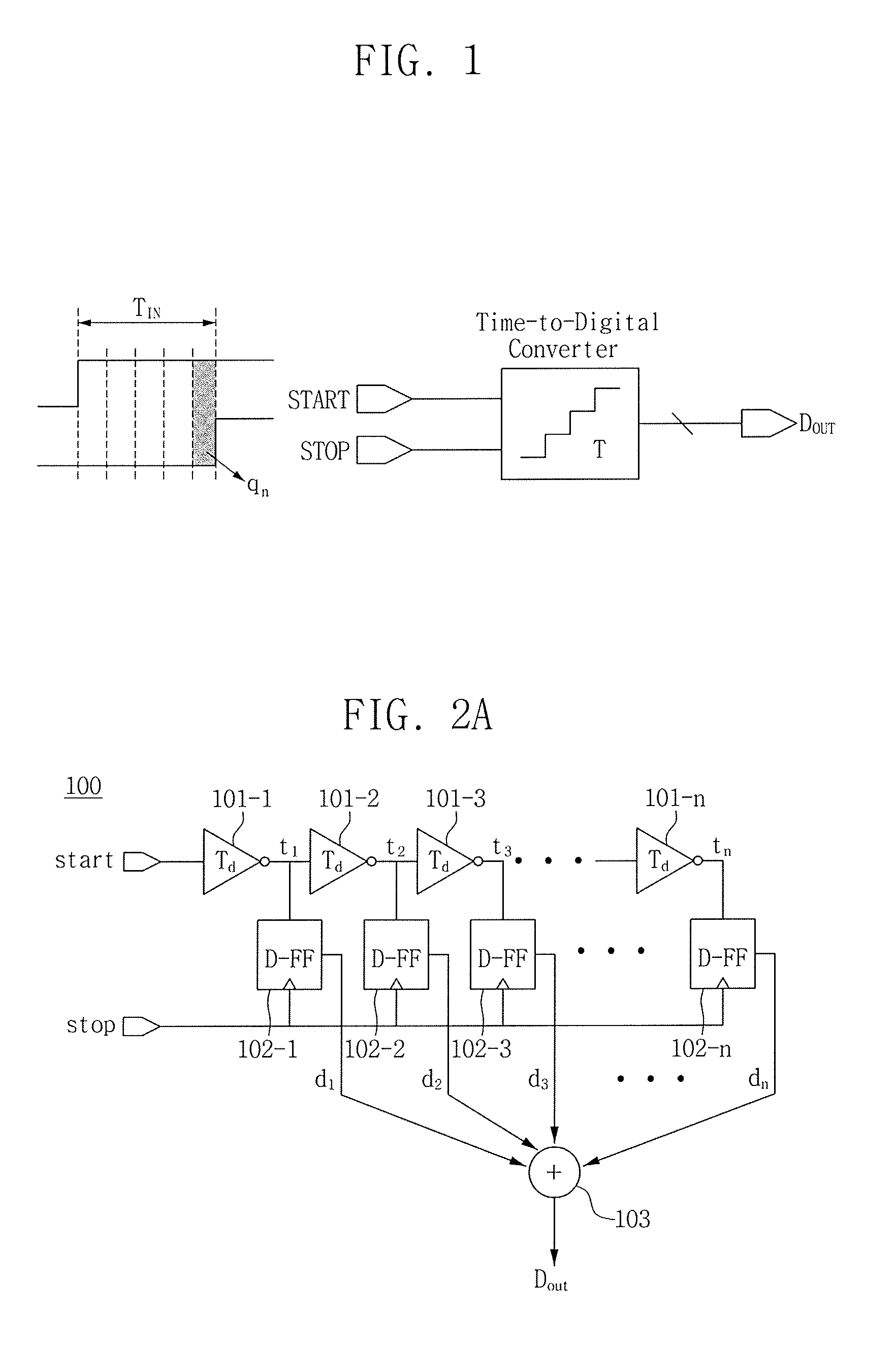
Figure 2 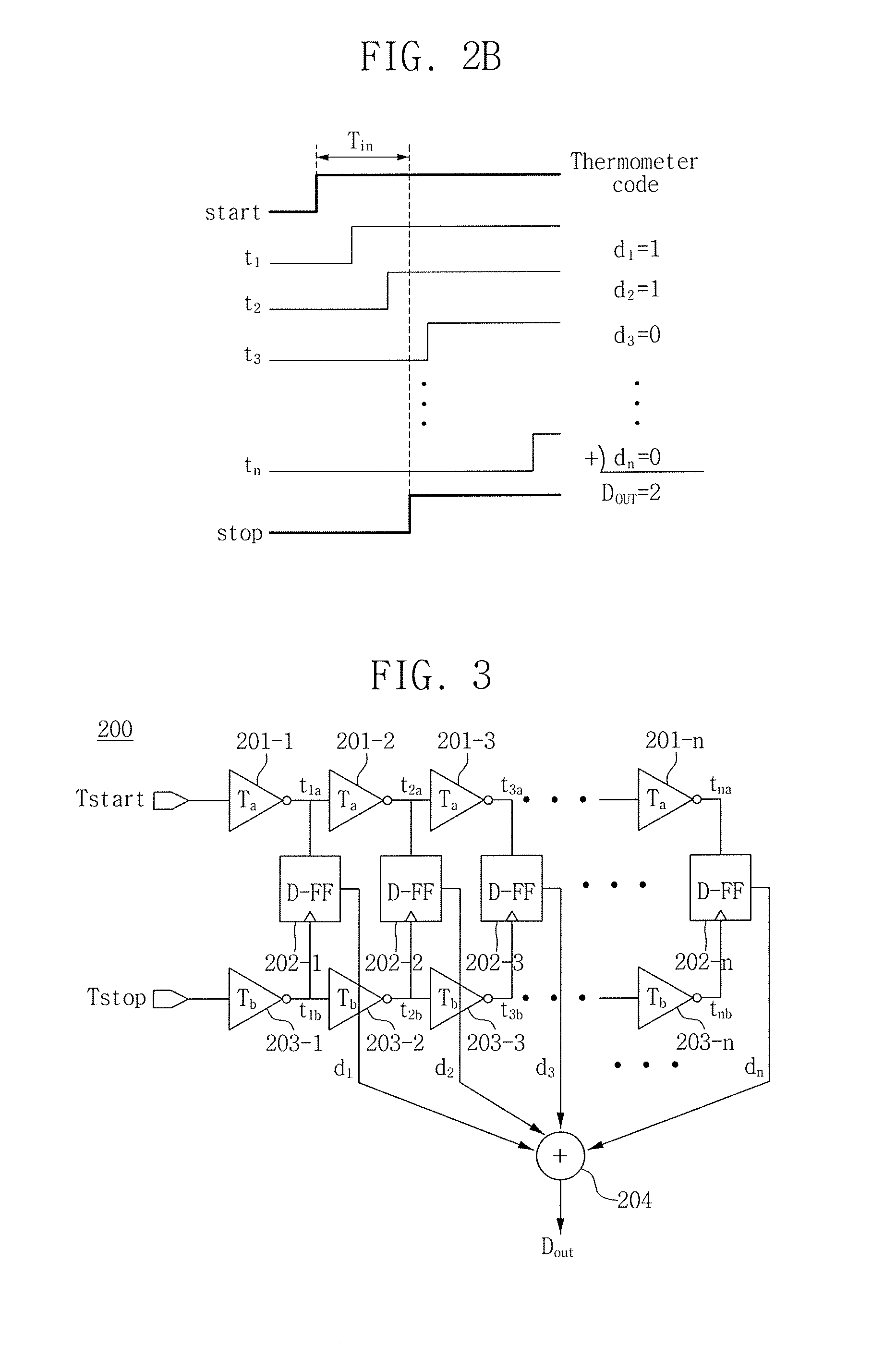
Figure 3
Abstract
Description
CROSS-REFERENCE TO RELATED APPLICATION
[0001] This application claims priority under 35 U.S.C. §119 to Korean Patent Application No. 10-2014-0169873 filed on Dec. 1, 2014, the disclosure of which is incorporated by reference in its entirety herein.BACKGROUND
[0002] 1. Technical Field
[0003] Embodiments of the inventive concept relate to a time-to-digital converter, and more particularly, to a time-to-digital converter with high performance.
[0004] 2. Discussion of Related Art
[0005] A phase locked loop (PLL) is a control system that generates an output signal whose phase is related to the phase of an input signal, and has an important role in a digital system. A PLL may be based on a charge pump, which is a kind of DC to DC converter.
[0006] However, when a PLL is based on a charge pump, some of the operations it performs may be unstable due to its sensitivity to process, voltage, and temperature (PVT) variations.SUMMARY
[0007] At least one embodiment of the inventive concept can provide a time-t...
Examples
Embodiment Construction
[0047]The inventive concept will now be described more fully with reference to the accompanying drawings. These inventive concepts may, however, be embodied in different forms and should not be construed as limited to the embodiments set forth herein.
[0048]It will be understood that when an element is referred to as being “connected” or “coupled” to another element, it can be directly connected or coupled to the other element or intervening elements may be present. As used herein, the singular forms “a,”“an” and “the” are intended to include the plural forms as well, unless the context clearly indicates otherwise.
[0049]Hereinafter, exemplary embodiments of the inventive concept will now be described more fully with reference to the accompanying drawings.
[0050]FIG. 1 is a conceptual view illustrating a general time-to-digital converter.
[0051]Referring to FIG. 1, a time-to-digital converter (hereinafter, referred to as a ‘TDC’) converts predetermined time information into a digital co...