
Fluorine-containing silicon compound, method for producing same, and method for producing fluorine-containing silicon resin
Patent Information
- Authority / Receiving Office
- US · United States
- Current Assignee / Owner
- Publication Date
- 2016-08-11
Smart Images
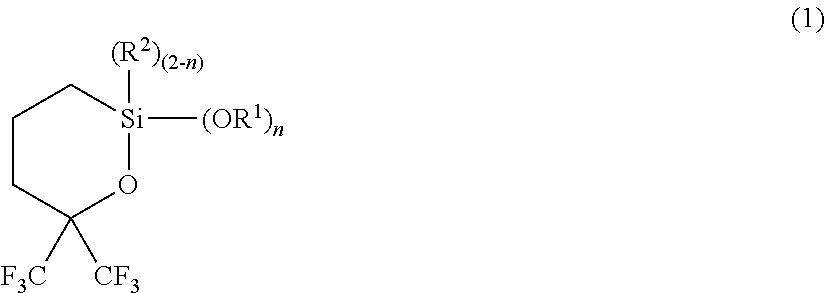
Figure 1 
Figure 2 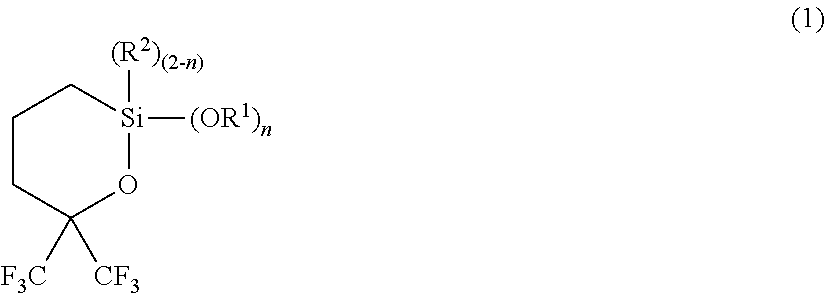
Figure 3
Abstract
Description
BACKGROUND OF THE INVENTION
[0001] 1. Field of the Invention
[0002] The present invention relates to a novel fluorine-containing silicon compound, a method for producing the same, and a method for producing a fluorine-containing silicon resin using the same.
[0003] 2. Description of the Related Art
[0004] The introduction of a hydrolysable fluorine-containing silicon compound is useful for adjusting various properties of a condensation resin. For example, in the multilayer resist method used for a fine processing in the manufacturing process of a semiconductor device or the like, it has been proposed to apply this compound to a composition for forming a silicon-containing film used as an intermediate layer or a silicon-containing photoresist composition (Patent Documents 1 and 2).
[0005] In Patent Document 2, 1,1,1-trifluoro-5-(triethoxysilyl)-2-(trifluoromethyl)-2-pentanol represented by the formula (6) has been proposed as the hydrolysable fluorine-containing silicon compound particularly u...
Examples
example 1-1
Synthesis 1 of 2,2-diethoxy-6,6-bis(trifluoromethyl)oxasilin (1A)
[0113]
[0114]Into a flask were put 93.1 g of 1,1,1-trifluoro-5-(triethoxysilyl)-2-(trifluoromethyl)-2-pentanol (2A) and 50 g of toluene, and the flask was heated to totally reflux for 30 minutes. Then, components with low boiling point were gently distilled off over 20 hours. After cooling, the resulting component was purified by distillation under reduced pressure to obtain 65.3 g of 2,2-diethoxy-6,6-bis(trifluoromethyl)oxasilin (1A), with a boiling point of 74° C. / 1,100 Pa.
[0115]With respect to the obtained product, Infrared absorption (IR) spectrum and nuclear magnetic resonance (1H-NMR, 13C-NMR, and 19F-NMR) spectra were measured, and the results are shown below.
[0116]IR (D-ATR): ν=2980, 2935, 2894, 1451, 1390, 1331, 1307, 1279, 1255, 1213, 1186, 1169, 1132, 1106, 1073, 1002, 956, 912, 875, 818, 798, 776, 711, 672 cm−1
[0117]1H-NMR (600 MHz, CDCl3): δ=0.80 (2H, t, J=7.0 Hz), 1.23 (6H, t, J=7.0 Hz), 1.92-2.02 (4H, m)...
example 1-2
Synthesis 2 of 2,2-diethoxy-6,6-bis(trifluoromethyl)oxasilin (1A)
[0120]
[0121]A mixture containing 208 g of 1,1,1-trifluoro-2-(trifluoromethyl)-4-penten-2-ol (3), 1.3 g of a toluene solution of platinum-1,3-divinyl-1,1,3,3-tetramethyldisiloxane complex (platinum content: 3% by mass), and 200 g of heptane was heated at about 100° C., and 172 g of triethoxy silane (4A) was added dropwise thereto over 20 hours while distilling off ethanol produced by the reaction. The heating was performed until the distillation of ethanol was completed, followed by cooling. Then, the resulting component was purified by distillation under reduced pressure to obtain 196 g of 2,2-diethoxy-6,6-bis(trifluoromethyl)oxasilin (1A), with a boiling point of 74° C. / 1,100 Pa.
[0122]With respect to the obtained product, Infrared absorption (IR) spectrum and nuclear magnetic resonance (1H-NMR, 13C-NMR, and 19F-NMR) spectra were measured, and the results are shown below.
[0123]IR (D-ATR): ν=2980, 2935, 2894, 1451, 1390...
example 1-3
Synthesis of 2,2-dimethoxy-6,6-bis(trifluoromethyl)oxasilin (1B)
[0127]
[0128]2,2-dimethoxy-6,6-bis(trifluoromethyl)oxasilin (1B) was obtained in the same manner as in Example 1, except for changing the raw material to 1,1,1-trifluoro-5-(trimethoxysilyl)-2-(trifluoromethyl)-2-pentanol (2B).