
Fluorescent material, process for producing the same and illuminator employing the same
Patent Information
- Authority / Receiving Office
- US · United States
- Current Assignee / Owner
- Publication Date
- 2010-09-02
Smart Images
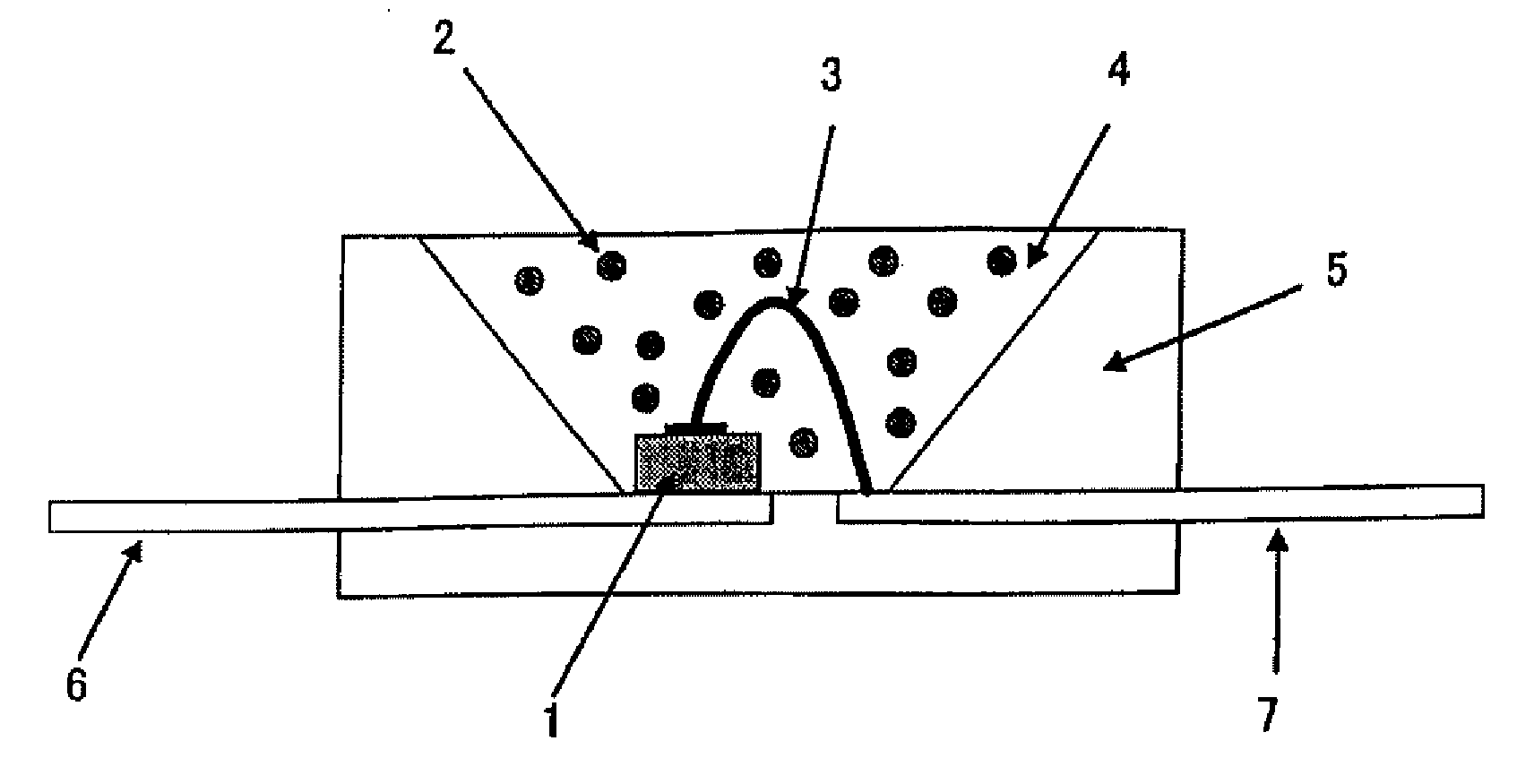
Figure 1 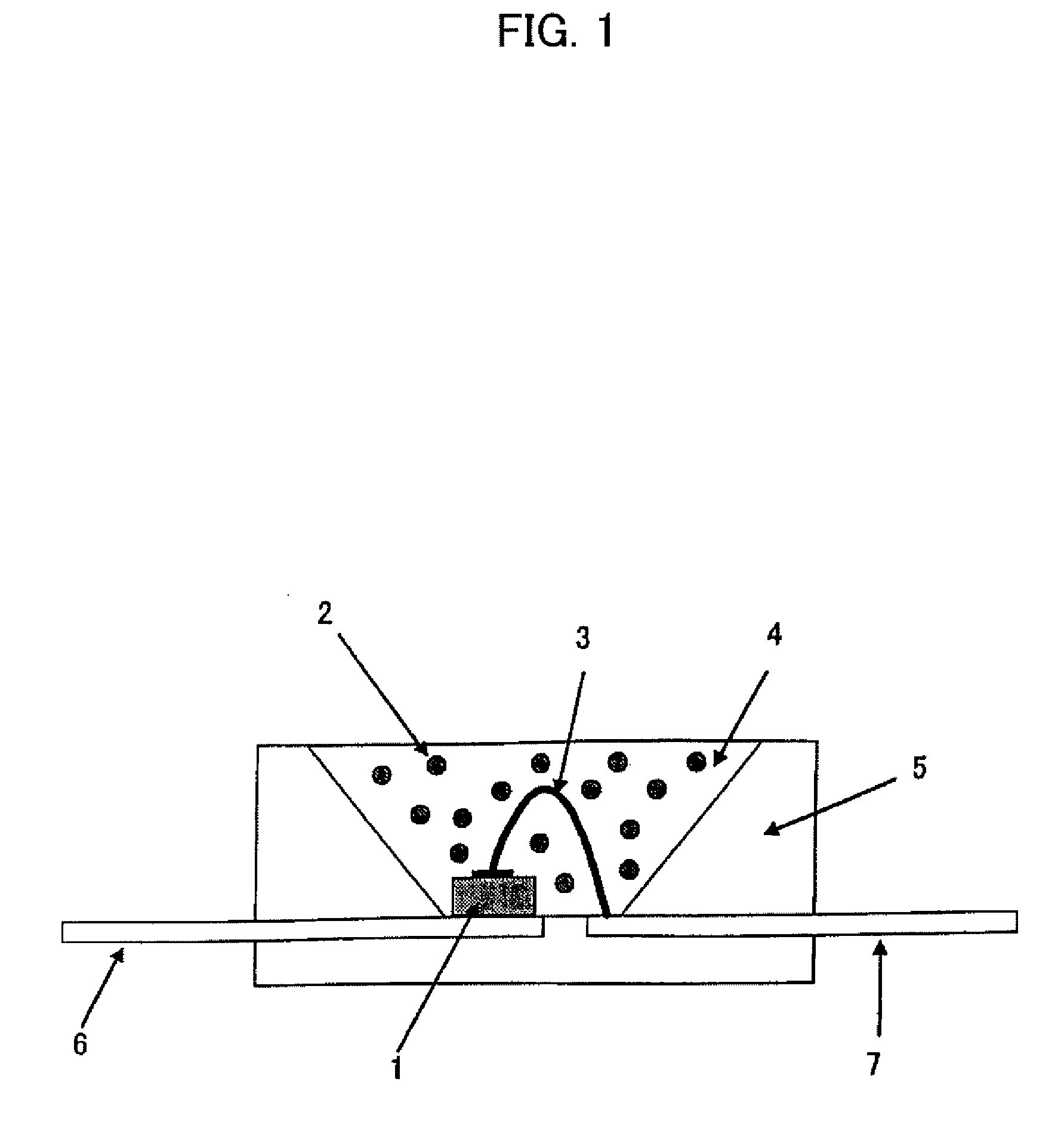
Figure 2
Abstract
Description
TECHNICAL FIELD
[0001] The present invention relates to a fluorescent material, a process for producing the fluorescent material, and an illuminator employing the fluorescent material. Specifically, the invention relates to the fluorescent material comprising a β-Sialon (SiAlON), which emits visible light when excited by ultraviolet or blue light, its production method for the same, and the illuminator employing the fluorescent material such as a white light emitting diode.BACKGROUND ART
[0002] Fluorescent materials comprising silicate, phosphate, aluminate, or sulfide as a host material and containing a transition metal or rare earth metal as a luminescent center are widely known.
[0003] Meanwhile, white light-emitting diodes (white LEDs) that emit visible light when excited by a high-energy excitation source such as ultraviolet or blue light have attracted attention, and their development is underway.
[0004] However, the above-mentioned conventional fluorescent materials have a problem th...
Examples
example
Description of Example 1
[0071]95.5% by mass of the α type silicon nitride powder (made by DENKI KAGAKU KOGYO KABUSHIKI KAISHA, grade NP-600, oxygen content: 1.3% by mass), 3.3% by mass of aluminum nitride powder (made by TOKUYAMA Corp., grade F, oxygen content: 0.9% by mass), 0.4% by mass of aluminum oxide powder (made by TAIMEI CHEMICALS CO., LTD., grade TM-DAR), and 0.8% by mass of europium oxide powder (made by SHIN-ETSU CHEMICAL Co., Ltd., grade RU) were prepared as shown in Table 1 to obtain 1.0 kg in total. Here, Eu content is maintained at 0.09% by atom.
TABLE 1EuBNBurning conditioncontentcontainerHoldingComposition (% by mass)(% bydensitytimeTPSi3N4AlNAl2O3Eu2O3atom)(g / cm3)(hr)(° C.)(MPa)Ex. 195.53.30.40.80.091.801219500.9Ex. 294.23.51.01.30.141.802419000.9Ex. 393.93.51.01.60.181.803618500.5Ex. 493.04.02.20.80.091.801020002.0C.95.53.30.40.80.091.80819500.9Ex. 1C.93.93.51.01.60.181.80818500.5Ex. 2Ex.95.53.30.40.80.09(Pyrolitic1219500.911BNcontainer)C.95.53.30.40.80.091.6012195...
example 5
Description of Example 5
[0088]In Example 5, 560 g of the same raw powder as the one used in Example 1 was enclosed in a lidded cylindrical container made of boron nitride (made by DENKI KAGAKU KOGYO KABUSHIKI KAISHA, grade N-1, density: 1.78 g / cm3) having inner diameter of 14.8 cm and height of 13.8 cm, which was then subjected to heat treatment by an electric furnace having carbon heaters in the pressurized nitrogen atmosphere of 0.9 MPa at 1500° C. for one hour. After cooling, the burned product taken out of the container was sifted with an mesh of 833 μm (20 mesh) nylon sieve, the sieved product was enclosed back into the container and then subjected to heat treatment in a pressurized nitrogen atmosphere of 0.9 MPa at 1950° C. for 8 hours. The obtained product was a loosely coagulated mass, which was broken into flakes easily with human fingers wearing clean rubber gloves. After undergoing the light crushing, the product was sifted through a 45 μm sieve. 450 g of synthesized powd...
example 9
Description of Example 9
[0100]In Example 9, synthesized powder was obtained in the same manner as Example 1 except that β-Sialon powder was added by 3% by mass. The raw powder thus obtained was subjected to X-ray powder diffraction, particle diameter distribution, and fluorescence intensity measurements as in Example 1, and the results are listed in Table 2. The table indicates that the synthesized powder obtained in Example 9 was a single-phase β-Sialon. D10 obtained by particle diameter distribution measurement of the β-Sialon in Example 9 was 10.8 μm, whereas D90 was 73.3 μm. The peak intensity of the fluorescent spectrum at 455 nm excitation of the β-Sialon obtained in Example 9 was 716, and its peak wavelength was 541 nm.