
End use articles derived from polypropylene homopolymers and random copolymers
Patent Information
- Authority / Receiving Office
- US · United States
- Current Assignee / Owner
- Publication Date
- 2006-11-21
Smart Images
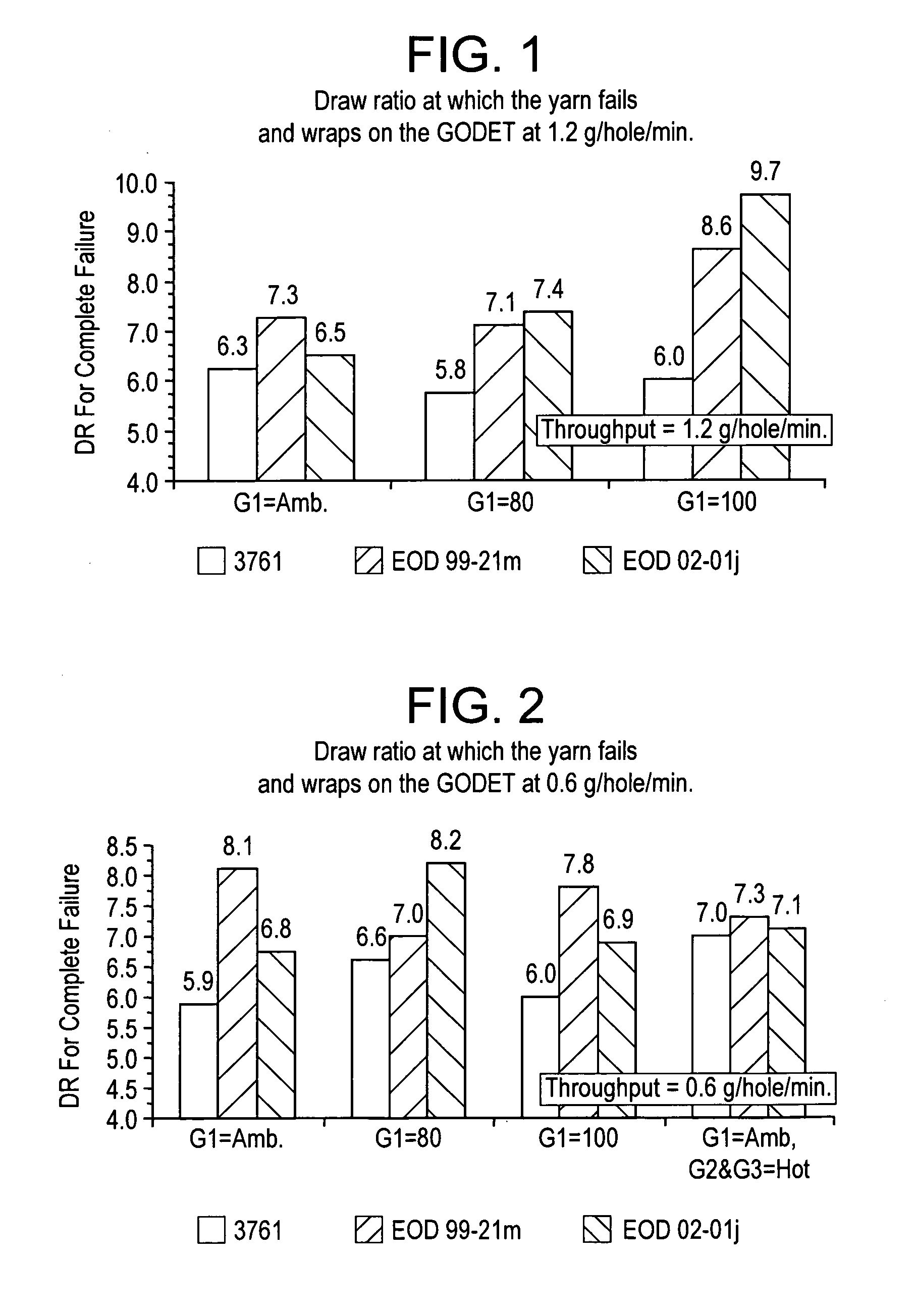
Figure 1 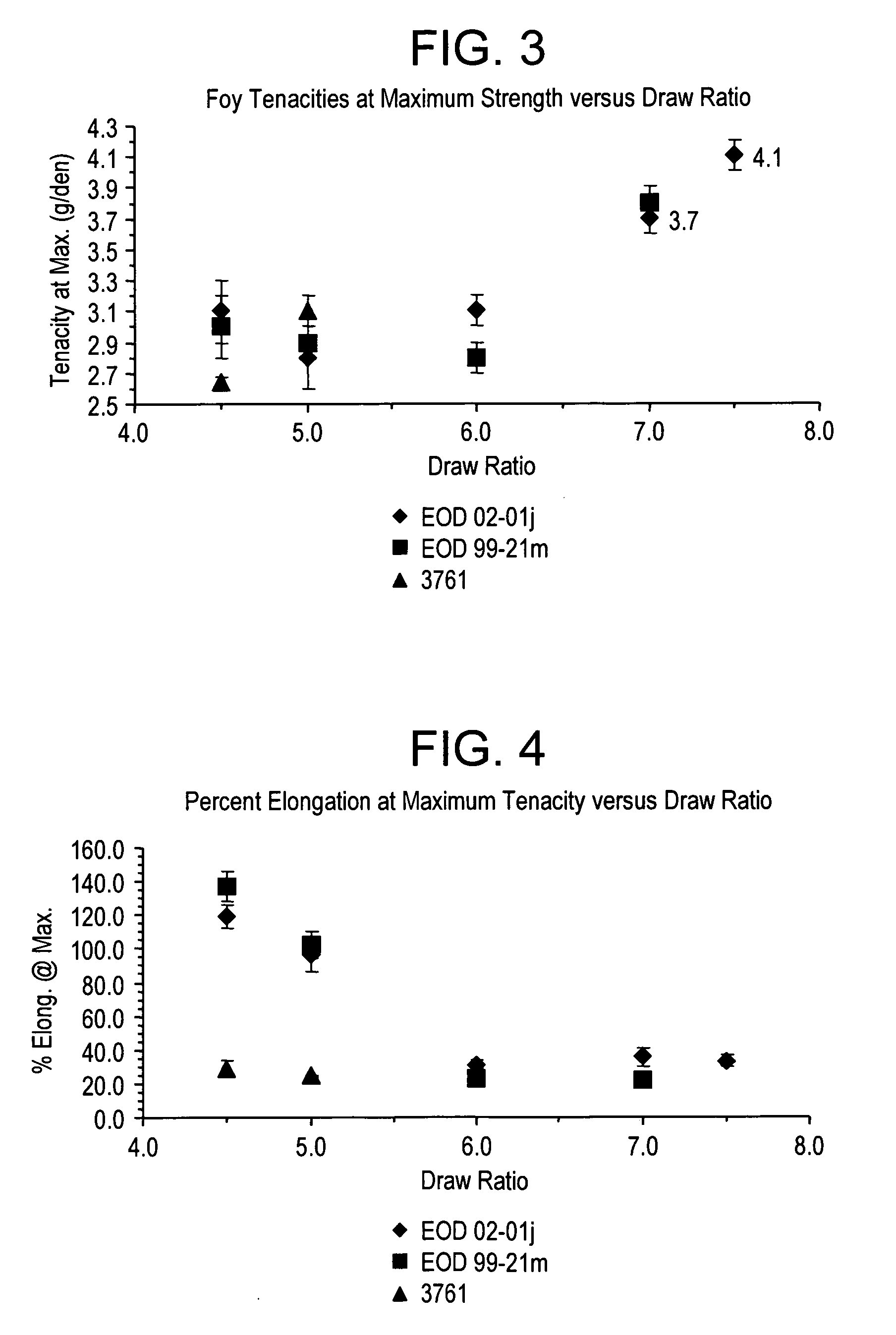
Figure 2 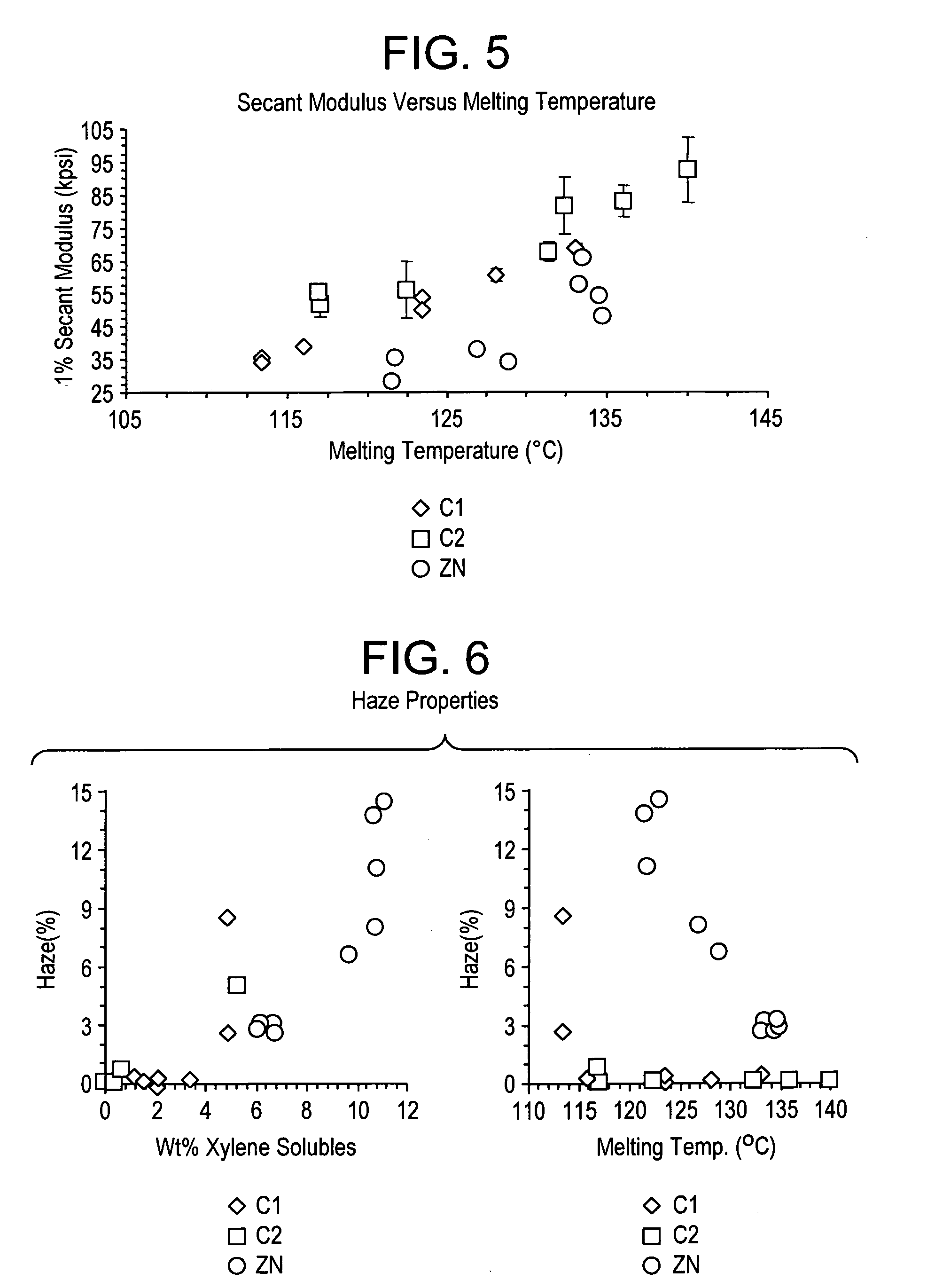
Figure 3
Abstract
Description
BACKGROUND OF THE INVENTION
[0001] 1. Technical Field
[0002] This invention relates to the field of polymers and more specifically to the field of articles prepared from polypropylene homopolymers and copolymers.
[0003] 2. Background of the Art
[0004] Homopolymers and copolymers of polypropylene are typically polymerized in continuous polymerization reactors, such as, for example, loop reactors. To produce these polymers one or more monomer streams are generally introduced into the selected reactor and then circulated with an appropriate catalyst. Frequently, conventional Ziegler-Natta catalysts are employed. The resulting polymers may be subjected to appropriate purification and post-processing steps and then made into end products using conventional techniques such as injection molding and extrusion. These end products may be, for example, films, molded articles, and fibers, as well as the woven and non-woven products that may be prepared from the fibers.
[0005] Unfortunately, Ziegler-Natta...
Examples
example 1
Highly Drawn Fibers
[0263]Three polymers are used to prepare fully oriented yarn (FOY) and then tested for certain physical properties.
[0264]The first polymer has the designation 3671 and is a conventional Ziegler-Natta catalyzed polypropylene homopolymer and is a comparative example. The second polymer is also a polypropylene homopolymer and has the designation EOD 99-21m and is prepared using a bis-dienyl catalyst, C1, and is also a comparative example. It has a xylenes soluble content of about 0.5 percent and a polydispersity of about 3.4. The third polymer is a polypropylene copolymer having less than 0.5 percent ethylene and has the designation EOD 02-01j. It is prepared using a CpFlu catalyst, C2. EOD 02-01j has a xylene solubles level of about 0.06 percent and a polydispersity of about 2.35.
[0265]The melt spinning and drawing operations are carried out using a Fourne melt spinning line with an extruder profile of 200 / 210 / 220 / 230 / 230° C. Quench conditions are 1.0 mbar at 10° C....
example 2
Polymer Films
[0269]Cast films of the resins used in Example 1 are made using an Egan cast film line (Model # F007403). The extrusion system is run with the zone temperatures listed in Table 2 below. The extruder has a L / D ratio of 32:1, with the screw being 3½″ in diameter. It is equipped with a 200 mesh screen pack. A Johnson 24″ Spartan Flex Lip die is attached to the end of the extruder piping. It has a back center feed entrance with a coat hanger-type die manifold and hard chrome plated flow surfaces. Die gap is s held at 20 mils. The exiting melt is cast onto polished chrome-plated cast and chill rolls. The distance between the die exit and cast roll surface is <1 cm. Roll temperatures were maintained at 60° F. (15° C.) through a chilled water circulation unit. The melt was pinned to the roll surface using an air knife. Line speed was maintained at 100 ft / min (30.5 m / min).
[0270]The 2 mil (0.05 mm) films are tested for haze, secant modulus as a function of metlign temperature an...
example 3
Heat Seal Properties
[0272]Films are prepared as in Example 2 using two comparative resins prepared using catalyst C1 and four example resins prepared using catalyst C2 having the properties shown in Table 3. The maximum seal strength and average seal strength in newtons per centimeter is plotted on the ordinate versus the seal temperature T in degrees Centigrade on the abscissa for the polymer shown in Table 3. The results from the testing are displayed in FIGS. 8–10.
[0273]
TABLE 3Properties of some random copolymersMelt FlowXyleneRateSolublesMeltingEthylenePolyMat'l(dg / min)(wt %)Point (° C.)(wt %)dispersityC1-a7.22.07122.74.72.90C1-b7.74.73112.26.53.13C2-a18.00.06140.80.72.35C2-b19.00.05131.41.82.44C2-c13.70.15120.92.72.20C2-d10.50.38116.33.22.18
Discussion of the Examples.
[0274]The Examples illustrate the superior haze and tensile properties of the films and fibers prepared using the subject CpFlu catalyzed polypropylene homopolymers and copolymers. The good heat seal properties of ...