P2P transmission method based on roles and credit access control mechanism

A technology of access control and transmission method, applied in the field of P2P transmission, can solve the problems that plague P2P transmission security problems and network performance, and achieve the effect of protecting resource copyright and user privacy, and reducing occupation.

CN101136916AInactive Publication Date: 2008-03-05夏莹杰 +1
0 Cites 30 Cited by

Patent Information

Authority / Receiving Office
CN · China
Patent Type
Applications(China)
Current Assignee / Owner
Publication Date
2008-03-05
Estimated Expiration
Not applicable · inactive patent

Smart Images

  • Figure 1
    Figure 1
  • Figure 2
    Figure 2
  • Figure 3
    Figure 3
Patent Text Reader

Abstract

The method includes following steps: client end sends user certificate information to server; server validates the certificate; server returns node list of the certificate obtainable downloadable resources back to the client end, and P2P transmission (Trans) connection is built between the client end and nodes in the list; in procedure of Trans connection, client end carries out automatic scoring; and after finishing Trans, the method prompts user to carry out manual scoring based on quality of downloaded resources; the score is corresponding to a set of certificate; the client end controls at least one more indexes from downloading speed, upper limit of connected number, and priorities of waiting queues based on the certificate utilized. Comparing with traditional P2P system, the invention combines two kinds of access mechanism of roles and credits with P2P Trans. Features are: secure, high efficiency, controllable resource Trans under environment of peer-to-peer network.
Need to check novelty before this filing date? Find Prior Art

Description

technical field

[0001] The invention relates to the field of P2P transmission methods. Background technique

[0002] In recent years, peer-to-peer computing (Peer-to-Peer, referred to as P2P) has quickly become one of the hot topics in the computer industry. Fortune magazine listed P2P as one of the four technologies that will affect the future of the Internet. It breaks the traditional client / server (C / S) mode, and the status of each node in the network is equal. Each node not only acts as a server, provides services for other nodes, but also enjoys the services provided by other nodes.

[0003] The reason why P2P can be widely recognized all over the world is because it has advantages that the traditional C / S model does not have:

[0004] (1) Decentralization: The resources and services in the P2P network are scattered on all nodes, and the transmission of information and the realization of services are carried out directly between nodes, without the intervention of inte...

Examples

Embodiment Construction

[0043] Architecture:

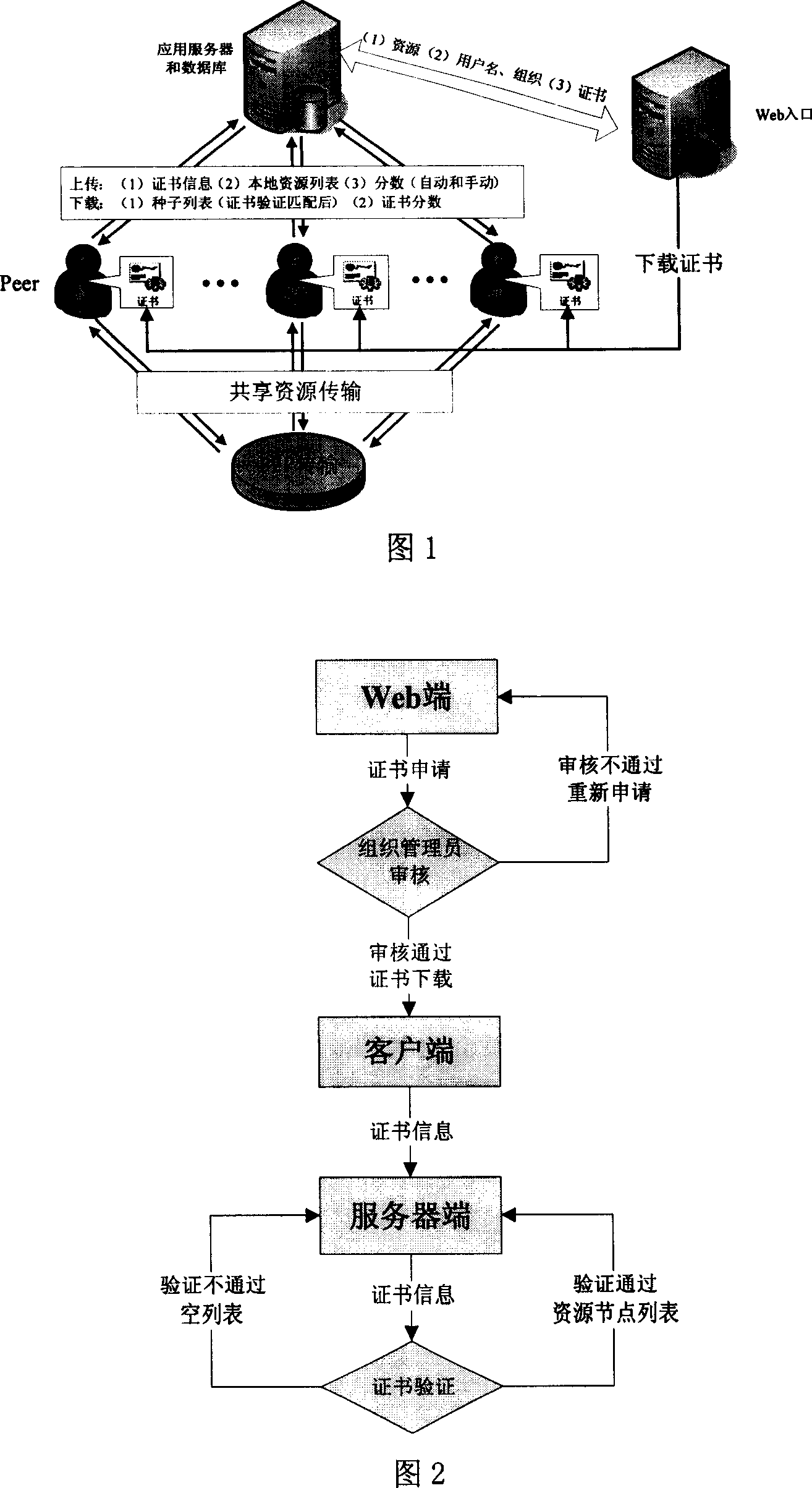
[0044]Refer to accompanying drawing 1. This method combines two sets of access control mechanisms based on role and reputation, and uses P2P technology to realize the shared transmission of file resources. Its architecture is shown in Figure 1, which mainly includes three parts: server side, client side and Web side.

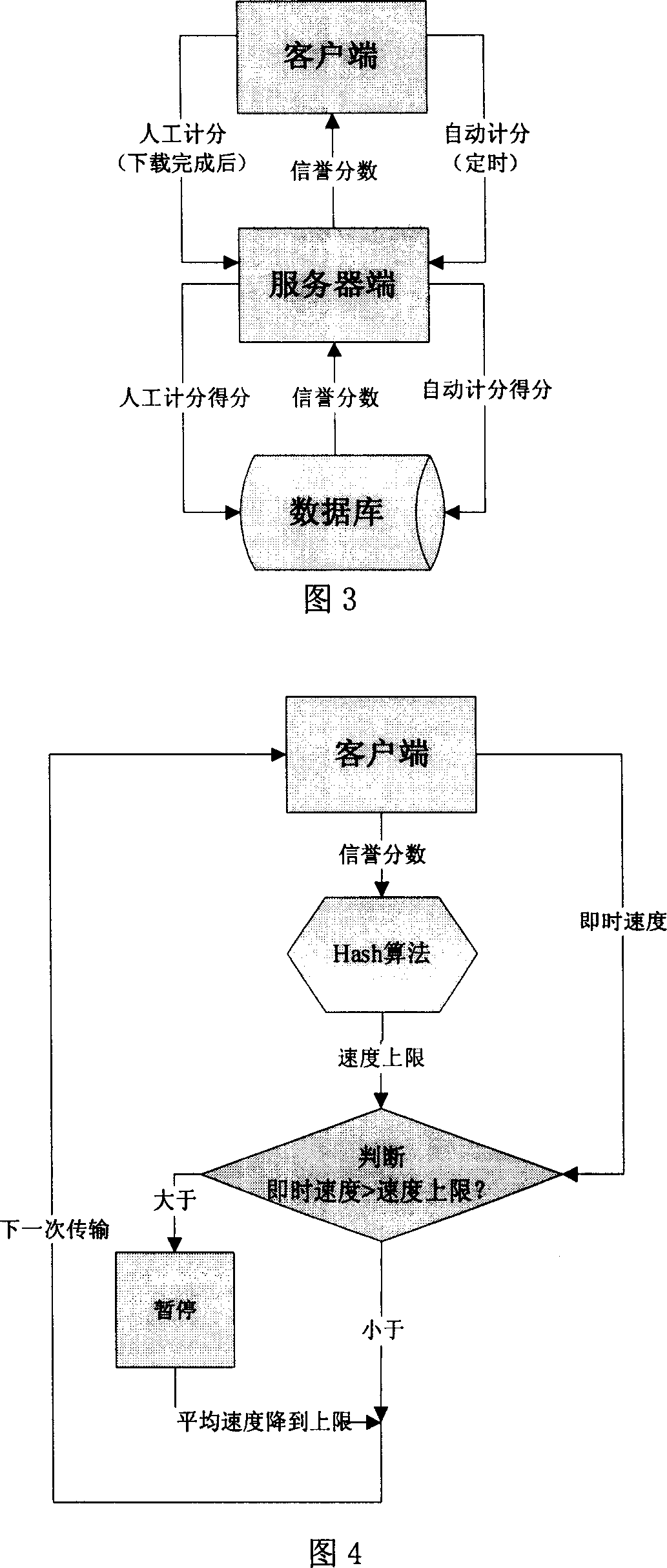
[0045] The server side is mainly responsible for real-time management of system resources. By establishing a connection with the client, the resource information and reputation scores uploaded by the client are reflected in the database in real time. At the same time, verify the certificate information uploaded by the client to decide whether to transmit the node list to the client. In addition, the server side corrects the credit score uploaded by the client according to the original credit score of the uploader, so as to achieve the purpose of reflecting the user credit most accurately.

[0046] The client mainly implements the trans...