Method for obtaining digital photo orientation elements based on digital map

A digital map and acquisition method technology, applied in the direction of photo interpretation, etc., can solve the problems of heavy workload and inability to achieve real-time performance

CN101545776AInactive Publication Date: 2009-09-30SOUTHEAST UNIV
0 Cites 18 Cited by

Patent Information

Authority / Receiving Office
CN · China
Patent Type
Applications(China)
Current Assignee / Owner
Publication Date
2009-09-30
Estimated Expiration
Not applicable · inactive patent

Smart Images

  • Figure 1
    Figure 1
  • Figure 2
    Figure 2
  • Figure 3
    Figure 3
Patent Text Reader

Abstract

The invention provides a method for obtaining digital photo orientation elements based on a digital map. The method comprises the following steps: step 1, a digital photo and a digital map corresponding to the digital photo are shot, wherein the digital photo comprises at least five ground object points, and the digital map comprises homologous points corresponding to the ground object points; the ground object points and the homologous points are totally called as control points; the digital photo is provided with a phone two-dimensional coordinate system, and the digital map is provided with a digital map coordinate system; step 2, coordinates of the control points in the digital map coordinate system and the phone two-dimensional coordinate system and coordinates of a photo principal point in the phone two-dimensional coordinate system are obtained, wherein the photo principal point is a perpendicular foot point of a shooting lens center on the photo; and step 3, a photogrammetric coordinate system D-XDYDZD is established. The invention utilizes the prior digital map as a condition to calculate the orientation elements of a common digital image, thereby providing a simple, convenient and rapid low-cost path for obtaining three-dimensional space information and having small field operation workloads and low expense.
Need to check novelty before this filing date? Find Prior Art

Description

technical field

[0001] The invention relates to a method for obtaining the orientation elements of a photo, in particular to a method for obtaining the orientation elements of an ordinary digital photo by using a digital map. Background technique

[0002] Calculating the orientation elements of photographs is an important content in the field of photogrammetry and computer. Using the orientation elements of photographs can further carry out three-dimensional measurement of photographic targets. At present, there are mainly two methods for calculating the orientation elements of photos: the method of calculating with the help of control points and the method of GPS / INS observation.

[0003] The method of calculation with the help of control points is to use a certain number of reasonably distributed three-dimensional control points (also known as golden points in computer vision) to establish the corresponding relationship with the corresponding image points. The parameters o...

Examples

Embodiment Construction

[0033] The present invention will be further described below in conjunction with the accompanying drawings.

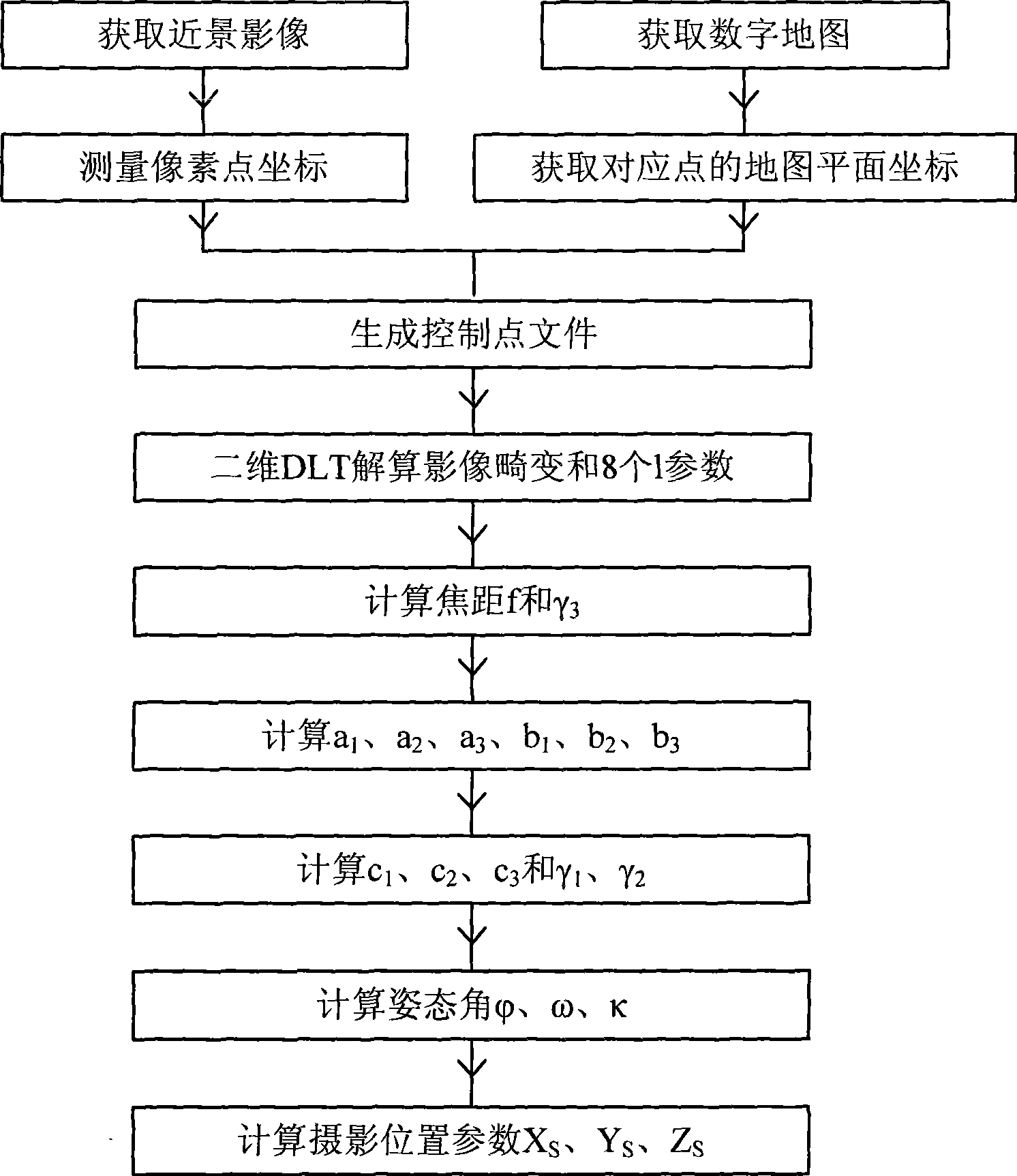
[0034] The calculation method provided by the invention can realize the calculation of the shooting position, shooting attitude, focal length and distortion of the digital photo, can be widely used in digital city construction and three-dimensional modeling, and belongs to the field of close-range photogrammetry and computer vision. The present invention utilizes the two-dimensional direct linear transformation formula, according to the x in the orientation element in the digital photo 0 、y 0 is approximately equal to 0, a method for calculating the orientation elements in the photo is proposed, see figure 1 , the steps are as follows:

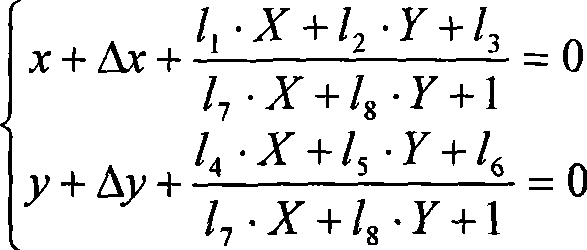
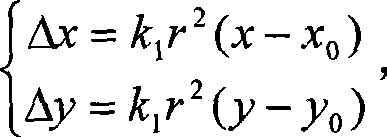
[0035] Step S11: Obtain a digital photo and a digital map corresponding to the digital photo, the digital photo includes at least 5 feature points, the digital map includes points of the same name corresponding to the feature points,...