
Retinitis pigmentosa related gene identification, and product, method and use thereof
A retinal pigment and gene technology, applied in the fields of genetics and molecular biology, can solve the problems of low efficiency in finding disease-causing mutations and difficulties in identifying RP
- Summary
- Abstract
- Description
- Claims
- Application Information
AI Technical Summary
Problems solved by technology
Method used
Image

Examples
Embodiment 1
[0129] Example 1 Identification of disease-associated mutations in patients in RP families
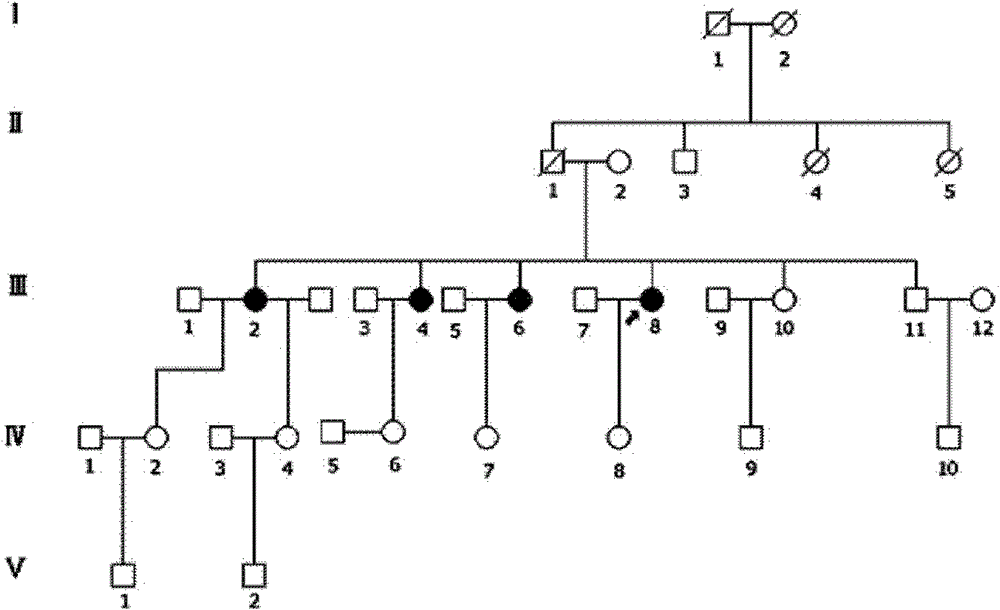
[0130] The inventor used the Agilent SureSelect Human All Exon kit (Agilent Company) in combination with Solexa high-throughput sequencing technology (i.e., using the sequencer Hiseq2000 of Illumina Company to operate in accordance with the instructions provided by the manufacturer, and its introduction or product manual can be found at http: / / www.illumina.com / ) sequenced the exome sequences of three patients in the family (III2, III4, III6) and one normal person in the family (II2). The methods and steps used are all carried out according to the instructions for use provided by the manufacturer and conventional techniques in this area, and the brief experimental process is as follows:
[0131] 1) Genomic DNA extracted from the blood sample of the patient or normal person was randomly broken into fragments of about 150-200bp, and then adapters were connected to both ends of the frag...
Embodiment 2
[0135] Example 2: Further identification of compound heterozygous mutations associated with retinitis pigmentosa
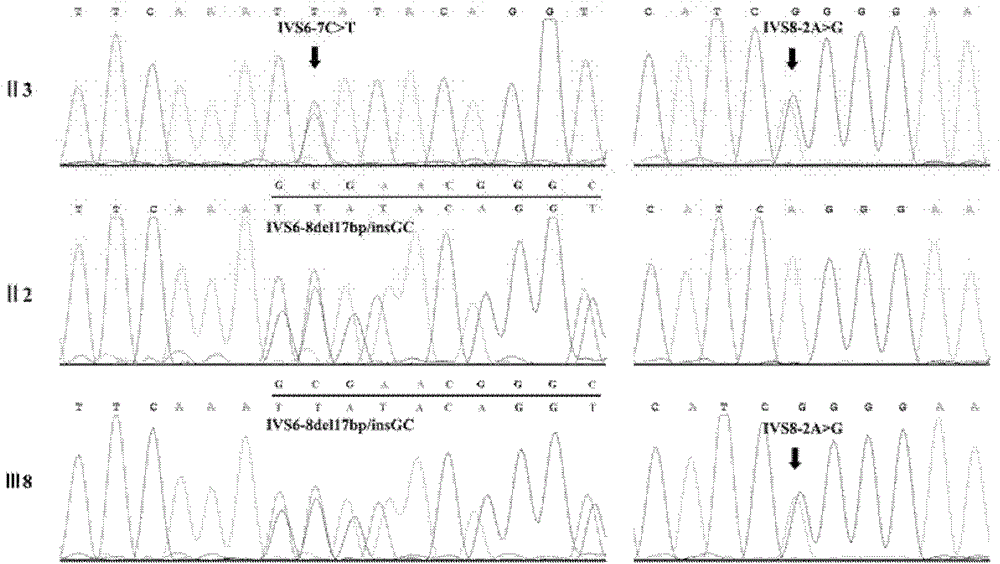
[0136] As can be seen from the above description, the RP family detected in the present invention has a total of 4 patients, all of which are the third generation, and there are no patients in the second and fourth generations. This means that the mode of inheritance should be recessive, that is, the disease will occur only when there are homozygous mutations or compound heterozygous mutations (two heterozygous mutations appear in different positions of the same gene). However, the 26 variants obtained after filtering in Example 1 were all heterozygous mutations, which made the inventors start looking for the possibility of compound heterozygous mutations.
[0137] Among the genes corresponding to the 26 heterozygous mutations identified in Example 1, CYP4V2 was reported to be associated with Bietti crystalline corneoretinal dystrophy (BCD) (Li A, Jiao X, Munier F...
Embodiment 3
[0153] Example 3 Mutations IVS8-2A→G and IVS6-8del17bp / insGC can be used to identify patients with RP
[0154] In order to further verify that the identified mutations can be used to identify the occurrence of RP disease, the inventors further detected the genes of 4 patients in the pedigree, 11 normal people in the pedigree and 7 normal people outside the pedigree, and amplified by PCR , product purification, and sequencing methods to obtain CYP4V2-related sequences, and verify the correlation between the CYP4V2 mutation and retinitis pigmentosa according to whether the sequence determination results belong to the mutant type or the wild type. The specific experimental process is as follows:
[0155] 3.1 Sample Preparation.
[0156] The peripheral venous blood of 4 patients in the family, 11 normal people in the family and 7 normal people outside the family were collected respectively, and 2ml of peripheral blood was extracted from the subjects, and DNA was extracted with Qi...
PUM
 Login to View More
 Abstract
Description
Claims
Application Information
 Login to View More