
Power distribution method used in cognitive wireless relay network
A wireless network and cognitive relay technology, which is applied in the field of power allocation in cognitive relay wireless networks, can solve the problems of high computational complexity and large number of iterations in power allocation methods for bidirectional cognitive wireless networks
- Summary
- Abstract
- Description
- Claims
- Application Information
AI Technical Summary
Problems solved by technology
Method used
Image

Examples
Embodiment Construction
[0024] The invention will be described in further detail below in conjunction with the accompanying drawings.
[0025] 1. Build a model
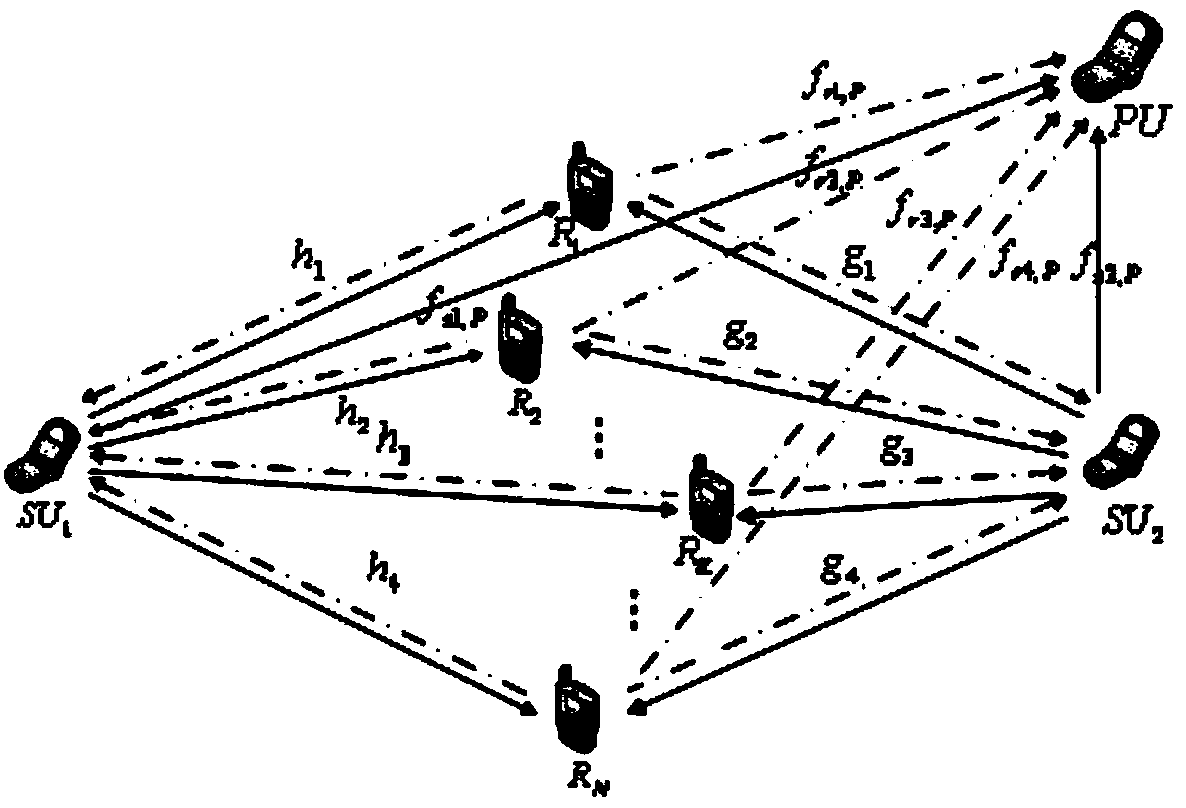
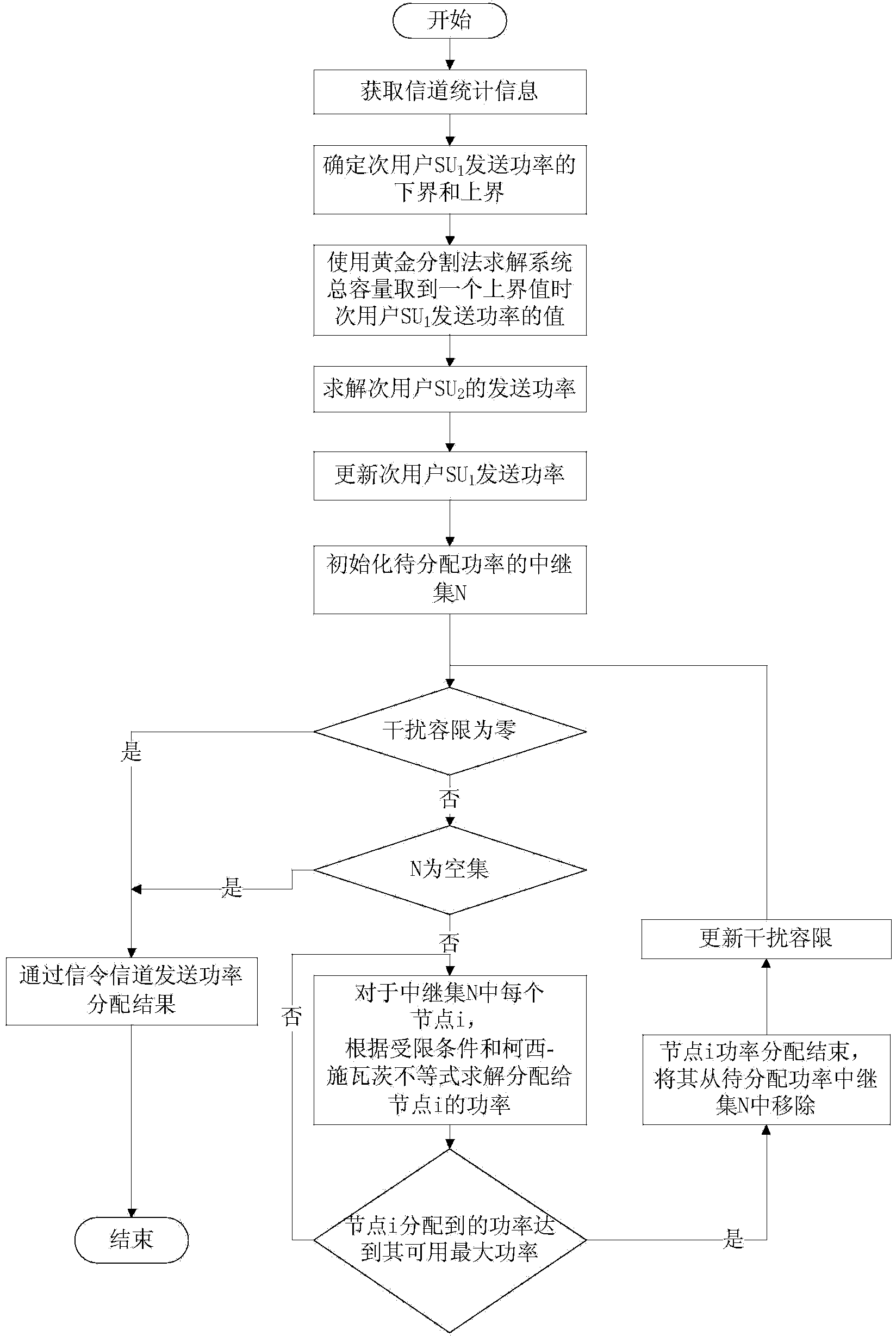
[0026] Such as figure 1 As shown, the model of the present invention includes a primary user PU and two secondary users SU 1 and SU 2 , due to the poor quality of the communication channel between the two secondary users, it must be in the relay set {R 1 , R 2 ,...R N} in the cooperation of N relay nodes to help users transmit signals next time. The present invention assumes that each node has only one antenna and cannot send and receive at the same time, and SU 1 or SU 2 Grasp all the instantaneous channel state information (Channel State Information, CSI), this process can be obtained through the traditional channel state information acquisition method. Power Allocation Process at SU 1 or SU 2 Execute at , and the optimal power allocation result is sent to each node through an additional auxiliary channel.
[0027] The communica...
PUM
 Login to View More
 Abstract
Description
Claims
Application Information
 Login to View More