Method for improving precision and accuracy of capacitive touch key

An accuracy and key technology, applied in electrical components, electronic switches, pulse technology, etc., can solve the problems of high sensitivity, non-adjustable touch key sensitivity, reduced change ratio, etc., to achieve the effect of improving precision and accuracy

CN104202031AInactive Publication Date: 2014-12-10SHANDONG CHAOYUE DATA CONTROL ELECTRONICS CO LTD
3 Cites 1 Cited by

Patent Information

Authority / Receiving Office
CN · China
Current Assignee / Owner
Publication Date
2014-12-10
Estimated Expiration
Not applicable · inactive patent

Smart Images

  • Figure 1
    Figure 1
  • Figure 2
    Figure 2
Patent Text Reader

Abstract

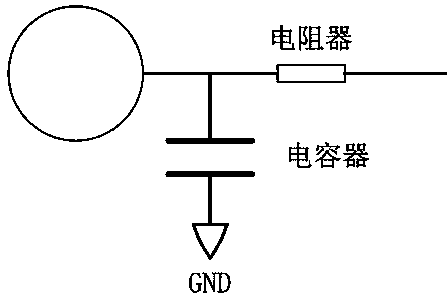
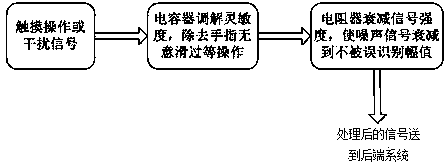
The invention provides a method for improving the precision and the accuracy of a capacitive touch key. The method comprises the following specific steps of: step 1), a resistor is added to the transmission path of the touch key, thus the various noise signals are attenuated to amplitudes which cannot be identified after passing through the resistor, so as to improve the identification precision, a resistor with a resistance of 1k to 3k is added to the transmission path at the rear end of the touch key, and because the amplitude of an interference signal is low, the amplitude is greatly attenuated and cannot be wrongly identified after passing through the resistor; step 2) in order to solve the problem of nonadjustable sensitivity or too high sensitivity of the touch key, a capacitor is connected aside the key in parallel, after the capacitor is added, a total capacitance of the touch area of the touch key to the ground is equivalently increased, when the key is touched by a finger, the generated capacitance change is certain, and if the total capacitance is increased, that is, a change ratio is reduced, the problem of too high sensitivity of key touch identification is solved, and when a certain distance exists between the finger and the key or the finger incidentally slides through the surface of the key, the operations of the key cannot be triggered.
Need to check novelty before this filing date? Find Prior Art

Description

technical field

[0001] The invention relates to the design of capacitive touch keys for notebook computers, desktop computers and tablet computers. The invention proposes a method for improving the touch recognition precision and accuracy of touch keys, improving the anti-interference ability and avoiding misoperation of keys, specifically a method for improving the precision and accuracy of capacitive touch keys. Background technique

[0002] Touch keys are widely used in electronic products including computers because of their good waterproof and moisture resistance, relatively simple structural design, and no limit on the number of times of use of mechanical keys. However, due to the low reliability of touch buttons and the instability of general solutions, it is rarely used in special fields such as special computers. The present invention is proposed for the fields that require the application of touch buttons and at the same time pay attention to the precision and acc...

Examples

Embodiment Construction

[0011] A method for improving the precision and accuracy of capacitive touch keys according to the present invention will be described in detail below with reference to the accompanying drawings.

[0012] A method of improving the precision and accuracy of the capacitive touch button of the present invention, in order to solve the problem that the sensitivity of the touch button is not adjustable and the sensitivity is usually too high, a method of connecting a capacitor in parallel next to the button is proposed in the circuit design. After adding this capacitor, it is equivalent to increasing The total capacitance from the touch area of ​​the touch button to the ground, when a conductor such as a finger touches the button, the capacitance change is constant, but the total capacitance increases, that is, the change ratio decreases, which solves the problem of the button The problem of high touch recognition sensitivity, when the finger is still a certain distance away from the...