Non-data aided OQPSK (Offset Quadra Phase Shift Keying) signal closed loop carrier synchronization method

A non-data-assisted, carrier synchronization technology, applied in the field of testing, can solve the problems of phase-locked loop loss of lock, long phase-locked loop lock-in time, carrier synchronization algorithm can not meet the actual system processing requirements and other problems

CN104601506AActive Publication Date: 2015-05-06THE 41ST INST OF CHINA ELECTRONICS TECH GRP
6 Cites 10 Cited by

Patent Information

Authority / Receiving Office
CN · China
Patent Type
Applications(China)
Current Assignee / Owner
Publication Date
2015-05-06

Smart Images

  • Figure 1
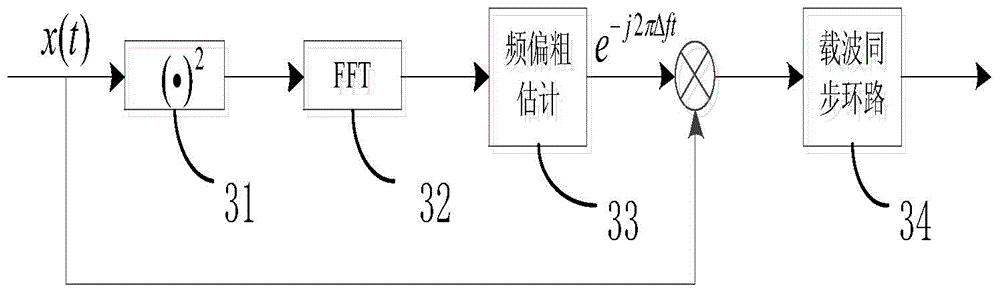
    Figure 1
  • Figure 2
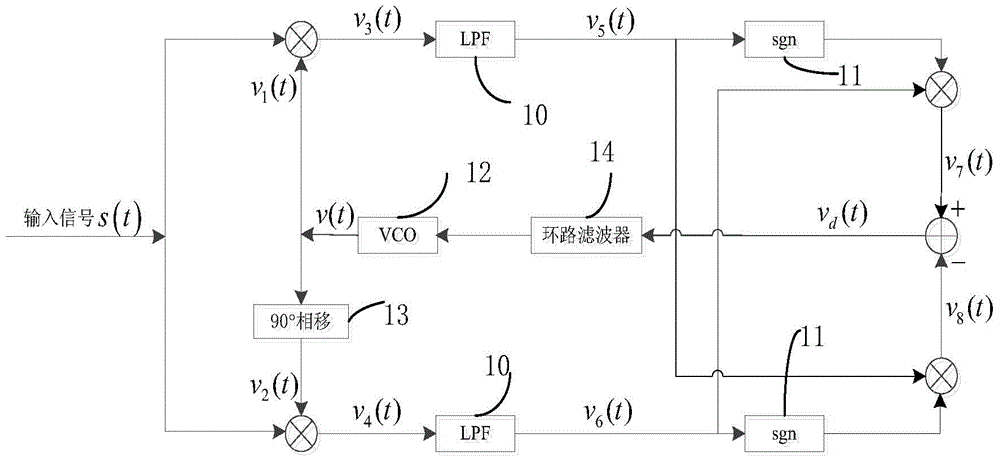
    Figure 2
  • Figure 3
    Figure 3
Patent Text Reader

Abstract

The invention provides a non-data aided OQPSK (Offset Quadra Phase Shift Keying) signal closed loop carrier synchronization method. The square spectrum characteristics of an OQPSK signal are utilized, a square spectrum estimation based carrier frequency offset coarse estimation algorithm is adopted, and accordingly the range of the frequency of the signal can be effectively reduced. A carrier synchronization loop is of a dot product and cross product frequency discriminator and phase discriminator combined cross ring structure and accordingly the speed and the accuracy of the carrier synchronization can be ensured simultaneously. A proportional integral filter is adopted as a loop filter to enable the synchronization loop to be a second-order loop and accordingly the stable loop dynamic response can be implemented under the conditions that the direct current gain is infinite and the frequency offset is a constant. According to the non-data aided OQPSK signal closed loop carrier synchronization method, the frequency offset can be accurately estimated, the accuracy and the speed of the carrier synchronization can be ensured, and the recruitments of a communication system can be met through the combined utilization of a dot product and cross product frequency discriminator and phase discriminator on the basis of the square spectrum frequency offset coarse estimation.
Need to check novelty before this filing date? Find Prior Art

Description

technical field

[0001] The invention belongs to the technical field of testing, and in particular relates to a non-data-assisted OQPSK signal closed-loop carrier synchronization method. Background technique

[0002] As a constant envelope digital modulation technology, OQPSK not only has high frequency band utilization and power utilization, but also eliminates the 180° carrier phase jump. In the actual communication system with limited bandwidth, the envelope fluctuation is small and has been It has become a commonly used modulation method in the field of measurement, control and communication, such as TDMA and CDMA systems.

[0003] Since many communication systems use coherent demodulation to restore the modulated signal, the receiver needs to generate a carrier signal with the same frequency and phase relationship as the signal transmitted by the transmitter when performing coherent demodulation. Therefore, in order to realize the correct transmission of the signal and ...

Examples

Embodiment 1

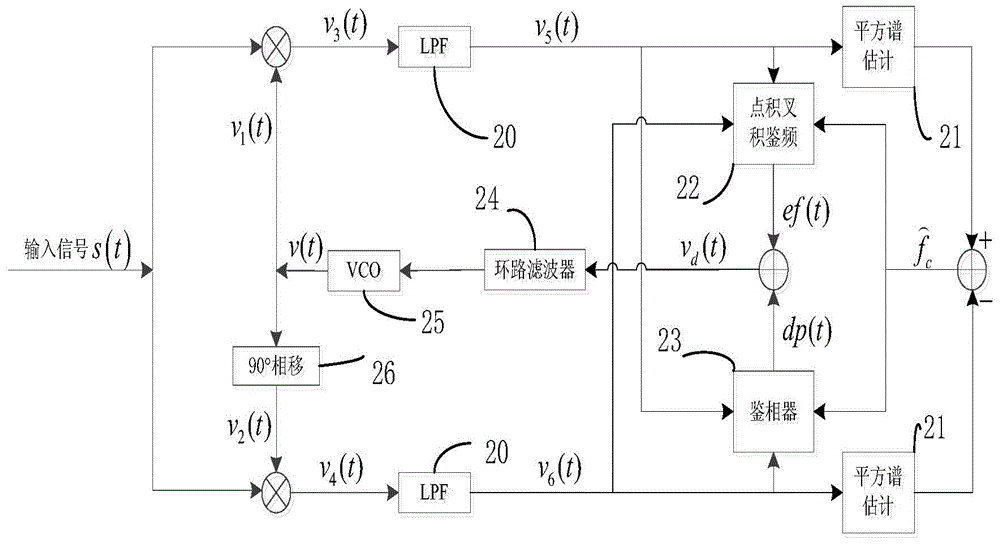
[0029] The principle block diagram of the carrier synchronization algorithm based on square spectrum estimation realized by the present invention is as follows: figure 2 shown. This method adds a square spectrum estimation 21 and a dot-product cross-product frequency discriminator 22 to the structure of the traditional phase-locked loop-based synchronization method. The specific signal processing flow is as follows:

[0030] Let the received signal be s(t)=I(t)cos(ω c t+θ)+Q(t)sin(ω c t+θ), the local carrier signal is the output signal v(t)=cos(ω) of the local oscillator (VCO) 25 0 t+θ 0 ), then the upper and lower signals for quadrature demodulation are in-phase signals v 1 (t)=cos(ω 0 t+θ 0 ) and quadrature signal v after 90° phase shift 26 2 (t)=sin(ω 0 t+θ 0 ), the received signal s(t) and the two orthogonal signals v 1 (t) and v 2 (t) Perform quadrature demodulation in the mixer to obtain two orthogonal demodulation signals v 3...