Moving target detecting and tracking algorithm evaluation method based on data set compensation

A moving target, detection and tracking technology, applied in image data processing, computing, instruments, etc., can solve problems such as similar interference, restricting evaluation accuracy, and large workload.

CN104851112AActive Publication Date: 2015-08-19BEIJING INSTITUTE OF TECHNOLOGYGY
4 Cites 23 Cited by

Patent Information

Authority / Receiving Office
CN · China
Current Assignee / Owner
Publication Date
2015-08-19

Smart Images

  • Figure 1
    Figure 1
  • Figure 2
    Figure 2
  • Figure 3
    Figure 3
Patent Text Reader

Abstract

The invention discloses a moving target detecting and tracking algorithm evaluation method based on data set compensation. The moving target detecting and tracking algorithm evaluation method automatically adds quantification factors of eight performance interference factors for data sets, and allows the user to select variation factors when evaluating an algorithm conveniently; the moving target detecting and tracking algorithm evaluation method can customize weight sizes of the variation factors according to degree of sensitivity of a specific evaluated algorithm to specific variation factors, so that comprehensive quantification factors corresponding to the data sets truly reflect the algorithm application environments, and finally the objectiveness of evaluation results is ensured; at last, since the comprehensive quantification factors are comprehensive quantification embodiments of the variation factors affecting algorithm performances in the corresponding data sets, the comprehensive quantification factors of the data sets are adopted for performing weighted compensation for threshold values used for carrying out success determination of the evaluation index precision OverlapP, can show different influences of the data sets with different variation factors on the algorithm performances in the evaluation result, can simulate results of the algorithm under some interference conditions, and provides certain guidance for the further improvement direction of the algorithm.
Need to check novelty before this filing date? Find Prior Art

Description

technical field

[0001] The invention relates to the field of video image processing, in particular to an evaluation method of a moving target detection and tracking algorithm based on data set compensation. Background technique

[0002] With the far-reaching development in the field of computer vision, target detection and tracking algorithms emerge in an endless stream, and automatic target tracking systems are widely used in our lives, which also brings a variety of complex application environments, resulting in target The imaging forms are different, which brings difficulties to the detection and tracking of targets by computer vision algorithms. The evaluation of target detection and tracking algorithm and its system is the most basic stage in the development of automatic target tracking system. The evaluation of the algorithm can not only compare and select the existing algorithms, but also clarify the further development direction of the algorithm and promote the furt...

Examples

Embodiment Construction

[0084] The present invention will be described in detail below with reference to the accompanying drawings and examples.

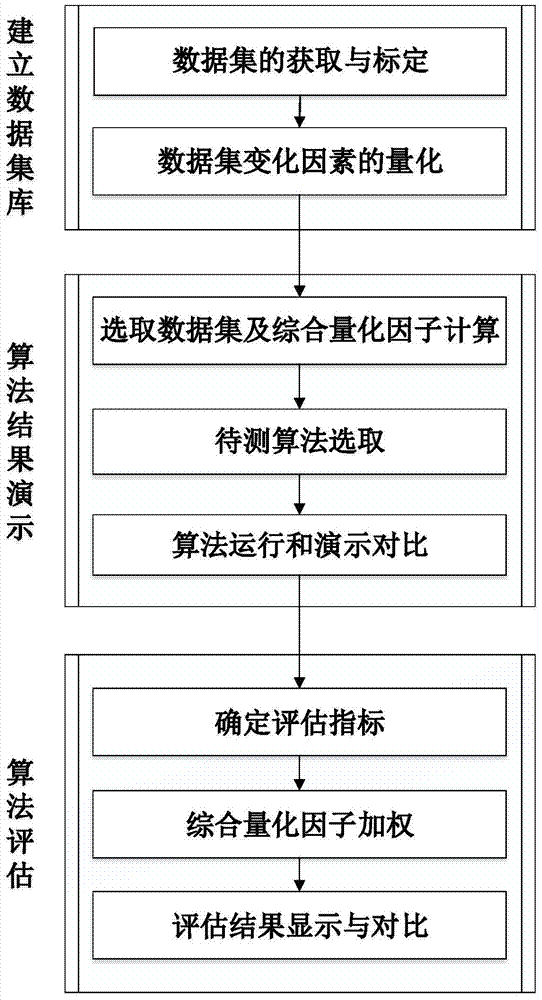
[0085] The invention proposes an evaluation method for moving target detection and tracking algorithms based on data set variation factor compensation. This embodiment is implemented on a PC with VS2010 and OpenCV2.4.0 installed. Such as figure 1 As shown, it specifically includes the following steps:

[0086] Step 1, the establishment of the dataset library.

[0087] Step 1-1, data set acquisition and calibration.

[0088] The source of the data set is mainly divided into two categories, one is the public data set released by other experimental institutions collected through the network and other channels, and the other is a new data set produced by ourselves through shooting and calibration. The first type of public data set is convenient and quick to collect but not very specific to the specific environment. The second type of new data set is slow t...