Breeding method of cabbages processed by cold plasma and application thereof

A cold plasma and cabbage technology, applied in the agricultural field, can solve the problems of not reaching the early maturity of cabbage, unable to know the cold plasma, reducing the affinity index, etc., to shorten the breeding cycle, improve the mutation rate, and achieve a high mutation rate. Effect

CN105580727AActive Publication Date: 2016-05-18SHANDONG PROVINCE SEEDS CO LTD
9 Cites 5 Cited by

Patent Information

Authority / Receiving Office
CN · China
Current Assignee / Owner
Publication Date
2016-05-18

Smart Images

  • Figure 1
    Figure 1
  • Figure 2
    Figure 2
  • Figure 3
    Figure 3
Patent Text Reader

Abstract

The invention discloses a breeding method of cabbages processed by cold plasma and application thereof. Early-maturing cabbage parental seeds are placed in an ion radio-frequency seed processing instrument and are processed at proper power, planting and screening are performed at proper time, the compatible index of self-incompatible lines is measured, and the duration period and the matching capacity of early-maturing materials are compared. According to breeding targets, the self-incompatible lines and the early-maturing materials are selected, the self-incompatible lines are identified and analyzed through the conventional breeding means of selfing, back-crossing, test crossing and the like and by means of molecule marked and isozyme marked self-incompatible genes, cabbage stable male and female parent materials are obtained through breeding, the male and female parent materials are crossbred and matched in a testing mode so that cabbage cross combinations can be obtained, and finally new excellent cabbage species are obtained through resistance identification experiments and variety comparison experiments. The cabbage breeding materials are processed at proper power-supply power, the self-compatible index of the self-incompatible lines can be reduced, the early-maturing performance of cabbages is promoted, the breeding period is shortened, and new extremely-early-maturing species good in comprehensive performance are cultivated.
Need to check novelty before this filing date? Find Prior Art

Description

technical field

[0001] The invention relates to a cabbage breeding method, in particular to a cold plasma-treated cabbage breeding method and its application, belonging to the field of agriculture. Background technique

[0002] Cabbage (Brassica oleracea L.) is an annual or biennial herbaceous plant of the Brassica genus. As one of the main vegetable crops, with the adjustment of industrial structure and the increase of consumption demand, the planting area of ​​cabbage has increased year by year, which puts forward higher requirements for cabbage breeding. However, at present, the probability of selection and utilization of self-incompatible lines and male sterile lines in cabbage breeding is low, and it is difficult to control the purity of hybrids, which affects the progress of cabbage breeding. Plasma is the fourth state of matter, that is, the fourth state of matter, which is a state of matter aggregation with higher energy. Acting on complex biomacromolecules, part o...

Examples

Embodiment 1

[0034] Embodiment 1, a kind of cold plasma treatment cabbage breeding method

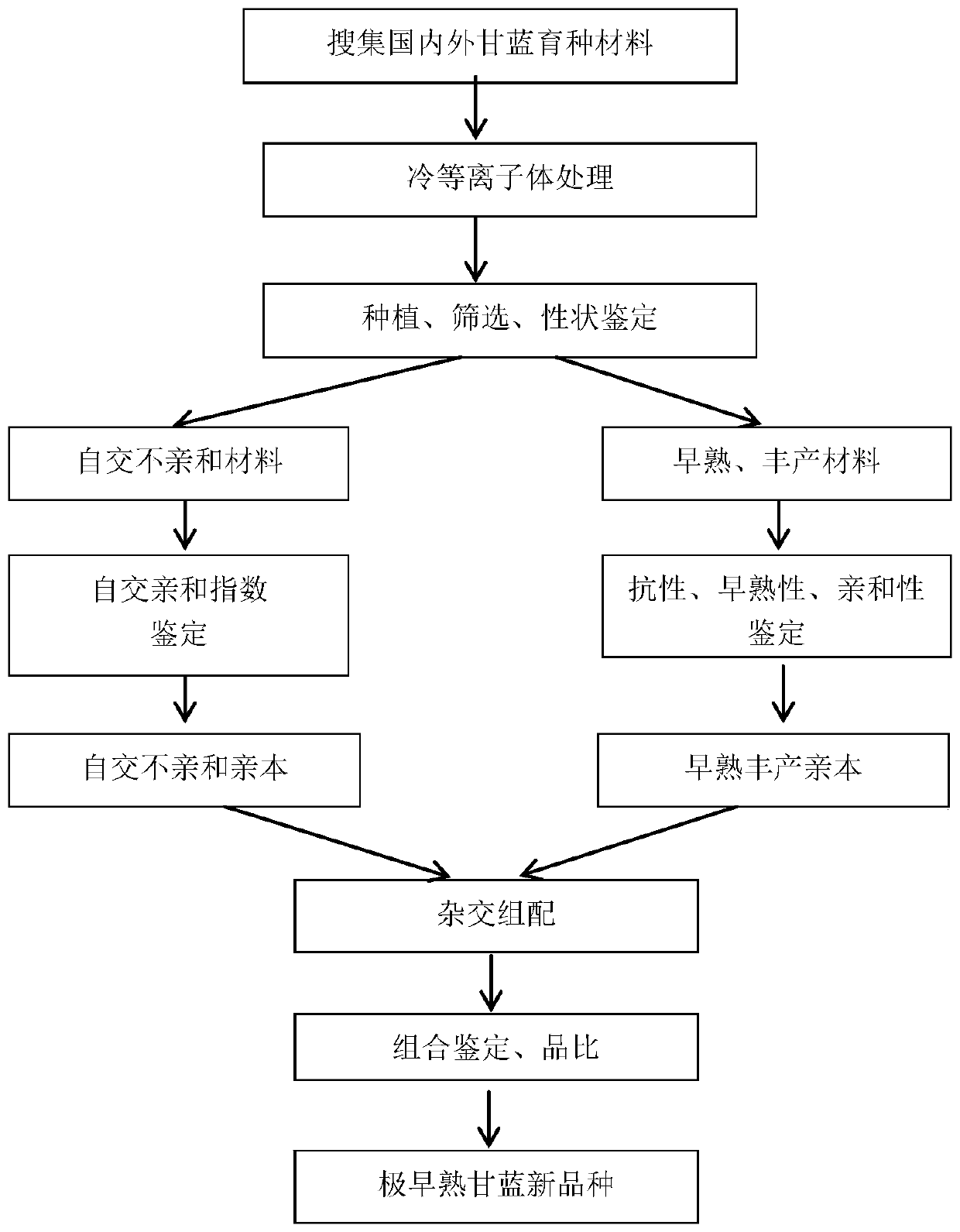
[0035] The cabbage breeding method treated with cold plasma can obtain new cabbage varieties with characteristics such as low self-compatibility index, early maturity, strong stress resistance, and high yield, which specifically includes the following steps, as figure 1 Shown:

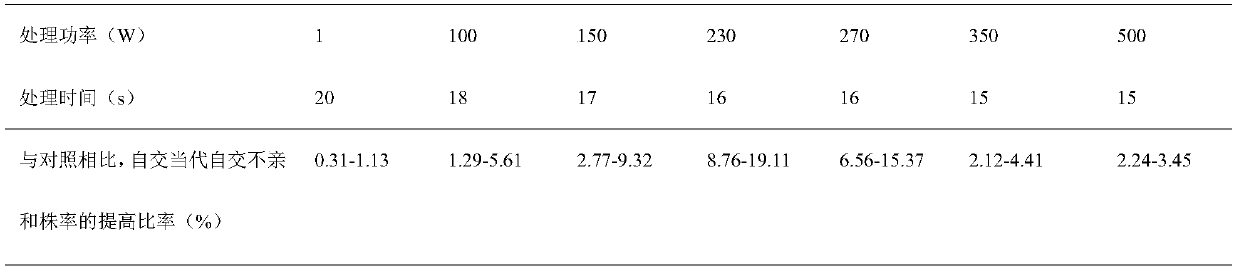
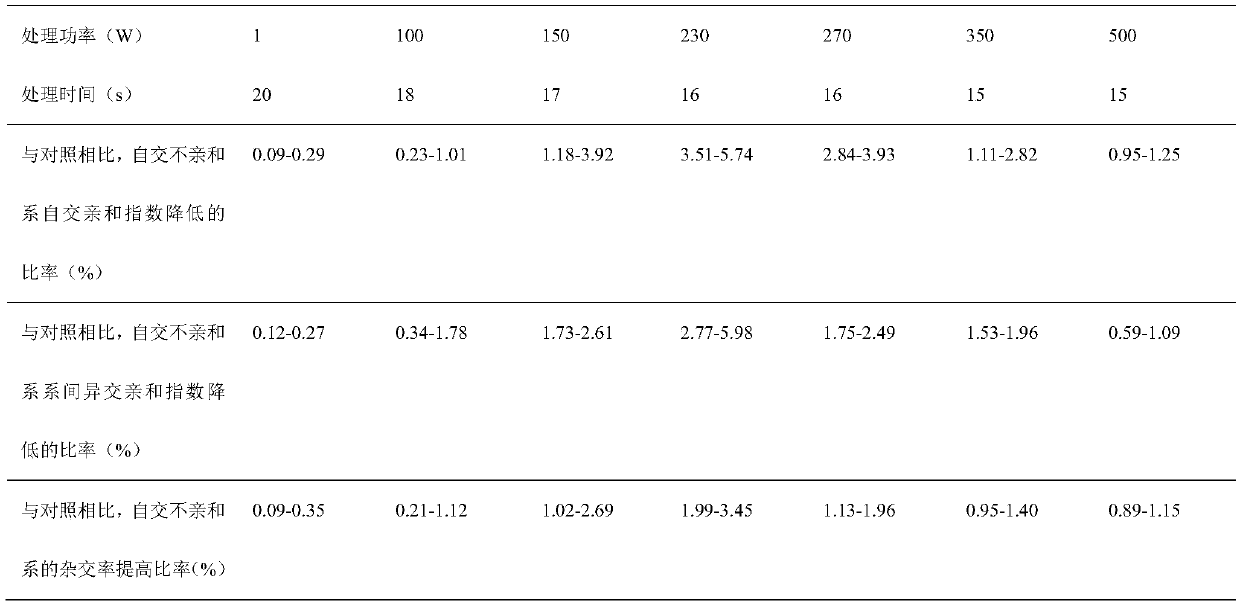
[0036](1) Collect the breeding material that meets the breeding target as the key breeding object, put the parental seeds of cabbage in the ion radio frequency seed treatment instrument, carry out 16s non-ionizing radiation treatment with 230W power supply power, the necessary condition for processing is to use helium as The working medium is carried out in a vacuum sealed environment. The specific experimental materials are LZ001, LZ002, LZ003, LZ004, LZ005, LZ006.

[0037] (2) Preserve under low temperature and dry conditions, so as to be sown in due course;

[0038] (3) Planting, screening, measuring the compatibility ...