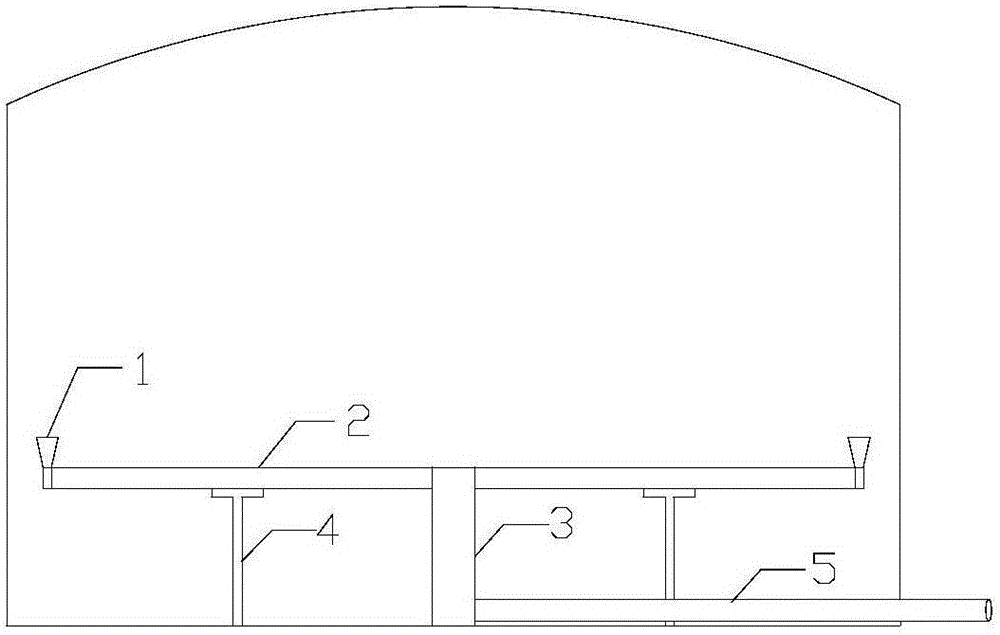
Crude-oil-precipitation-tank aging-oil collecting device

A collection device and settling tank technology, applied in the direction of mechanical dehydration/demulsification, etc., can solve the problem of incomplete removal of aged oil, achieve the effect of improving crude oil treatment effect, improving structural strength, and preventing corrosion and scaling

CN105838414AInactive Publication Date: 2016-08-10PETROCHINA CO LTD
5 Cites 0 Cited by

Patent Information

Authority / Receiving Office
CN · China
Patent Type
Applications(China)
Current Assignee / Owner
Publication Date
2016-08-10
Estimated Expiration
Not applicable · inactive patent

Smart Images

  • Figure 1
    Figure 1
Patent Text Reader

Abstract

The invention discloses a crude-oil-precipitation-tank aging-oil collecting device. The crude-oil-precipitation-tank aging-oil collecting device at least comprises an oil collecting pipe, a middle converging pipe and an oil discharging pipe. The oil collecting pipe is arranged in the circumferential direction of the inner wall of a crude-oil precipitation tank, and upward oil collecting openings are formed in the oil collecting pipe; the oil collecting pipe is further connected with the middle converging pipe in a dredged mode; the middle converging pipe is connected with the oil discharging pipe in a dredged mode. According to the crude-oil-precipitation-tank aging-oil collecting device, as the oil collecting openings are formed in the inner circumferential direction of the crude-oil precipitation tank to collect aging oil in the tank, the aging oil is converged at the middle converging pipe and discharged through the oil discharging pipe, efficient collecting and efficient discharging of the aging oil in the crude-oil precipitation tank are achieved, and the aims that the loads of the precipitation tank are reduced, corrosion and scaling of a tank body are prevented, the treating effect on crude oil is improved, and the oil-water interface position is accurately determined are achieved.
Need to check novelty before this filing date? Find Prior Art

Description

technical field

[0001] The invention relates to the technical field of collecting devices, in particular to an aging oil collecting device for a crude oil settling tank. Background technique

[0002] The settling tank is a container for dehydration of crude oil by physical sedimentation in the process of crude oil treatment. Due to the difference in density between crude oil and water, oil moves upward and water moves downward, thereby realizing oil-water separation. In the crude oil in the settling tank, there are some 50-500nm solid particles, which contain heavy components such as colloid and asphaltenes and solid impurities higher than ordinary crude oil, and are adsorbed at the oil-water interface. The jelly formed by solid particles and asphaltene has certain stability. This jelly forms a ring around the tank wall of the settling tank and is not easy to be collected and utilized. It is usually called aging oil.

[0003] The aging oil remaining in the crude oil settlin...

Examples

Embodiment Construction

[0020] The embodiment of the present invention provides a crude oil settling tank aging oil collection device, which solves the technical problem of incomplete removal of aging oil in the settling tank in the prior art, realizes reducing the load of the settling tank, and prevents corrosion and scaling of the tank body. Improve the crude oil treatment effect and accurately determine the technical effect of the oil-water interface position.

[0021] The technical solution in the embodiment of the present invention is to solve the above-mentioned technical problems, and the general idea is as follows:

[0022] The aging oil in the tank is collected by arranging oil collectors in the circumferential direction in the crude oil settling tank, and collected at the intermediate header, and discharged through the oil discharge pipeline, which realizes the efficient collection and discharge of the aging oil in the crude oil settling tank , so as to achieve the purpose of reducing the l...