
Dust removal device applicable to PCB (Printed Circuit Board)
A technology of PCB board and dust removal device, applied in the direction of removing smoke and dust, cleaning methods and utensils, chemical instruments and methods, etc., can solve the problems of dust spreading, inability to effectively remove dust, workshop air pollution, etc., and achieve the effect of simple structure
- Summary
- Abstract
- Description
- Claims
- Application Information
AI Technical Summary
Problems solved by technology
Method used
Image

Examples
Embodiment Construction
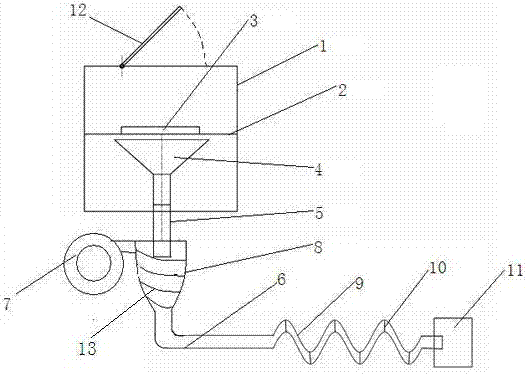
[0014] The present invention will be further described below in conjunction with the accompanying drawings. The following examples are only used to illustrate the technical solution of the present invention more clearly, but not to limit the protection scope of the present invention.
[0015] In the description of the patent of the present invention, it should be noted that the terms "center", "upper", "lower", "left", "right", "vertical", "horizontal", "inner", "outer" The orientation or positional relationship indicated by etc. is based on the orientation or positional relationship shown in the drawings, which is only for the convenience of describing the patent of the present invention and simplifying the description, rather than indicating or implying that the referred device or element must have a specific orientation, with a specific The azimuth structure and operation, therefore, cannot be construed as a limitation of the patent of the invention. In addition, the terms...
PUM
 Login to View More
 Abstract
Description
Claims
Application Information
 Login to View More