
Delivery path optimization method considering client grade and delivery time requirements
A route optimization and customer-oriented technology, applied in the direction of instruments, calculation models, data processing applications, etc., can solve the problems of not considering the customer level and delivery time requirements, and it is difficult to meet the actual needs, so as to avoid the loss of large customers and improve the solution accuracy and convergence efficiency, increasing the effect of economic benefits
- Summary
- Abstract
- Description
- Claims
- Application Information
AI Technical Summary
Problems solved by technology
Method used
Image

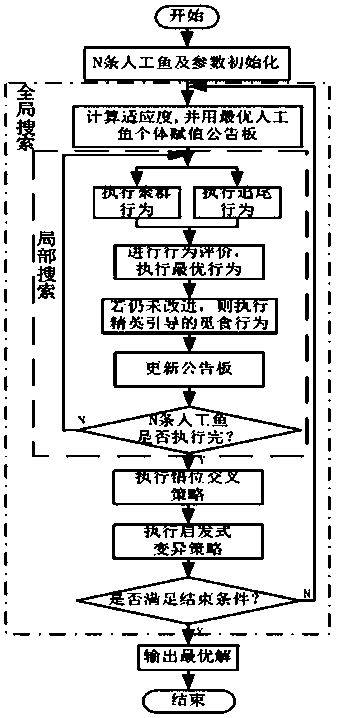
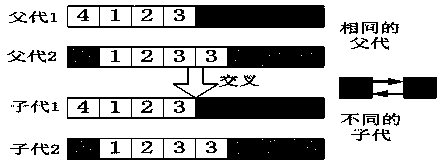
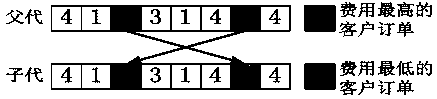
Examples
Embodiment 1
[0098] This embodiment designs a distribution route optimization problem with customer level and distribution time requirements for a certain logistics distribution center, and uses the present invention to find the optimal solution or suboptimal solution that satisfies the constraint conditions.
[0099] In accordance with the above technical solution, an example will be given with a logistics distribution center as the application background. Randomly generate 30 customer orders for testing. The specific customer order information is shown in Table 1. The item information involved in the order is listed in Table 2. At the same time, the lead time and delay period penalty coefficients related to the customer level are shown in Table 3. Also explained. The distance between the distribution center and the customer or between the customer and the customer is uniformly distributed on [20km, 250km], the average driving speed v and the maximum load Q of the distribution vehicle max A...
PUM
 Login to View More
 Abstract
Description
Claims
Application Information
 Login to View More