Image denoising method based on pixel-level global noise estimation coding and decoding network

A noise estimation and pixel-level technology, applied in image enhancement, image analysis, image data processing, etc., can solve problems such as poor generalization ability, achieve reasonable design, take into account the running time of the algorithm, and improve the effect of denoising

CN111127331AActive Publication Date: 2020-05-08GUANGZHOU TUWEI NETWORK TECH
6 Cites 8 Cited by

Patent Information

Authority / Receiving Office
CN · China
Current Assignee / Owner
Publication Date
2020-05-08

Smart Images

  • Figure 1
    Figure 1
  • Figure 2
    Figure 2
  • Figure 3
    Figure 3
Patent Text Reader

Abstract

The invention relates to an image denoising method based on a pixel-level global noise estimation coding and decoding network, and the method comprises the steps: inputting an original noisy image into an input module of the coding network, carrying out the preliminary feature extraction of the original noisy image through convolution, and outputting an original feature map; processing the original feature map through a plurality of cascaded coding modules in the coding network, and outputting a denoised high-level feature map with a relatively small spatial size and a relatively high semanticlevel; processing the high-level feature map through a plurality of decoding modules with skip connection structures in a decoding network symmetrical to the encoding network, and obtaining an outputfeature map after noise removal considering space information and semantic information; and mapping the output feature map of the decoding network to an output feature dimension by using convolutionprocessing through an output module of the decoding network, and outputting a final clear image. According to the method, real image noise, global information and pixel value related characteristics are fully considered, and the denoising effect and the operation speed are both considered.
Need to check novelty before this filing date? Find Prior Art

Description

technical field

[0001] The invention relates to the technical field of computer vision images, in particular to an image denoising method based on a pixel-level global noise estimation codec network. Background technique

[0002] As an important information carrier, digital images are playing an increasingly important role in daily production and life. Image information is widely used in aerospace, industrial production, military, medical, communication, etc. because of its intuitive and vivid features and large amount of information. Fields are closely related to our work and life. However, digital images in reality are often affected by the interference of imaging equipment and external environmental noise during the digitization and transmission process, which leads to the degradation of image quality and brings difficulties for subsequent research and processing. Therefore, image denoising, as a basic and very important low-level computer vision task, has high scientifi...

Examples

Embodiment Construction

[0037] In order to make the above objects, features and advantages of the present invention more comprehensible, the technical solutions of the present invention will be described in detail below in conjunction with the accompanying drawings and specific embodiments. It should be pointed out that the described embodiments are only a part of the embodiments of the present invention, rather than all embodiments. Based on the embodiments of the present invention, all those skilled in the art can obtain without creative work. Other embodiments all belong to the protection scope of the present invention.

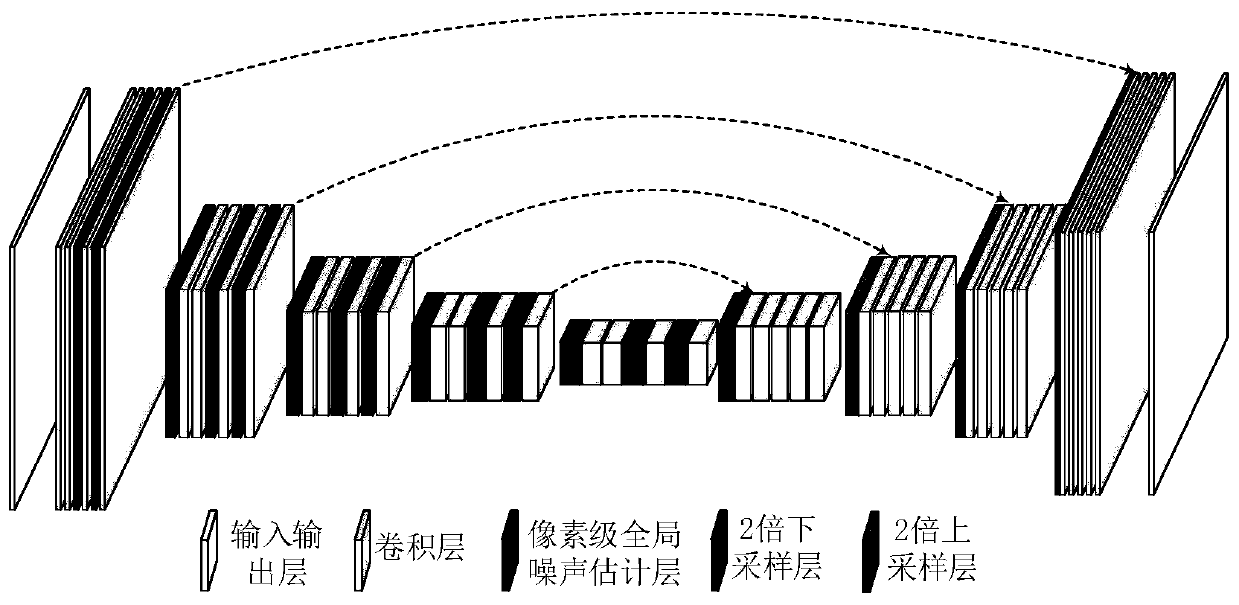
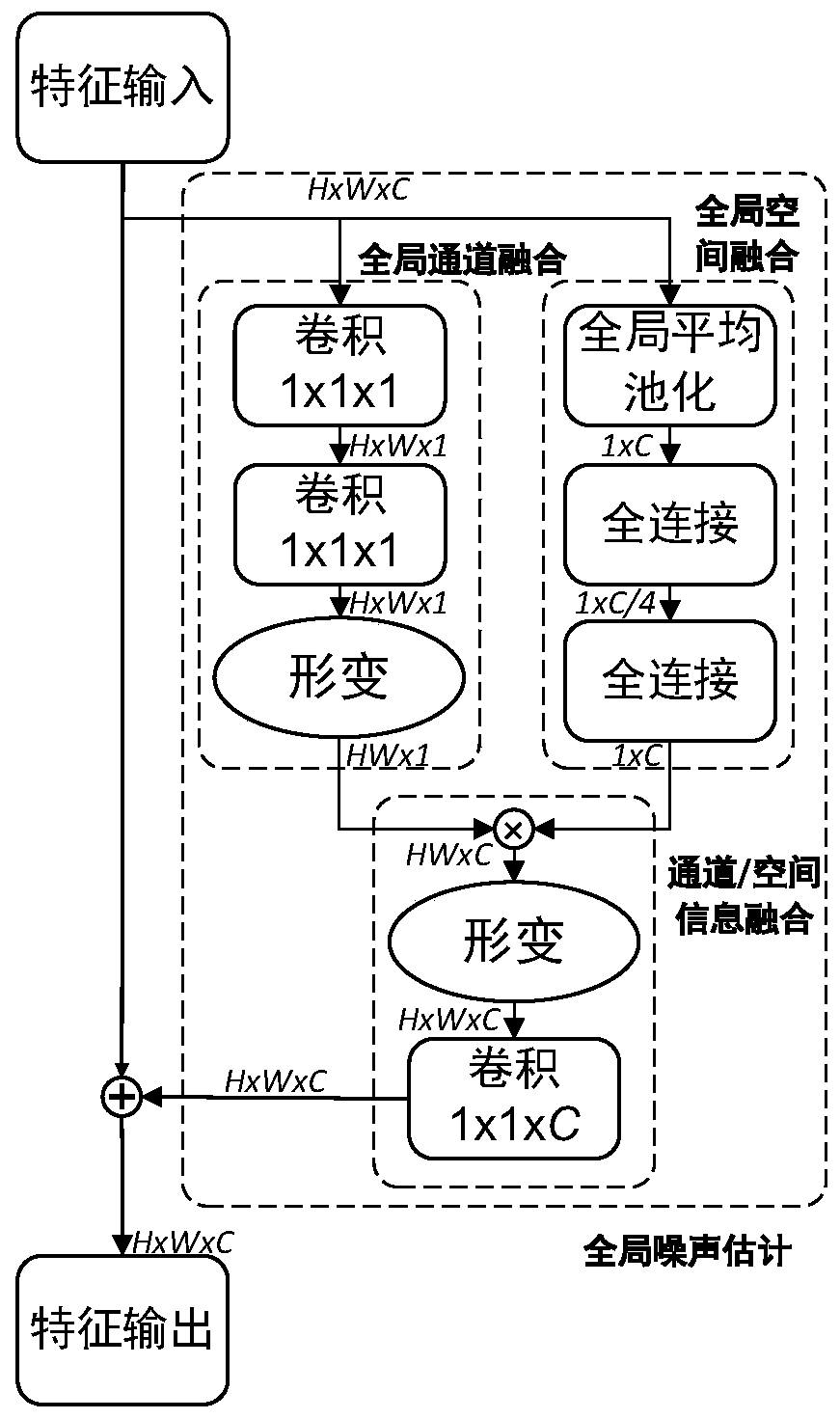
[0038] The image denoising method based on the pixel-level global noise estimation codec network provided by the embodiment of the present invention, such as figure 1 and figure 2 shown, including the following steps:

[0039] Step S1. Input the original noisy picture into the input module of the encoding network. The input module is composed of four 3×3×32 convolutional layer...