Design and construction method of a risk-relief reinforcement measure for suppressing embankment foundation piping

A design method and technology for embankment foundations, applied in marine engineering, water conservancy engineering, construction, etc., can solve problems such as adverse effects, waste of cultivated land, and difficult implementation, and achieve the effects of preventing particle loss, reducing expansion speed, and low operating costs.

CN112962516BActive Publication Date: 2022-06-03HOHAI UNIV
0 Cites 0 Cited by

Patent Information

Authority / Receiving Office
CN · China
Patent Type
Patents(China)
Current Assignee / Owner
Publication Date
2022-06-03

Smart Images

  • Figure 1
    Figure 1
  • Figure 2
    Figure 2
  • Figure 3
    Figure 3
Patent Text Reader

Abstract

The invention discloses a design and construction method of a risk-relief and reinforcement measure for suppressing embankment foundation piping. A barrier structure is arranged inside the embankment foundation on the backwater side, which is used to suppress the generation and expansion of concentrated seepage channels inside the embankment foundation; wherein, For the single-layer embankment, the barrier structure is arranged at the foot of the backwater side; for the double-layer embankment and the multi-layer embankment, the barrier structure is arranged at the impermeable covering layer and its lower layer Between the above-mentioned strong water-permeable layers, the barrier structure is located on the water-facing side of the weak part of the weakly-permeable covering layer on the backwater side; the material of the barrier structure ensures that it has sufficient water permeability and can effectively prevent the strong water-permeable layer. Particle loss in the soil; the material particle size of the barrier structure is determined by calculation; the barrier structure is ecological and environmentally friendly, and the cost is low; the construction is convenient and the reinforcement effect is good.
Need to check novelty before this filing date? Find Prior Art

Description

technical field

[0001] The invention belongs to the technical field of water conservancy engineering, and particularly relates to a design and construction method of a hazard-removing reinforcement measure for suppressing the piping surge of a dike foundation. Background technique

[0002] Embankment engineering is an important foundation of my country's flood control system, and piping is the most common and most important danger in embankment engineering. According to statistics, during the basin-wide flood that occurred in the Yangtze River in 1998, there were 73,825 dangerous situations in the middle and lower reaches of the dykes, and 35.2% of them were in danger, of which 1,702 were in greater danger, and 51.2% were in danger. The practice of emergency rescue and reinforcement of dikes has shown that piping is the most common and difficult to cure confidant of dike engineering in my country.

[0003] Although the traditional reinforcement measures such as vertical anti...

Examples

Embodiment Construction

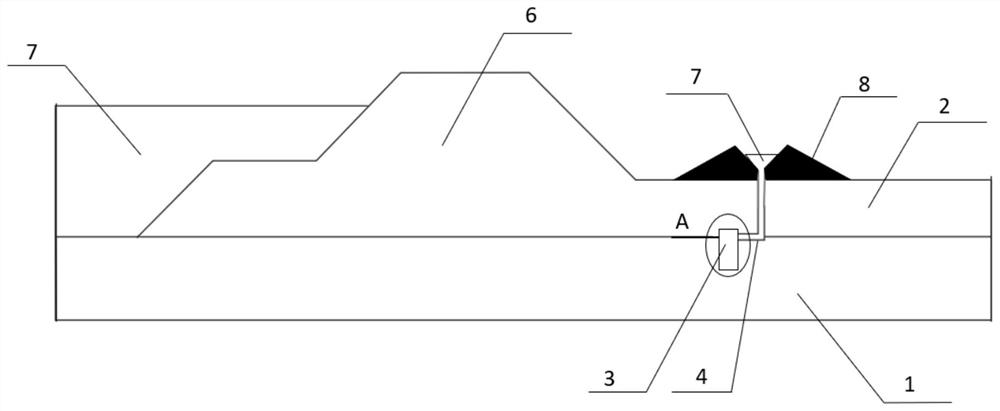
[0044] The specific embodiments of the present invention will be described in detail below with reference to the accompanying drawings, but it should be understood that the protection scope of the present invention is not limited by the specific embodiments.

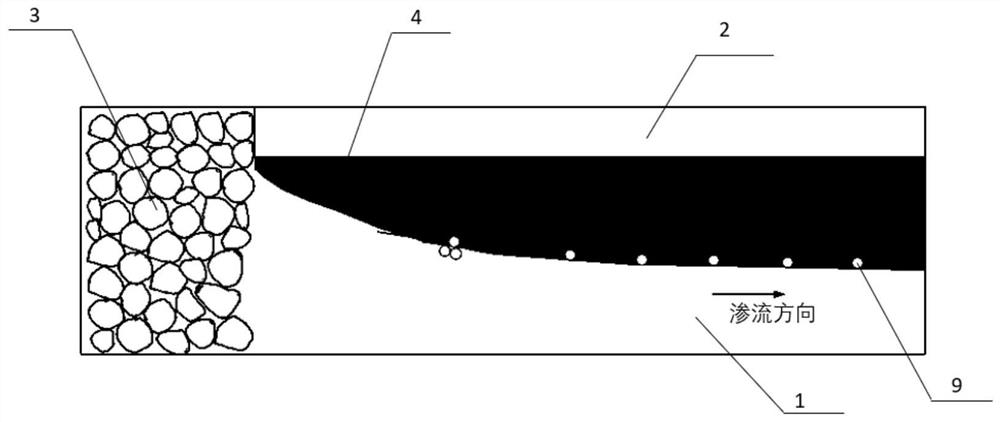
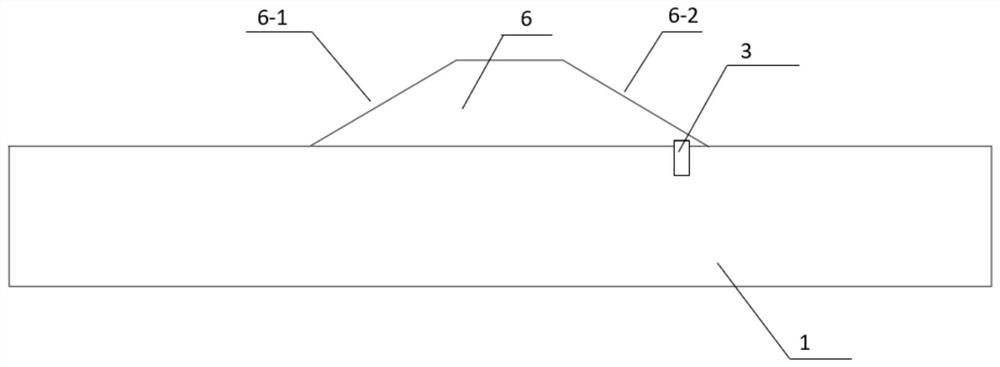
[0045] A design method of a hazard-removing reinforcement structure for preventing piping in embankment foundations, such as Figure 1-2As shown, the embankment body 6 is arranged above the embankment, and the embankment body 6 is divided into a water-facing side contacting the water 7 and a backwater side on the other side; taking the double-layer embankment as an example, the design principle is: The fine particles 5 of the strong permeable layer 1 are easily taken away by seepage, and the soil loss in the embankment foundation for a long time will cause soil damage. For example, a concentrated seepage channel 4 will be formed in the embankment foundation, and the sand will follow the surge. The outgoing water 7 forms ...