Method for testing residual stress of steel thin welding plate with narrow welding seam characteristic

A technology of residual stress and weld characteristics, which is applied in the field of residual stress testing of thin steel welded plates, can solve the problems of inability to measure the direction of residual stress, the inability to achieve accurate positioning and measurement of residual stress in narrow welds, and the difficulty of accurate measurement, achieving an improvement The effect of production process and welding process efficiency and quality stability, fast and accurate detection, and high detection efficiency

CN113203509APending Publication Date: 2021-08-03NANJING IRON & STEEL CO LTD +1
7 Cites 0 Cited by

Patent Information

Authority / Receiving Office
CN · China
Current Assignee / Owner
Publication Date
2021-08-03

Smart Images

  • Figure 1
    Figure 1
  • Figure 2
    Figure 2
  • Figure 3
    Figure 3
Patent Text Reader

Abstract

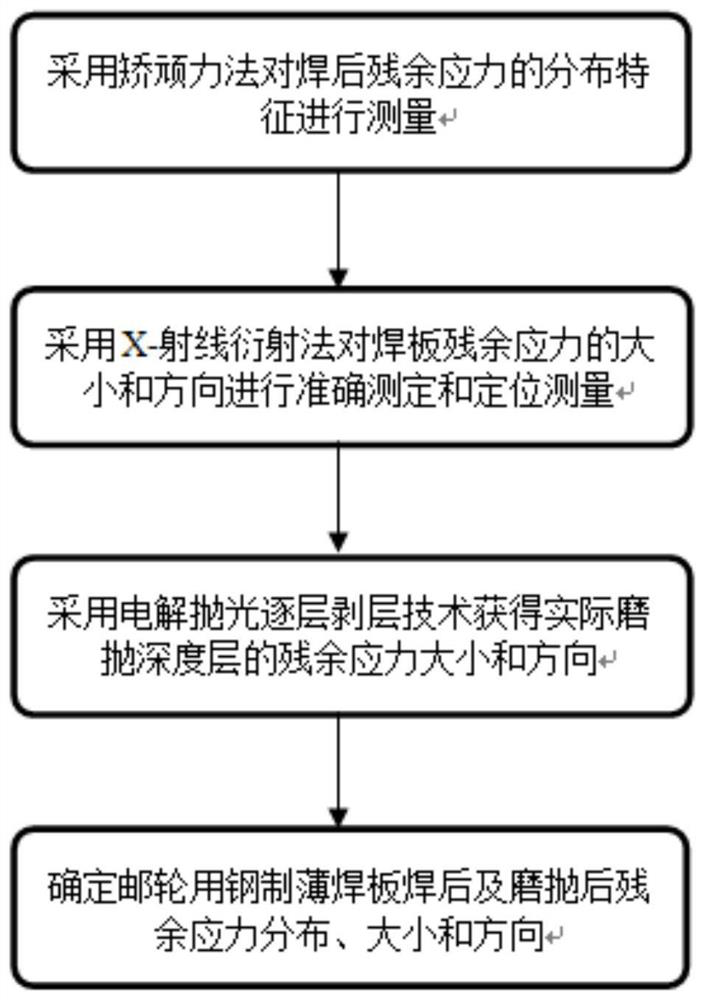
The invention discloses a method for testing residual stress of a steel thin welding plate with a narrow welding seam characteristic. The method is characterized by comprising the steps of measuring distribution characteristics of residual stress of a steel plate after welding by adopting a coercive force method; measuring the size and the direction of the residual stress at the grinding and polishing depth of the narrow welding seam by adopting an X-ray diffraction method; and obtaining the magnitude and direction of the residual stress of the actual grinding and polishing depth layer through an electrolytic polishing layer-by-layer stripping technology. The method is simple in detection process and high in detection efficiency, the distribution, the size and the direction of the residual stress after welding and grinding and polishing can be obtained after detection, and on-site rapid and accurate detection of the residual stress is achieved.
Need to check novelty before this filing date? Find Prior Art

Description

technical field

[0001] The invention relates to a method for testing the residual stress of welding materials, in particular to a method for testing the residual stress of thin steel welded plates with narrow weld seam characteristics. Background technique

[0002] Steel thin plates are prone to uneven internal stress during welding and use, which leads to deterioration or deterioration of the plate shape. The wall panels and decks of luxury cruise ships are mainly made of 4-6 mm high-strength steel thin plate structures. The aesthetics and comfort of cruise ships require that the high-strength steel sheets used should have extremely high forming accuracy and quality. The amount of welding of thin plates such as wall panels and decks of luxury cruise ships is large, and the welding deformation of thin plate structures and the precision of segmented construction are extremely high. Larger welding deformation seriously affects the beauty of the hull and sailing comfort, and re...

Examples

Embodiment Construction

[0024] In order to make the purpose, technical scheme and advantages of the present invention clearer, the accompanying drawings will be used below to detect the residual stress of thin steel welded plates for cruise ships with narrow weld characteristics and the residual stress of the narrow weld surface to the depth of 1mm. The embodiment describes in detail the details of the technical solution of the present invention.

[0025] Such as figure 1 As shown, a method for testing the residual stress of thin steel welded plates with narrow weld features includes the following steps:

[0026] The first step is to use the coercive force method to measure the distribution characteristics of the residual stress of the steel thin welded plate for cruise ships after welding.

[0027] The principle of the coercive force method is to use the magnetic method to measure the residual stress of the material. Under the action of the working load, the ferromagnetic workpiece in the geomagnet...