[0012]According to a yet further advantage of the invention, the system also comprises a calibration facility. This may be arranged to calibrate the total body-frame roll axis error of a respective imaging device and the attitude sensing arrangement. In this context, total body-frame roll is intended to refer to the combined error due to both the attitude sensor accuracy and any misalignment between the mounting of the camera and attitude sensor. This may be accomplished by taking an image of the horizon, which by definition must be horizontal. Frequent self-checks can be carried out, which have the advantage that a device can be verified to work correctly in the marine environment. Distortions arising from e.g. shipment of the unit, resulting in increased measurement errors, can be easily detected using such a method.
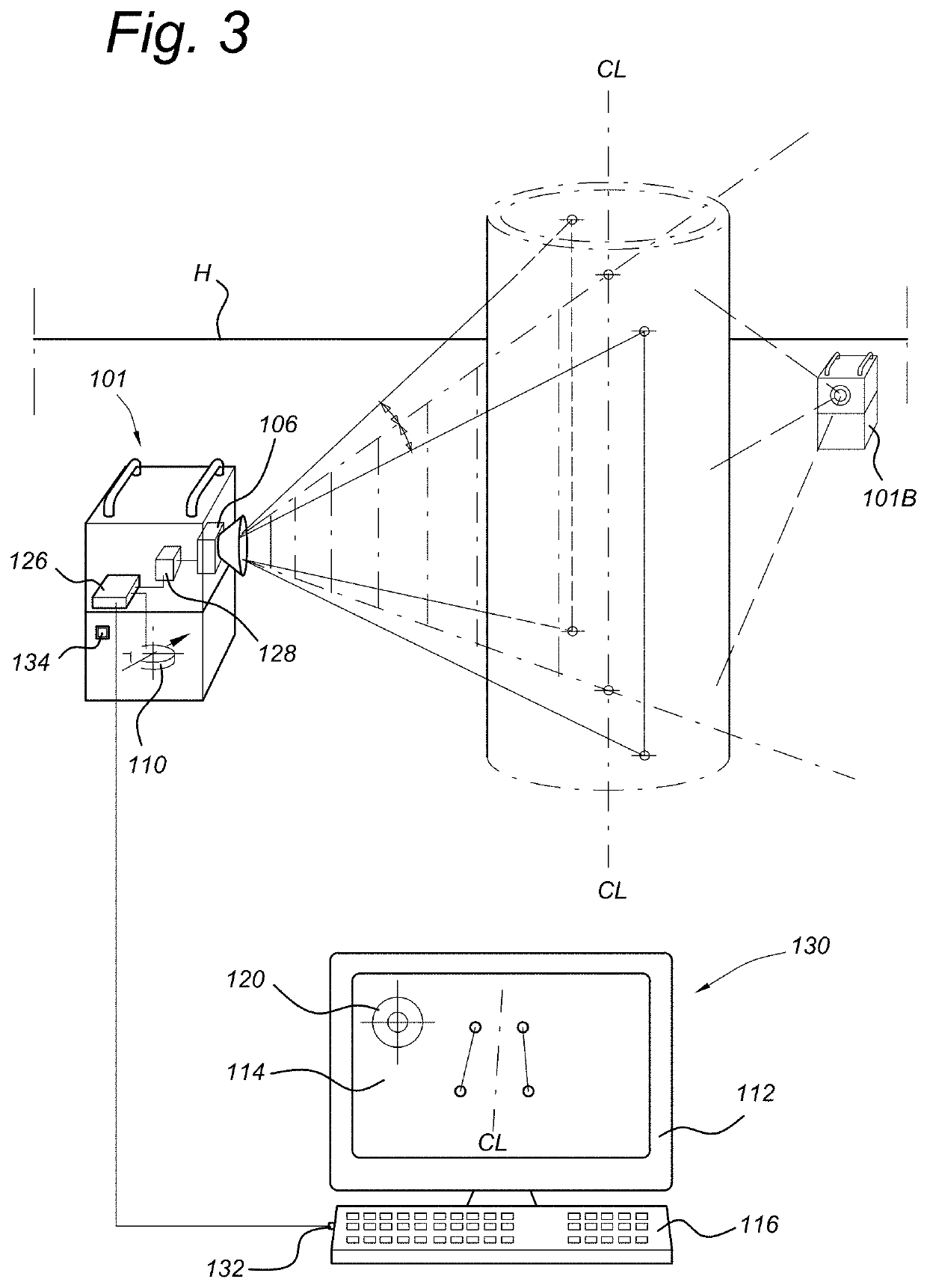
[0013]According to a still further aspect of the invention, the system allows measurement and determination of the attitude in real time. There may also be an attitude display providing a real-time representation of the attitude of the object. One particularly convenient display is in the form of a sight glass or spirit level, allowing an operator to monitor deviation of the object from a desired attitude. The system may also or alternatively comprise a user interface and an image display. In one convenient form, the image processing system may be arranged such that a user can manually pick a portion of an image of the object on the display for use in determining the attitude of the object. The portion of the object may be a characteristic edge or marking on the object and picking may take place using a mouse or similar pointer to identify the portion on the image display. Additional software may be provided for locking the image based on image recognition of the characteristics of the portion. This can be of use in situations where the object becomes partially obscured and a human operator may more reliably identify the relevant portions.
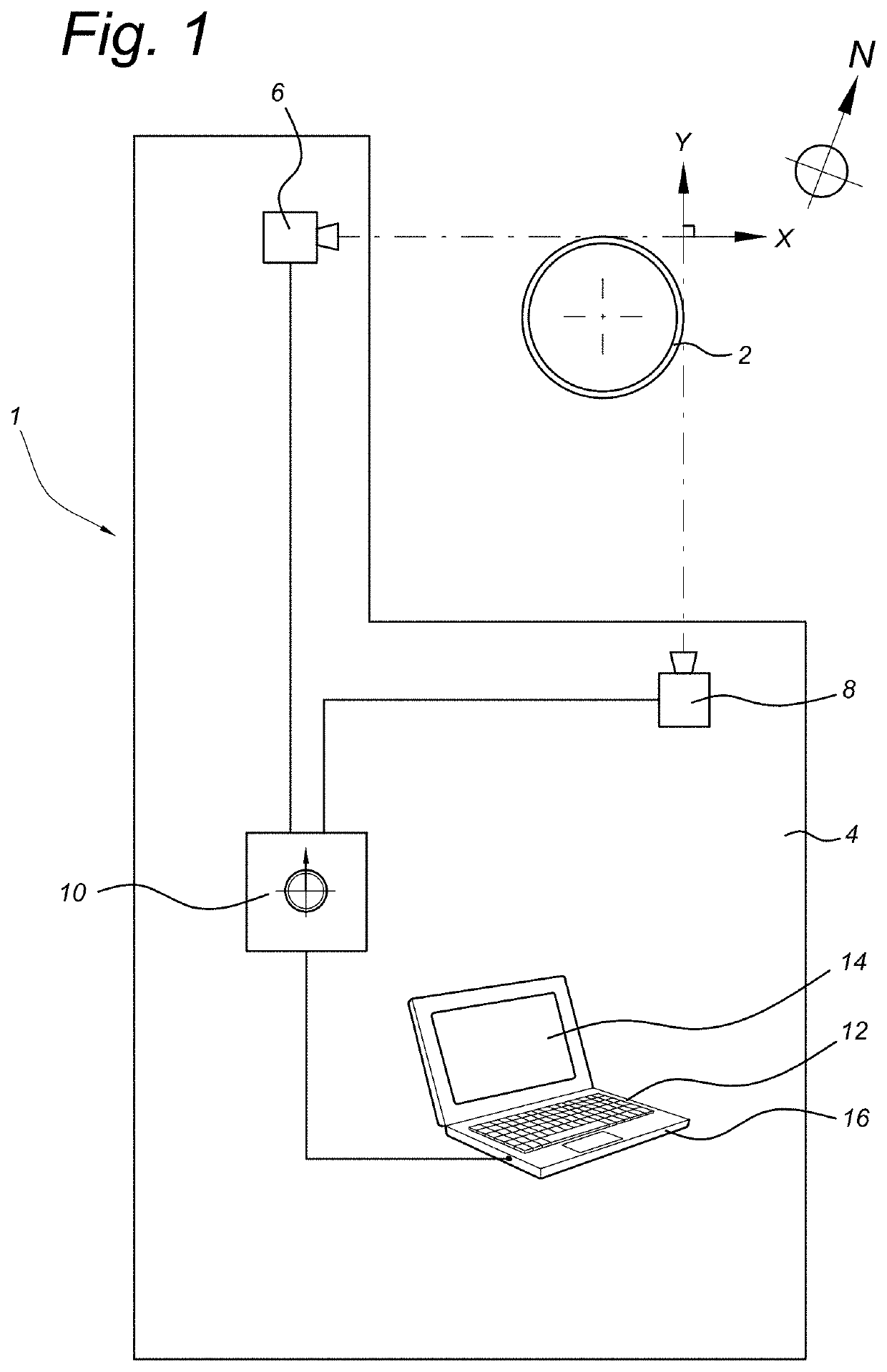
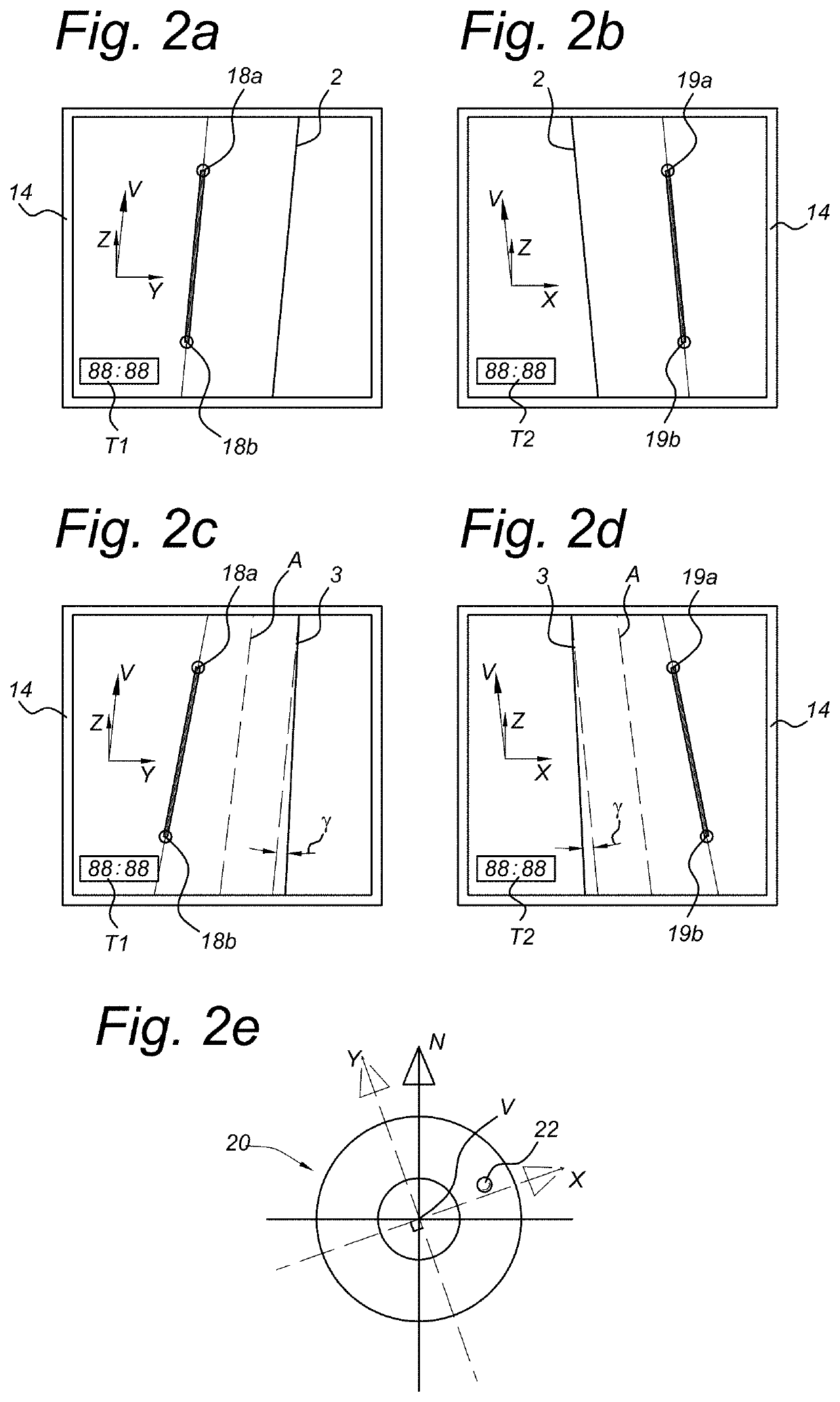
[0014]Although the system may be used for determining the orientation or attitude of many alternative objects, it is particularly suitable for use in determining the verticality of a pile, more specifically the sort of pile or monopile used for offshore wind turbine generators. In one embodiment of the system, the image processing system is arranged to: determine left and right borders of the pile from the first imaging device and identify a location of the plane therebetween that passes through the first imaging device; determine left and right borders of the pile from the second imaging device and identify a location of the plane therebetween that passes through the second imaging device; and combine the location of the planes from both the first and second imaging devices to determine the attitude of the axis of the pile. Assuming that the pile is rotationally symmetric, the mid-plane between the edges will identify the central axis irrespective of the direction of viewing. This makes it considerably easier to evaluate the results, as it is independent of the distance between the imaging devices and the pile. It is also applicable even when the pile tapers.
[0015]The invention also relates to a device for measuring an attitude of an object in a fixed frame of reference from a moving frame of reference, the device comprising: an imaging device for producing image data for the object; an attitude sensor for determining an attitude of the imaging device with respect to the fixed frame of reference at the time the image is taken and for generating attitude data; and a communication port for transmitting data to a data processing system for determining or displaying the attitude of the object. In a simple form, the attitude sensor may be a one- or two-axis attitude sensor without north-seeking capability. It will be understood that north-seeking devices are considerably more expensive and a simple non north-seeking device may be more than adequate for many purposes, especially when used e.g. in combination with a ship's north-seeking facility or with additional GPS positioning. A more complex embodiment of the invention provides a single device in which the imaging device and a north-seeking attitude sensor are integrated. Such a device is extremely versatile and can in fact be moved to a given location and immediately provide relevant input for determining the attitude of the object. This may be the case, even when the absolute position is unknown, based merely on the attitude information. It will be understood that the data transmitted may be the image data and the attitude data. In this case, the remote data processing system may include an image processing system for analyzing and combining the image data and attitude data to determine the attitude of the object as described above. Alternatively, an image processing system may be provided in the device and the transmitted data may comprise partially processed data related to the attitude of the object. The device may also include a local image display and user interface.
[0016]According to an embodiment, the device may comprise a clock, arranged to time stamp the image data relative to the attitude data. The clock may be a local clock or may be a clock signal derived from an external source such as the data processing system or a satellite navigation system. Stamping the image and attitude data in an accurate manner is of importance in ensuring that they are coherent, especially when analysis takes place subsequently. The clock or time stamp facility may be part of a real-time signal multiplexer that combines the attitude data and the image data.
[0017]Most preferably, the device is portable and the imaging device and the attitude sensor are fixed to each other to prevent relative movement. By portable, it is understood that the device is of a size and weight to be easily carried and set up by one person. It will be understood that such a device may even be used alone to provide measurements from two directions by moving from a first position to a second position. Such a device could be mounted on a separate vessel, movable with respect to the object being measured.


 Login to View More
  Login to View More