[0008] Methods and apparatus are described for improving the production of ions from bulk liquids and other materials, for example for use in mass spectrometers and other analyzers, and providing for greater control and redundancy in ion delivery systems. One or more aspects of these methods and apparatus also provide for ion production which may approach linearity in proportion to flow rate. Moreover, these methods and apparatus may be particularly suited to micro-miniaturization.
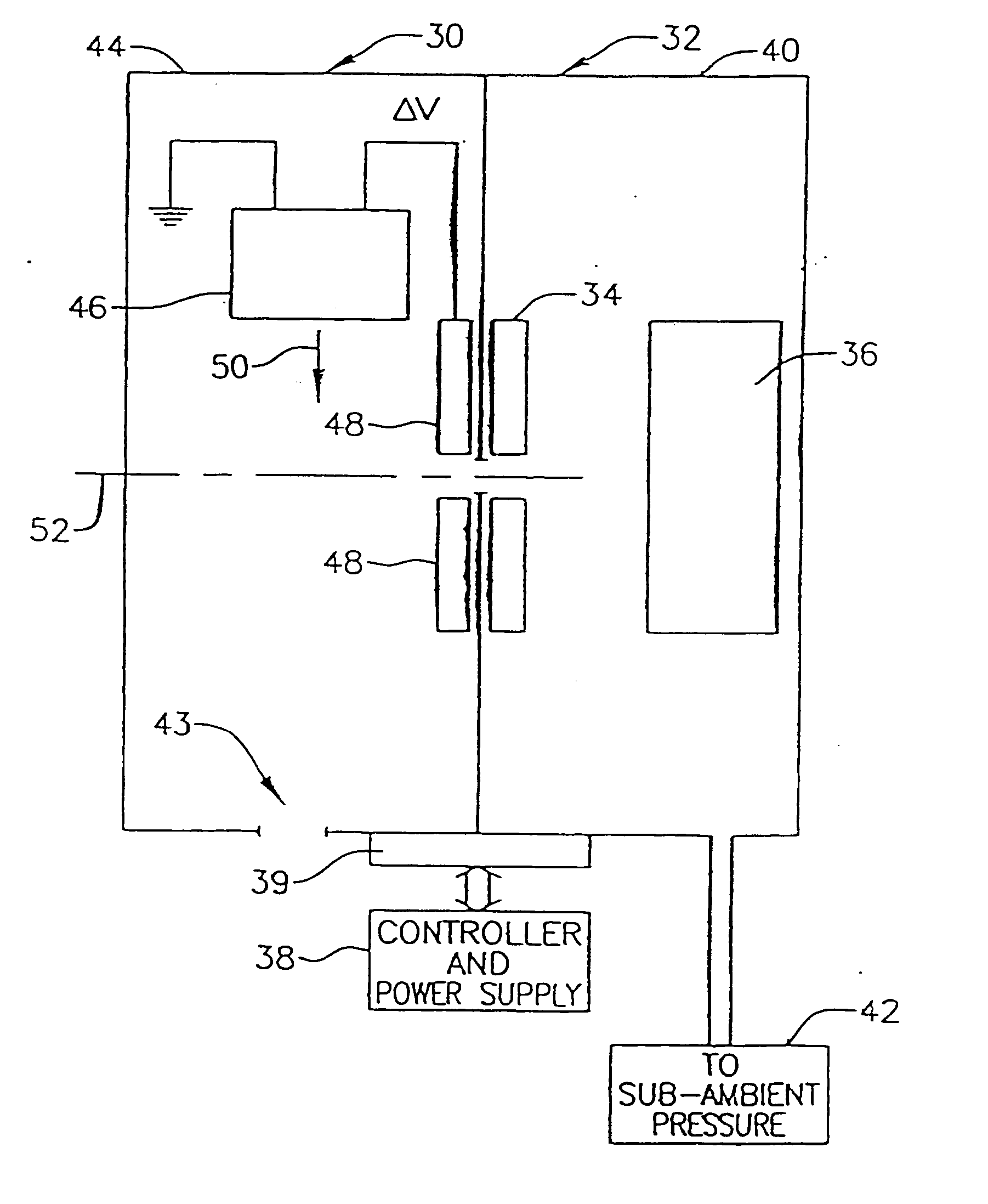
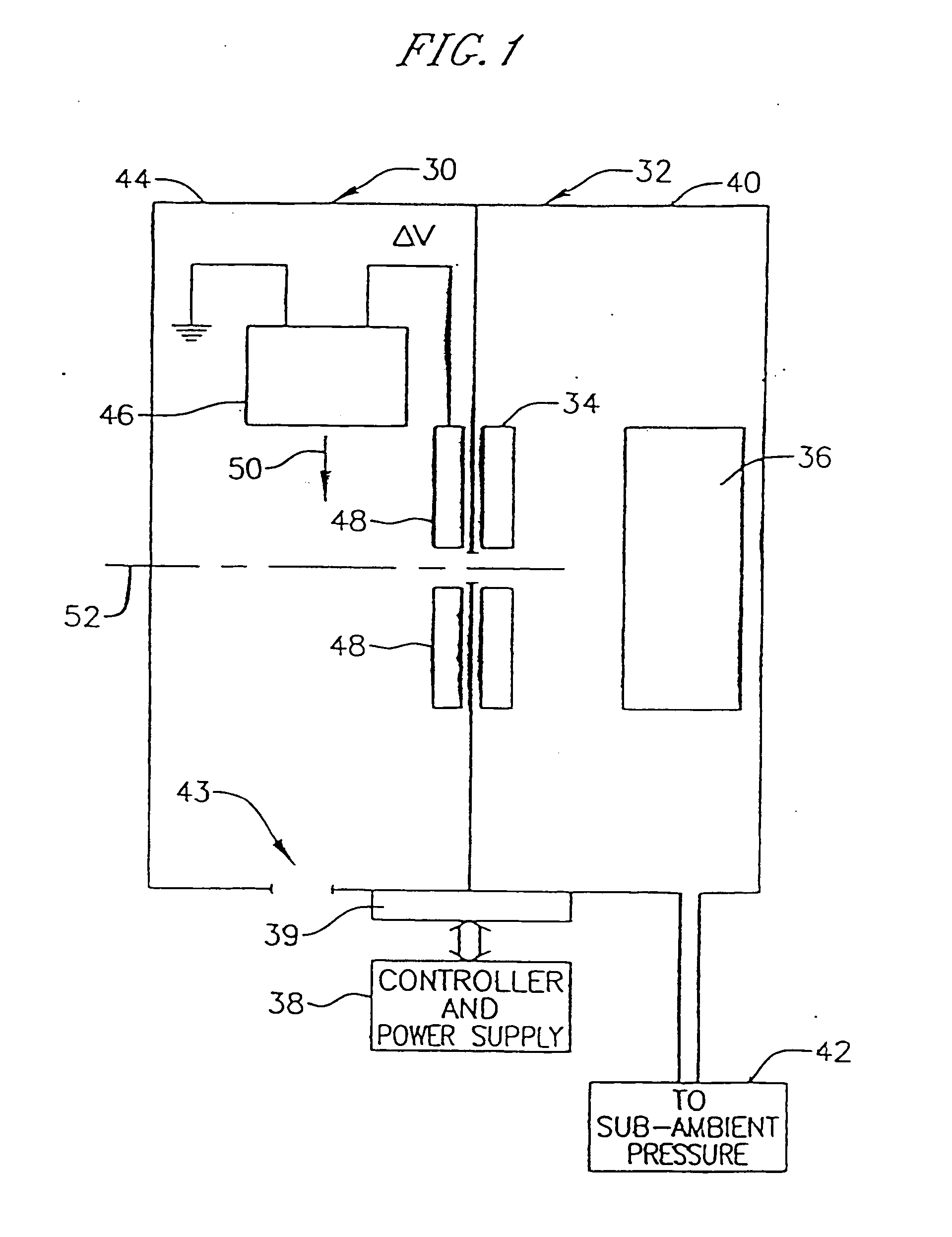
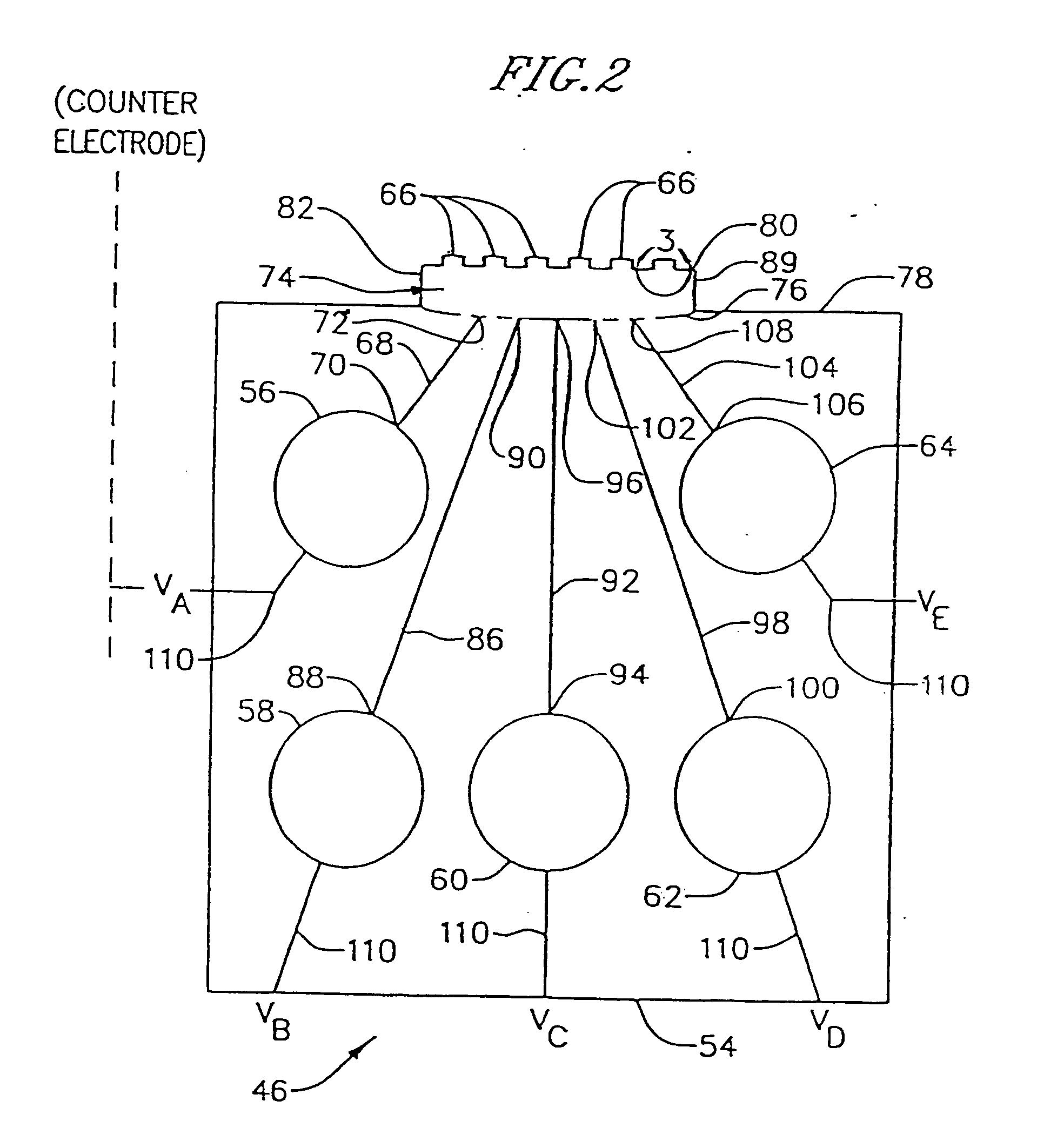
[0009] In accordance with one aspect of the present inventions, a source of ions for an analyzer includes a liquid source such as a reservoir for containing a liquid and a channel having a first end opening into the reservoir. The source of ions also may include a droplet emission element or assembly such as a nozzle element adjacent a second end of the channel that may also include a plurality of tips for producing individual droplets from the liquid. The plurality of tips reduces the likelihood that individual droplets will coalesce, increases the production of ions from bulk liquids and other materials in an approximately linear relationship, and increases the overall flow of material or analyte to the mass spectrometer, which gives a higher current output and a greater signal for the analyzer. They also provide a level of redundancy in the delivery of liquid for producing droplets. With micro-miniaturization, the individual droplets are relatively small, thereby increasing the likelihood that ions would be ejected from the droplet surfaces under the influence of an electric field.
[0010] In one form of one aspect of the present inventions, the channel may feed into a manifold which can be used to more efficiently provide fluid to the nozzle element. Additionally, multiple nozzle elements can be used to more selectively deliver fluid droplets to the inlet of the analyzer, or to increase the overall flow rate of droplets from the reservoir.
[0011] In another form of one aspect of the present inventions, the plurality of tips are arranged linearly with respect to each other for ease of use and for ease of manufacture. Additionally, or alternatively, tips may be arranged so that all of the tips are spaced apart from each other in all directions from a center point. Such an arrangement may define a circle filled with spaced apart tips extending outwardly from a surface. In one form, the tips have a volcano or truncated cone shape for the desired fluid delivery, electrostatic effects and manufacture ability. Additionally, parallel arrangements of tips may produce parallel beams or streams of ions with a lower probability of coalescing in the path between the tips and a counter electrode and the analyzer.
[0012] In still another form of one aspect of the present inventions, a source of ions for an analyzer includes a liquid supply for supplying analyte to a nozzle or nozzles pointing in a first direction and a counter electrode spaced from the nozzle in the first direction. Means are provided for creating an electric field in the vicinity of the nozzle for producing ions from droplets ejected from the nozzle. Each nozzle may include a plurality of tips extending in the first direction for producing droplets from each of the tips. Supplying the analyte as a liquid and producing multiple droplets improves the efficiency and the ion production of the system, and also allows operation of the system at ambient pressures. Consequently, the ion delivery system is easier to manufacture, use and maintain.
[0013] In a further form of one aspect of the present inventions, ions are produced from a liquid by passing a liquid along a first channel and into a plurality of second channels terminating in respective openings facing at least partly toward a counter electrode. An electric field is produced so that there is a potential difference between the fluid at the respective openings and the counter electrode. As before, supplying the analyte as a liquid and producing multiple droplets improves the efficiency and the ion production of the system. Additionally, the method of producing ions can be carried out at ambient pressures. The counter electrode may be spaced sufficiently from the tips to allow sufficient time for the ions to be ejected from the droplets and / or for the droplets to evaporate. The counter electrode can be facing the tips or can be oriented at an angle relative to the tips. For example, the counter electrode can be approximately perpendicular to the plane defined by the ends of the tips.


 Login to View More
  Login to View More