
Time of day zoning climate control system and method
a climate control and time of day technology, applied in the field of time of day zoning climate control system, can solve the problems of not really regulating the temperature in each room or area of the dwelling or structure particularly well, occupant discomfort and complaint when those areas are occupied, and achieve the effect of improving the overall comfort of the occupants and regulating the temperature of the zon
- Summary
- Abstract
- Description
- Claims
- Application Information
AI Technical Summary
Benefits of technology
Problems solved by technology
Method used
Image

Examples
Embodiment Construction
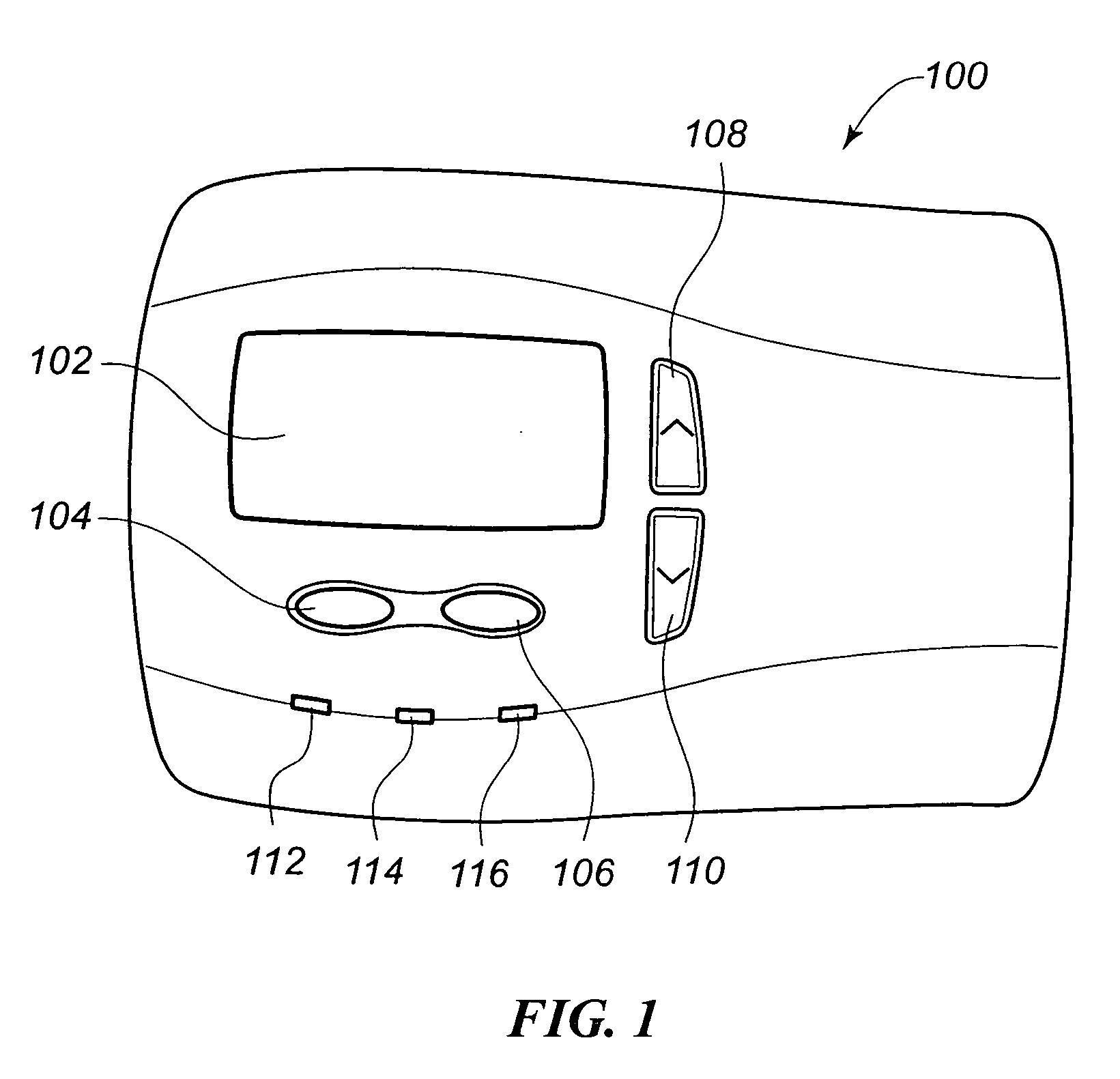
[0024] An embodiment of a thermostat constructed in accordance with the teachings of the present invention to incorporate the time of day zoning control of the HVAC system of the invention is illustrated in FIG. 1. As with many thermostats, an internal temperature sensor is included within the thermostat 100. As may be seen from this FIG. 1, this embodiment of the thermostat 100 includes a user display 102 on which is displayed programmatic, system, and ambient information regarding the operation of the HVAC system. This user display 102 may take various forms as are well-known in the art, and in a preferred embodiment is a dot matrix LCD display. With such a display 102, the consumer may activate various programmatic and control functions via a pair of soft keys 104, 106. The functionality executed by these soft keys 104, 106 varies dependent upon the programmatic state in which the thermostat 100 is at the time one of the soft keys 104, 106 is depressed. The particular functionali...
PUM
 Login to View More
 Abstract
Description
Claims
Application Information
 Login to View More